



 Ask Sencha AI
Software Development Platforms for Regulated Industries: Compliance Features Compared
December 17, 2025
20108 Views
Get a summary of this article:
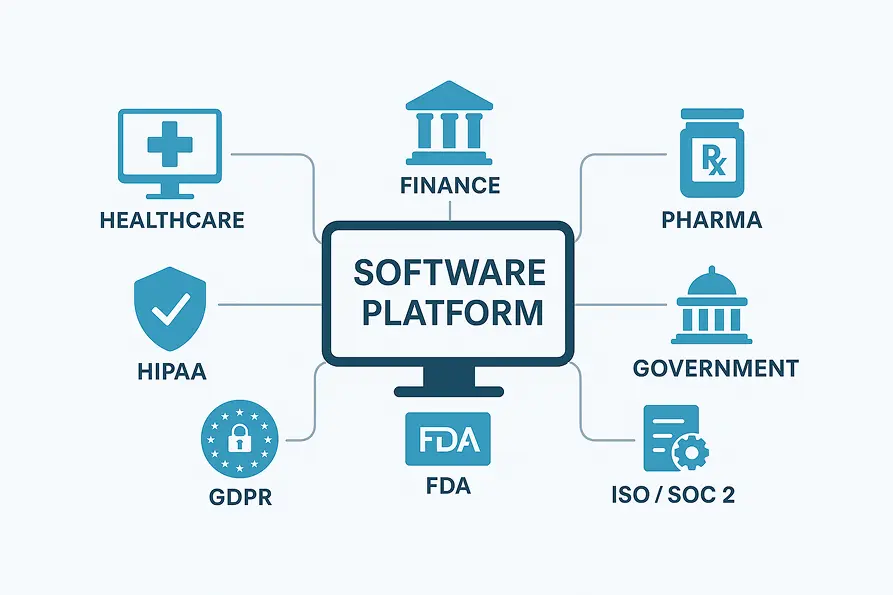
Building software for regulated industries demands more than functional code. Healthcare organizations must protect patient data under HIPAA. Financial institutions navigate SOX, PCI DSS, and a growing patchwork of state and federal regulations. Government contractors face FedRAMP, FISMA, and agency-specific requirements. Life sciences companies operate under FDA 21 CFR Part 11 for electronic records. Energy and utilities answer to NERC CIP standards.
The development platform you choose shapes how naturally your team achieves and maintains compliance. Some platforms treat compliance as an afterthought, requiring extensive custom development to meet regulatory requirements. Others embed compliance capabilities into their architecture, reducing the burden on development teams and lowering the risk of costly violations.
This analysis compares software development platforms across the compliance dimensions that matter most: access control and authentication, audit logging, data protection, validation and documentation, deployment and infrastructure, and long-term maintainability. Whether you’re selecting a platform for a new regulated application or evaluating whether your current technology stack adequately supports compliance obligations, this guide provides the framework for making an informed decision.
Understanding Regulatory Compliance Requirements
Before comparing platforms, it’s essential to understand what regulated industries actually require. While specific regulations differ, common themes emerge across industries.
Access Control Requirements
Every major regulatory framework requires controlling who can access what data and functionality. HIPAA’s minimum necessary standard limits access to the information needed for specific purposes. SOX requires segregation of duties to prevent fraud. FDA 21 CFR Part 11 mandates that only authorized individuals can access electronic records. PCI DSS specifies role-based access controls for cardholder data.
Platforms must support granular, role-based access control that goes beyond simple user-level permissions. Regulated applications often require field-level access control, where different roles see different data elements on the same screen. They need dynamic permissions that change based on context, workflow state, or data characteristics. They must enforce segregation of duties by preventing users from performing conflicting actions.
Audit Trail Requirements
Regulatory frameworks universally require tracking who did what, when, and to what data. FDA 21 CFR Part 11 explicitly requires secure, computer-generated, time-stamped audit trails. HIPAA requires tracking access to protected health information. SOX demands audit trails for financial data changes. PCI DSS requires logging all access to cardholder data.
Effective audit trails must be tamper-evident, ensuring that log entries cannot be modified or deleted without detection. They must be complete, capturing all relevant events including failed access attempts. They must be attributable, tying every action to a specific authenticated user. They must be retained appropriately, with logs preserved for periods mandated by specific regulations.
Data Protection Requirements
Protecting sensitive data involves encryption, anonymization, and secure handling throughout the data lifecycle. HIPAA requires encryption of protected health information in transit and at rest. PCI DSS specifies encryption standards for cardholder data. GDPR and state privacy laws require appropriate technical measures to protect personal data.
Platforms must support encryption that meets regulatory standards, typically AES-256 for data at rest and TLS 1.2 or higher for data in transit. They must enable data masking and anonymization for development, testing, and analytics environments. They must facilitate secure deletion when data retention periods expire.
Electronic Signature Requirements
Life sciences, financial services, and government applications often require legally binding electronic signatures. FDA 21 CFR Part 11 specifies requirements for electronic signatures in drug development and manufacturing contexts. ESIGN and UETA establish legal frameworks for electronic signatures in commerce. Various regulations require specific authentication levels for signatures on critical documents.
Platforms must support electronic signature workflows with appropriate authentication, non-repudiation, and audit trail integration. They must distinguish between routine authentication and formal electronic signatures that carry legal weight.
Validation and Documentation Requirements
Regulated industries require documented evidence that software functions correctly and reliably. FDA regulations require validation of software used in drug manufacturing and medical devices. Financial regulators expect validation of systems affecting financial reporting. Healthcare organizations must validate systems containing or processing protected health information.
Platforms should facilitate validation by supporting comprehensive testing, maintaining documentation, and providing traceability between requirements, implementation, and verification. Change control processes must document and approve modifications to validated systems.
Platform Categories for Regulated Development
Software development platforms for regulated industries fall into several categories, each with distinct compliance characteristics.
Low-Code and No-Code Platforms
Platforms like Mendix, OutSystems, Appian, and Microsoft Power Platform enable rapid application development with minimal custom coding. They attract regulated industries seeking faster development cycles and reduced reliance on specialized developers.
These platforms typically provide built-in security features, pre-configured compliance controls, and centralized governance. However, they may limit customization options when unique compliance requirements arise. Their abstraction layers can complicate compliance documentation and validation because the underlying implementation details are hidden from developers.
Enterprise JavaScript Frameworks
Comprehensive JavaScript frameworks like Ext JS provide extensive pre-built components designed for enterprise applications. Unlike minimal frameworks that require assembling functionality from multiple libraries, enterprise frameworks offer integrated solutions for complex requirements including data grids, forms, charts, and security features.
For regulated industries, enterprise frameworks offer a middle ground between low-code platforms and ground-up custom development. They provide more control and transparency than low-code platforms while delivering faster development than building everything from scratch.
Modern JavaScript Frameworks
React, Angular, and Vue.js power most new web application development. These frameworks provide excellent flexibility but require assembling compliance features from multiple sources. Development teams must integrate authentication libraries, audit logging systems, encryption utilities, and validation frameworks, ensuring they work together correctly.
This approach offers maximum control but demands significant expertise to implement compliance features correctly. Organizations with mature security teams and well-defined patterns often succeed with this approach. Organizations without deep security expertise risk gaps in their compliance posture.
Backend Platforms and Frameworks
Django, Laravel, Ruby on Rails, Spring Boot, and ASP.NET Core provide server-side foundations for regulated applications. These platforms vary significantly in their built-in compliance features. Some offer robust authentication, authorization, and audit logging out of the box. Others require extensive customization to meet regulated industry requirements.
Cloud Development Platforms
AWS, Azure, and Google Cloud provide compliance-focused services and certifications that simplify building regulated applications. They offer identity services, encryption, logging, and compliance documentation that would be expensive to replicate independently. However, cloud platform services require careful configuration to achieve compliance, and shared responsibility models mean organizations retain significant compliance obligations.
Access Control and Authentication Comparison
Access control forms the foundation of regulatory compliance. Here’s how different platforms approach this critical capability.
Low-Code Platforms
Mendix provides enterprise-grade access control with role-based permissions configurable through visual interfaces. Security constraints can be applied at the entity level, restricting access to data based on user roles. The platform supports single sign-on integration with enterprise identity providers through SAML and OpenID Connect. For regulated industries, Mendix offers additional security services including fine-grained access control and comprehensive user management.
OutSystems delivers similar capabilities with role-based access control, entity-level permissions, and enterprise SSO integration. Its security model allows defining permissions at multiple granularity levels from screens down to individual attributes. OutSystems provides built-in integration with Active Directory and LDAP for organizations requiring centralized identity management.
Appian focuses heavily on regulated industries and provides correspondingly robust access controls. Its security model includes row-level security based on record data, field-level security, and complex permission rules based on user attributes and organizational hierarchies. Appian’s compliance-focused marketing reflects genuine capabilities for healthcare, financial services, and government applications.
The strength of low-code platforms for access control lies in centralized management and visual configuration. Administrators can review and modify permissions without code changes. The weakness is limited flexibility when requirements exceed the platform’s built-in security model. Complex permission logic may require workarounds or prove impossible to implement.
Enterprise JavaScript Frameworks
Ext JS provides a comprehensive architecture for implementing sophisticated access controls on the client side. While authentication and authorization decisions ultimately occur on the server, Ext JS supports enforcing those decisions consistently throughout the user interface.
Ext JS’s controller architecture enables centralized security enforcement. Developers can implement security interceptors that check permissions before executing actions. The framework’s component model supports disabling, hiding, or modifying interface elements based on user roles. Field-level security is straightforward to implement because Ext JS forms provide granular control over individual field visibility and editability.
For complex permission scenarios common in regulated industries, Ext JS’s data binding and view controller patterns enable dynamic permission enforcement. A single permission change can automatically update all affected interface elements without manual synchronization. This architecture reduces the risk of permission enforcement gaps where restricted functionality remains accessible due to implementation oversights.
The Ext JS data package supports implementing security at the data access layer. Store configurations can include authorization headers and handle access denied responses consistently. Models can mark fields as sensitive, enabling consistent handling of protected data throughout the application.
Compared to low-code platforms, Ext JS requires more explicit security implementation but offers greater flexibility for complex requirements. Compared to minimal JavaScript frameworks, Ext JS’s comprehensive architecture makes consistent security enforcement easier to achieve and maintain.
Modern JavaScript Frameworks
React, Angular, and Vue.js require assembling access control from multiple libraries and patterns. None provide built-in security beyond the framework’s basic architecture.
For React applications, authentication typically involves libraries like Auth0 SDK, AWS Amplify, or custom implementations using context providers. Authorization often uses libraries like CASL or custom role-checking utilities. Route protection requires either dedicated libraries or custom higher-order components. Component-level security demands manually implementing permission checks throughout the application.
Angular provides more built-in structure through its guards and dependency injection system. Route guards can check authentication and authorization before navigation. HTTP interceptors can add authentication tokens to requests. However, component-level permission enforcement still requires custom implementation.
Vue.js applications face similar challenges to React, requiring external libraries or custom implementations for authentication and authorization. The Vue Router navigation guards provide a natural integration point for route-level security, but fine-grained permissions require additional implementation.
The challenge with minimal frameworks isn’t capability but consistency. Skilled developers can implement robust security with any of these frameworks. The risk is inconsistency across a large application or across multiple teams. Each developer may implement permissions slightly differently, creating gaps or confusion.
Backend Platforms
Django’s authentication and authorization system is among the most comprehensive of backend frameworks. Built-in features include user authentication, permission systems, and group-based access control. Django’s admin interface respects permissions automatically. The framework’s middleware architecture enables request-level security checks.
For regulated industries, Django’s object-level permissions support through libraries like django-guardian enables complex scenarios where permissions depend on specific data records rather than just user roles. This capability addresses requirements like limiting users to records they own or records within their organizational unit.
Laravel provides authentication scaffolding through Laravel Breeze, Jetstream, or Fortify. Authorization uses a policy-based system where permission logic lives in dedicated policy classes. Gates provide simpler permission checks for actions not tied to specific models. Laravel’s middleware enables route-level protection.
Spring Boot integrates with Spring Security, an extremely comprehensive security framework. Spring Security supports method-level security annotations, URL-based security, and integration with enterprise identity systems. For regulated industries, Spring Security’s support for complex authentication requirements including multi-factor authentication and certificate-based authentication proves valuable.
Rails provides authentication through gems like Devise and authorization through gems like Pundit or CanCanCan. While capable, Rails security requires more assembly than Django or Spring, with core Rails providing minimal built-in security features.
Audit Logging Comparison
Comprehensive, tamper-evident audit logging satisfies requirements across regulated industries. Platform capabilities vary significantly.
Low-Code Platforms
Mendix automatically logs user activities at a configurable level of detail. The platform captures login events, data changes, and administrative actions. For regulated industries, Mendix provides enhanced audit logging features that track field-level changes and support long-term log retention.
OutSystems includes built-in audit logging for user authentication events and can be configured to log data changes. The platform’s Service Center provides centralized log management and analysis. However, detailed audit trails for application-specific events require custom implementation.
Appian provides extensive audit logging designed for regulated industries. The platform captures detailed trails of process execution, data access, and administrative changes. Appian’s audit logs are designed to be tamper-evident, satisfying FDA and financial services requirements. Log retention and archival capabilities support long-term compliance obligations.
Low-code platforms generally provide good audit logging for platform-managed activities but may require custom development for application-specific audit requirements. The hidden nature of platform internals can complicate demonstrating exactly what gets logged and how logs are protected.
Enterprise JavaScript Frameworks
Ext JS operates on the client side and therefore cannot provide authoritative audit logging directly. However, the framework’s architecture supports implementing comprehensive audit logging through server integration.
Ext JS’s data package provides natural integration points for audit logging. Store proxies can intercept all data operations, enabling consistent logging of read and write activities. The framework’s event system allows capturing user interactions for behavioral audit trails. AJAX request configurations can include audit metadata that server-side systems require.
For regulated applications built with Ext JS, a common pattern involves implementing an audit log service that captures client-side events and transmits them to secure server storage. The framework’s centralized architecture makes implementing this pattern consistently across the application straightforward. Every data store, every form submission, and every significant user action can flow through logging infrastructure without requiring individual implementation at each location.
Ext JS’s form and grid components support tracking field-level changes. Before-and-after values for modified fields can be captured for audit purposes. The framework’s comprehensive component library means less custom code overall, reducing the number of locations where logging might be inadvertently omitted.
Modern JavaScript Frameworks
React, Angular, and Vue.js provide no built-in audit logging. Implementing comprehensive logging requires custom development or third-party analytics and logging services.
Common approaches include integrating with logging services like LogRocket, Datadog, or Sentry for behavioral analytics and error tracking. For compliance-grade audit logging, teams typically implement custom logging layers that capture events and transmit them to secure server-side storage.
The challenge with minimal frameworks is ensuring consistent logging coverage. Large applications may have hundreds of components and actions. Ensuring every compliance-relevant action triggers appropriate logging requires discipline and review. Code reviews must specifically check for logging coverage, and audits may reveal gaps that require remediation.
Backend Platforms
Django’s django-auditlog and django-simple-history packages provide comprehensive audit logging for data changes. These packages automatically track who changed what, when, and capture before-and-after values. Django’s middleware supports logging request-level events for access auditing.
For FDA-regulated applications, Django implementations typically combine these packages with tamper-evident storage, often in append-only database tables or external logging services with integrity guarantees.
Laravel’s activity log packages, particularly Spatie’s laravel-activitylog, provide similar capabilities. The package automatically logs model events and supports custom events. Laravel’s event system provides a natural architecture for comprehensive logging without cluttering business logic.
Spring Boot integrates with enterprise logging infrastructure through Spring AOP and event publishing. Spring Data’s auditing support automatically tracks creation and modification metadata. For comprehensive audit trails, Spring applications typically integrate with enterprise logging platforms like Splunk or the ELK stack.
Rails provides audit logging through gems like audited or paper_trail. These gems track model changes with attribution and timestamps. Rails’ ActiveSupport::Notifications provides hooks for logging application events beyond data changes.
Data Protection Comparison
Protecting sensitive data through encryption, masking, and secure handling is essential for regulated industries.
Encryption Capabilities
All modern platforms support TLS for data in transit. The differentiator is how naturally they support encryption at rest and application-level encryption for sensitive fields.
Low-code platforms generally handle encryption through underlying database and infrastructure configuration rather than application-level controls. Mendix and OutSystems support encrypted database storage when deployed to appropriately configured infrastructure. Appian provides additional data encryption features suitable for regulated industries.
Ext JS, operating client-side, doesn’t directly handle server-side encryption but supports implementing encrypted communication patterns. The framework’s AJAX configurations support adding encryption headers, transmitting encrypted payloads, and handling encrypted responses. For applications requiring end-to-end encryption where even the server cannot read plaintext data, Ext JS provides the architectural flexibility to implement client-side encryption before transmission.
Backend platforms vary in encryption support. Django’s django-encrypted-model-fields enables field-level encryption for specific sensitive fields. Laravel offers similar packages for encrypting model attributes. Spring Boot applications can leverage Java’s encryption capabilities through Spring Security’s crypto module. These application-level encryption capabilities complement infrastructure encryption for defense in depth.
Data Masking and Anonymization
Development and testing environments for regulated applications cannot contain production data without appropriate protection. Platforms should support data masking or anonymization for non-production use.
Low-code platforms typically address this through environment separation rather than built-in anonymization. Development environments use synthetic data rather than masked production data.
For applications built with Ext JS and backend frameworks, data masking typically occurs at the database or API level rather than the frontend. However, Ext JS’s data model supports implementing display-level masking where sensitive values are obscured in the interface. Field renderers can mask sensitive data while preserving functionality for authorized operations.
Backend frameworks provide better hooks for data anonymization. Django’s django-anonymizer and similar packages can generate anonymized datasets for testing. Laravel packages provide similar capabilities. These tools prove essential for maintaining realistic test environments without compliance violations.
Secure Data Handling
Beyond encryption, regulated applications must handle data securely throughout its lifecycle. This includes secure deletion, memory handling, and preventing data leakage through logs or error messages.
Low-code platforms manage much of this automatically, reducing the risk of developer error but also reducing visibility into exactly how data flows through the system.
Ext JS provides control over client-side data handling. Developers can implement secure patterns for clearing sensitive data from memory, preventing caching of protected information, and ensuring error messages don’t expose sensitive values. The framework’s store and model architecture supports implementing data lifecycle management consistently.
Backend frameworks require developer attention to secure handling. Configuring logging to avoid capturing sensitive values, implementing secure session management, and ensuring error handlers don’t leak protected information all require explicit implementation.
Validation and Documentation Comparison
Regulated industries require documented evidence that software functions correctly. Validation involves testing, traceability, and change control.
Testing Support
All platforms support testing to some degree, but the depth of testing capabilities varies significantly.
Low-code platforms provide testing features within their development environments. Mendix includes unit testing and application testing capabilities. OutSystems provides BDD-style testing. Appian supports process testing and automated regression testing. These built-in testing features reduce the tooling integration burden but may limit testing sophistication compared to dedicated testing frameworks.
Ext JS applications benefit from the framework’s testable architecture. Components have well-defined APIs suitable for unit testing. The Sencha Test tool provides integrated testing capabilities specifically designed for Ext JS applications, including both unit testing and end-to-end testing. For regulated industries requiring extensive test automation, Ext JS’s comprehensive component library means fewer custom components requiring test development.
React, Angular, and Vue.js integrate with mature testing ecosystems. Jest, Testing Library, Cypress, and Playwright provide sophisticated testing capabilities. The challenge is ensuring test coverage across assembled components and libraries. Each integration point potentially requires testing, and complex applications may have many such points.
Backend frameworks provide robust testing support. Django’s testing framework, Laravel’s testing capabilities, and Spring Boot’s test support all enable comprehensive automated testing. These frameworks’ test capabilities typically exceed what low-code platforms provide.
Traceability
FDA 21 CFR Part 11 and similar regulations require traceability from requirements through implementation to verification. The ability to demonstrate that specific requirements are implemented and tested proves essential during audits.
Low-code platforms often integrate with requirements management tools and provide built-in traceability features. Mendix and OutSystems support linking user stories to implementation elements. This integration can streamline compliance documentation.
For applications built with traditional frameworks including Ext JS, traceability typically requires integration with external tools. JIRA, Azure DevOps, or specialized requirements management tools like Helix RM maintain requirements and their relationships to implementation and testing. This approach provides more flexibility but demands disciplined process adherence.
Change Control
Validated systems require formal change control processes documenting and approving modifications before implementation.
Low-code platforms provide built-in version control and deployment management. Changes flow through platform-controlled processes that can enforce approval requirements. This centralization simplifies change control but may not align with existing enterprise change management processes.
Traditional development using Ext JS and backend frameworks integrates with standard version control and CI/CD systems. Git workflows, pull request reviews, and deployment pipelines implement change control. This approach provides flexibility to match existing enterprise processes but requires more configuration to enforce compliance requirements.
Deployment and Infrastructure Comparison
Regulated industries often face constraints on where applications can be deployed and how infrastructure must be configured.
Deployment Options
Low-code platforms vary in deployment flexibility. Some require deployment to vendor-managed cloud infrastructure, which may not satisfy data residency or government requirements. Others support on-premises deployment or deployment to customer-managed cloud infrastructure.
Mendix supports deployment to Mendix Cloud, SAP, or private cloud environments. OutSystems offers cloud and on-premises deployment options. Appian provides cloud, government cloud, and on-premises deployment. Organizations should verify that deployment options align with their regulatory requirements before platform selection.
Applications built with Ext JS and backend frameworks can deploy to virtually any infrastructure. On-premises data centers, private clouds, public clouds, and government-certified cloud environments all support these applications. This flexibility proves essential for organizations with strict data residency requirements or government security mandates.
Infrastructure Compliance
Cloud providers offer compliance-certified infrastructure that simplifies meeting regulatory requirements. AWS GovCloud, Azure Government, and Google Cloud’s compliance offerings provide infrastructure certified for FedRAMP, HIPAA, and other regulatory frameworks.
Applications built on any platform can leverage these compliant infrastructure offerings, but low-code platforms may limit infrastructure choices. Verify that your preferred low-code platform supports deployment to your required infrastructure environment.
For maximum infrastructure control, traditional development approaches using Ext JS and standard backend frameworks provide the most flexibility. These applications can be containerized and deployed to any Kubernetes environment, enabling organizations to use exactly the infrastructure their compliance posture requires.
Long-Term Maintainability Comparison
Regulated applications often operate for decades. Long-term maintainability affects ongoing compliance and total cost of ownership.
Vendor Stability and Backward Compatibility
Low-code platforms depend heavily on vendor stability. If a vendor discontinues a platform or changes direction significantly, organizations may face expensive migrations or loss of access to their applications. Evaluating vendor financial stability and customer base matters for long-term planning.
Ext JS has been in continuous development since 2007, providing a nearly two-decade track record. Sencha, now part of Idera, maintains strong backward compatibility between versions. Applications built on older Ext JS versions continue to function, and upgrade paths exist for organizations wanting to adopt new features. This stability matters significantly for regulated industries where validated applications may operate for many years without major modifications.
React, Angular, and Vue.js are open-source frameworks with large communities reducing single-vendor risk. However, these frameworks evolve rapidly, and applications may require frequent updates to remain compatible with ecosystem tooling. React applications built five years ago may require significant refactoring to align with current patterns and dependencies.
Upgrade Complexity
Regulated applications face heightened risk from upgrades because validation may need to be repeated after significant changes. Platforms that minimize breaking changes reduce revalidation burden.
Low-code platforms typically manage upgrades automatically or through vendor-supported processes. This approach simplifies upgrades but reduces control over timing. Mandatory upgrades may force revalidation at inconvenient times.
Ext JS provides detailed upgrade guides and maintains backward compatibility extensively. Many applications can upgrade between major versions with minimal code changes. The framework’s comprehensive nature means fewer external dependencies that might force upgrades.
Modern JavaScript frameworks require managing dependencies across the framework, build tools, and numerous libraries. Dependency updates may cascade, requiring multiple simultaneous changes. The npm ecosystem’s rapid evolution creates ongoing maintenance burden.
Documentation and Knowledge Transfer
Regulated industries require documentation for validation, training, and knowledge transfer. Platform documentation quality affects these activities.
Ext JS provides extensive documentation including API references, guides, and examples. The framework’s comprehensive nature means documentation covers most functionality developers need rather than requiring searches across multiple library documentation sites.
Low-code platforms provide documentation for their specific features but may lack depth for complex customization scenarios.
Modern JavaScript frameworks have excellent core documentation, but applications built by assembling multiple libraries require maintaining documentation across those dependencies. Documentation quality varies significantly across the npm ecosystem.
Compliance Feature Summary
Synthesizing the comparison across compliance dimensions, here’s how platforms align with regulated industry requirements.
Best for Highly Regulated, Data-Intensive Applications
Ext JS combined with a robust backend framework like Django or Spring Boot provides the strongest foundation for applications with complex compliance requirements and sophisticated data management needs. The comprehensive component library reduces custom development while providing full transparency and control over security implementation. Long-term stability and backward compatibility reduce ongoing compliance burden.
This combination suits applications like electronic health record systems, financial trading platforms, clinical trial management systems, and regulatory submission portals. The development investment is higher than low-code alternatives but delivers greater control and flexibility for complex requirements.
Best for Rapid Development with Acceptable Compliance
Appian stands out among low-code platforms for regulated industry suitability. Its audit logging, access control, and process management capabilities address many compliance requirements out of the box. Organizations willing to accept platform constraints in exchange for faster development may find Appian suitable for workflow-oriented applications in regulated industries.
Mendix and OutSystems offer similar capabilities with varying emphasis. Organizations should evaluate specific compliance features against their regulatory requirements rather than assuming low-code platforms can’t meet compliance needs.
Best for Maximum Flexibility with Compliance Responsibility
React, Angular, or Vue.js with carefully selected security libraries and a compliance-capable backend provides maximum architectural flexibility. This approach suits organizations with strong security teams capable of implementing and maintaining compliance features across assembled components.
The risk is inconsistency and gaps in compliance implementation. Organizations choosing this path should invest heavily in security architecture, code review processes, and compliance testing. The flexibility comes with corresponding responsibility.
Implementation Recommendations
Based on this analysis, here are recommendations for organizations selecting platforms for regulated applications.
Conduct Regulatory Requirements Analysis First
Before evaluating platforms, document specific regulatory requirements applicable to your application. Generic compliance claims don’t ensure your specific requirements are addressed. Map regulations to technical capabilities required, then evaluate platforms against those specific capabilities.
Evaluate Total Cost of Compliance
Platform licensing costs represent a small portion of compliance-related expenses. Consider development time for implementing compliance features, testing and validation effort, ongoing maintenance for security updates, audit preparation and response costs, and potential violation penalties. Platforms with higher licensing costs but better built-in compliance features often deliver lower total cost of ownership.
Plan for Long-Term Operation
Regulated applications often operate for ten to twenty years. Evaluate platform stability, vendor viability, and upgrade paths with this timeframe in mind. Frameworks with long track records and strong backward compatibility, like Ext JS, reduce long-term risk compared to rapidly evolving alternatives.
Prototype Compliance Features Early
Before committing to a platform, prototype the most challenging compliance features your application requires. Implement a complex permission scenario, create an audit trail for sensitive data access, and verify the platform handles these requirements satisfactorily. Discovering limitations after significant development investment proves expensive.
Consider Hybrid Approaches
Different parts of regulated applications may have different requirements. Customer-facing portals might use modern JavaScript frameworks for user experience optimization. Administrative interfaces might use Ext JS for complex data management. Backend services might use Spring Boot for enterprise integration. Hybrid architectures can leverage each platform’s strengths while addressing varied requirements.
Conclusion
Software development platform selection for regulated industries involves balancing compliance capabilities, development efficiency, long-term maintainability, and organizational fit. No single platform optimally addresses all scenarios.
For complex, data-intensive applications requiring deep compliance integration and long-term stability, Ext JS paired with enterprise backend frameworks, provides unmatched capability and control. The framework’s comprehensive component library, extensive documentation, and proven stability suit the demanding requirements of healthcare, financial services, life sciences, and government applications.



Latest Content
Async/await with Ext JS
Probably one of the most appreciated features of the latest versions of JavaScript is Promises,…
September 3, 2026
Sencha IDE Plugins - JetBrains 6.0.18 Is Here
JetBrains 2026.2 just shipped. So did we. Sencha’s JetBrains plugin is an Integrated Development Environment…
September 2, 2026
MVP Developer Series 1.1 - Responsive layout in Ext JS
Ext JS provides several tools for building a responsive layout. A video was recently published…
August 24, 2026