






What we’re building next: Sencha 2026/2027 Roadmap Update
July 23, 2026
1563 Views
Get a summary of this article:
In this Sencha 2026/2027 roadmap update, you’ll find a detailed summary of what we’ve planned for the year ahead. Our team talks with customers every day, and your feedback plays a significant role in driving our overall product direction.

Overview
For the calendar year 2026 – 2027, we’re investing in a more modern developer experience, AI-powered productivity, and performance at scale for teams building enterprise web applications.
We’re continuing to strengthen Ext JS 8, with a planned Ext JS 8.1 release aimed at tightening quality, stability, and performance. We’re also modernizing the Sencha toolkit – including Cmd, ExtGen, Architect, Themer, Rapid Ext JS, ReExt, and Upgrade Adviser – to make it easier to create, maintain, modernize, and upgrade applications.
For JetBrains users, the upgraded Sencha plugin for IntelliJ and WebStorm will deliver smarter code completion, improved navigation, and a smoother in-IDE experience.
Sencha Test will also advance, with stronger support for automated testing, CI/CD workflows, test coverage, and release confidence.
AI will play a major role in what’s next. Planned innovations include AI-powered smart search for the Sencha Grid, so users can ask natural-language questions of large datasets, and AI Smart Themer, built to speed up on-brand UI design across scalable enterprise applications.
For Java-focused teams, we’re also planning a GXT upgrade focused on compatibility improvements and product enhancements.
The year ahead is about building on what makes Sencha so valuable to enterprise teams: powerful components, dependable performance, and tools that help developers deliver faster.
Recent Releases
Sencha Ext JS 8.0 – Released on April 7, 2026

Ext JS is Sencha’s flagship JavaScript framework for building data-intensive, cross-platform enterprise web applications, with 140+ pre-integrated, high-performance UI components. Ext JS 8.0 is a major release, bringing modern enhancements, better performance, and new capabilities to both the Classic and Modern toolkits. It ships the features customers most requested – with full backward compatibility, so no application rewrites are required.
Key highlights of this release include:
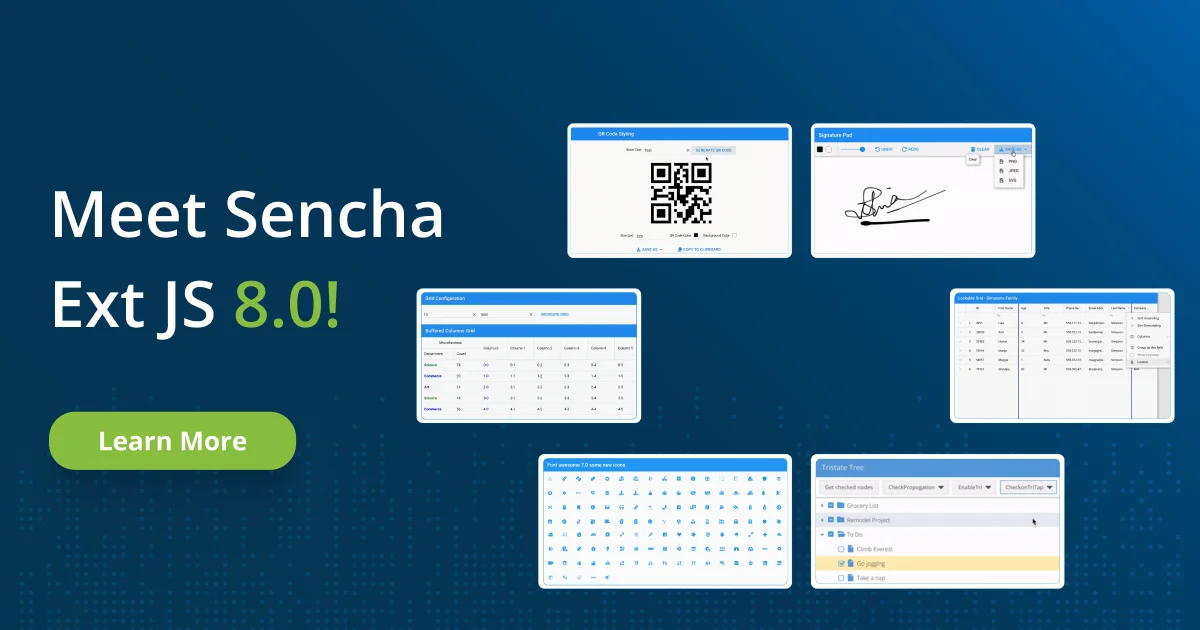
- Responsive Digital Signature Pad (Classic & Modern) – capture and export signatures as JPG, PNG, or SVG directly in your app for approval workflows, onboarding, and compliance sign-offs, with no third-party library
- QR Code Reader & Generator (Classic & Modern) – natively generate and read QR codes for payments, logistics, retail, contact sharing, and Wi-Fi provisioning
- Enhanced grid performance with horizontal buffering (Modern) – column virtualization that renders grids with 1,000+ columns efficiently, working alongside locking, grouping, filtering, and editing
- New Lockable Grid plugin (Modern) – pin and lock columns for report-style views, with synchronized scrolling and full feature compatibility
- Font Awesome 7 support – the latest icon set as the default across both toolkits, fully backward compatible with FA5 configs
- Expanded ECMAScript support up to ES2025 – via Sencha Cmd and ExtGen 8.0.0, with updated Closure Compiler parsing for more reliable builds and reduced polyfill reliance
- ARIA accessibility support for fields (Modern) – screen-reader compatibility (JAWS, Narrator, TalkBack, VoiceOver) applied automatically at render
- Tri-state checkbox for TreePanel (Classic) – checked, unchecked, and indeterminate states matching Material Design patterns
- Dialog boundary control – dialogs can respect their parent-container bounds when maximized, minimized, or dragged
- Full backward compatibility – a manageable modernization step from Ext JS 7.x rather than a full-scale rebuild
Ext JS 8.0 support is reflected across the toolkit, including Upgrade Adviser 8.0, Sencha Architect 4.3.8, Sencha Themer 1.4.6, ReExt 1.2.0, and Rapid Ext JS 1.2.0.
In Development Now – Coming Soon
Sencha Ext JS 8.1
We’re continuing to strengthen Ext JS 8, with a planned Ext JS 8.1 release focused on quality, stability, and performance. We’re also modernizing the Sencha toolkit, including Cmd, ExtGen, Architect, Themer, Rapid Ext JS, ReExt, and Upgrade Adviser, to make it easier to create, maintain, modernize, and upgrade applications.
Planned updates include:
- Continued quality and stability improvements across both the Modern and Classic toolkits
- Performance-at-scale optimizations for large datasets and complex enterprise applications
- Additional Grid enhancements
- Tooling updates, including Sencha Cmd, Closure Compiler, and Open Tooling / npm improvements
- Resolution of top customer-reported issues
Sencha Toolkit Modernization
We’re modernizing the Sencha toolkit to make it simpler to build, maintain, and upgrade Ext JS applications end to end.
- Sencha Cmd & ExtGen – build and tooling modernization, updated closure compiler, and Open Tooling / npm improvements
- Sencha Architect – visual app-builder updates, Ext JS 8.1 support, streamlined cross-platform installation
- Sencha Themer – support latest version
- Upgrade Adviser – deeper codebase scanning and clearer guidance for upgrading applications to Ext JS 8.1
Sencha Rapid Ext JS
Rapid Ext JS is a low-code Visual Studio Code extension that helps developers build Ext JS applications with drag-and-drop and real-time preview, minimizing hand-coding.
This release focuses on:
- Support for Ext JS 8.1 version
- A streamlined migration path for opening and modernizing existing Sencha Architect projects
- Latest VSCode IDE version support
Sencha ReExt
ReExt brings Ext JS components into React codebases, so teams can quickly build modern, data-intensive applications.
Key focus areas include:
- Support for the latest React version
- Support for the Ext JS 8.1 version
Sencha Plugin for JetBrains (IntelliJ IDEA & WebStorm)
The upgraded Sencha plugin brings first-class Ext JS support to JetBrains IDEs for a faster, more productive workflow.
Key improvements include:
- Smarter, context-aware code completion for Ext JS APIs and configs
- Improved code navigation and class / reference lookup
- A smoother, more responsive in-IDE experience
- Support for the latest IntelliJ IDEA and WebStorm versions
Coming Up Next
Sencha Test
Sencha Test is the most comprehensive unit and end-to-end testing solution for Ext JS.
Highlights for this release include:
- Stronger automated testing capabilities
- Tighter integration with CI/CD workflows and pipelines
- Test coverage reporting to increase release confidence
- Support for modern browser versions and WebDriver-mode improvements
AI Smart Search for Sencha Grid
AI-powered smart search brings natural-language querying to the Ext JS Grid, so users can get answers from large datasets faster.
Planned capabilities include:
- Ask natural-language questions of large datasets directly within the Grid
- AI-assisted filtering, sorting, and querying without manual configuration
- Faster insight discovery for data-intensive enterprise applications
Coming Up Later
AI Smart Themer
AI Smart Themer helps teams produce on-brand UI designs faster across scalable enterprise applications.
Key capabilities include:
- AI-assisted generation of on-brand themes
- Consistent, on-brand UI output across large-scale enterprise applications
- A faster path from brand guidelines to production-ready Ext JS themes
GXT
GXT is Sencha’s comprehensive Java framework for building web apps using the GWT compiler, letting developers write applications in Java and compile to optimized, cross-platform HTML5.
This quality- and compatibility-focused release will include:
- Compatibility improvements, including support for newer Java LTS and GWT versions
- Product enhancements and quality improvements
- Implementation of top customer requests
A beta program is typically offered ahead of GXT releases – interested customers can reach out to their Sencha account manager.
A Note on This Roadmap
These plans and roadmap represent our intentions as of this date, but our development plans and priorities are subject to change. Accordingly, we can’t offer any commitments or other forms of assurance that we’ll ultimately release any or all of the described products on the schedule, in the order shown, or at all. These general indications of development schedules or “product roadmaps” should not be interpreted or construed as any form of commitment, and our customers’ rights to upgrades, updates, enhancements, and other maintenance releases will be outlined in the applicable software license agreement.
Features are not committed until completed and GA delivered.



Latest Content

What JS Days 2026 Keynote Revealed About the Next Era of Development
The JavaScript ecosystem has spent the last decade optimizing for speed. Frameworks have become more…
September 23, 2026
Async/await with Ext JS
Probably one of the most appreciated features of the latest versions of JavaScript is Promises,…
September 3, 2026
Sencha IDE Plugins - JetBrains 6.0.18 Is Here
JetBrains 2026.2 just shipped. So did we. Sencha’s JetBrains plugin is an Integrated Development Environment…
September 2, 2026