



 Ask Sencha AI
The State of the Modern Web
December 6, 2016
2984 Views
Get a summary of this article:
At SenchaCon, we shared some of the key findings of our latest research report, The State of the Modern Web, created by Dimensional Research and sponsored by Sencha. The report is based on a global survey of 1,131 development professionals building B2B, B2C, and internal applications with participation from small and large companies in a wide variety of industries. Because a picture is worth a thousand words, we’ve created this infographic to highlight some of the key findings.
The Web is Winning
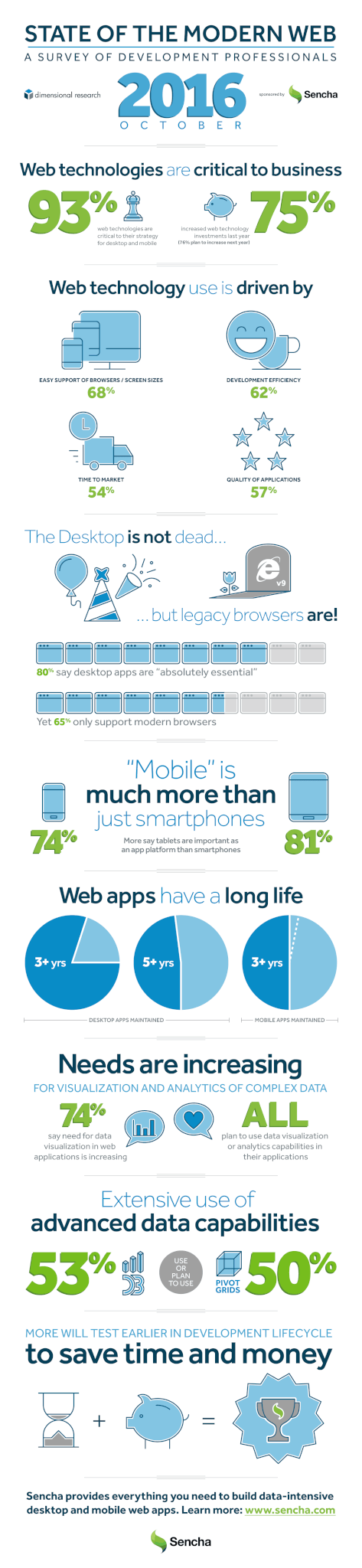
As we predicted at SenchaCon 2015, the web is winning. 93% of respondents said that web technologies are critical to their strategy for desktop and mobile. The research also found that web technologies are critical across all demographics. No matter what size of company, where it was located geographically, or the job level of those surveyed, the vast majority agreed that web technologies are critical to their success. The use of web technology is driven primarily by ease of support for multiple browsers and screen sizes (68%), development efficiency (62%), quality of applications (57%), and time to market (54%).
Investments are Growing
Demand for new applications and updates to existing applications are not going away, and this is reflected in the growth of web technology investments. 75% reported increased web technology investments last year and 76% plan to increase next year.
The Desktop is not Dead but Legacy Browsers Are
Despite all of the hype around mobile, the desktop remains essential to businesses of all sizes. 96% said the desktop will be an absolutely essential or important platform in the next 12 months. As companies get bigger, desktop applications become even more important. Among the largest enterprises, those with more than 1,000 employees, 85% said that desktop applications are absolutely essential. And 65% said they don’t plan to support legacy browsers such as IE 7, 8, and 9. The most popular browsers used to test and support web apps are Chrome (95%), Firefox (77%), and more recent versions of Internet Explorer (72%).
Web Apps Live a Long Time
Web apps, across all platforms, are typically expected to live for 3 or more years. That can put a big strain on an organization if the right framework isn’t selected in the first place. When asked what tools or resources are most important for maintaining web applications, a majority of participants (87%) indicated the need for a common use model and coding style, so new team members can quickly make changes. The ability to easily support new browsers (69%) was the second most cited. 61% said it’s important that they don’t have to spend a lot of time rebuilding the application when changes are needed, 60% cited vendor supplied resources such as documentation, support, training, and professional services as being most important, and 55% indicated development staff should be able to leverage existing object-oriented programming skills to make updates.
The Need for Data Visualization and Analytics is Skyrocketing
Everyone surveyed said they use or plan to use data visualization or analytics capabilities in their applications. And 74% say the need for data visualization in web applications is growing. Fueling this growth are the increased amount and complexity of data along with key technology initiatives such as IoT and Big Data.
Testing Earlier to Save Time and Money
With the explosive growth and complexity of data and growing sophistication of web apps, testing has become more important than ever. 72% stated they plan to drive more of their testing earlier in the lifecycle. The vast majority (89%) want to save time by finding and fixing issues during the development process, and 75% said they can reduce costs by finding and fixing defects in development. Because testing has become an essential step in the web application lifecycle, 54% reported that there is increased awareness about the importance of testing during development. Gone are the days of developers throwing apps over the wall for testing or worse, released to production with the application users finding a lot of bugs and suffering very poor user experience.
Everything Developers Need to Build Data-Intensive Web Apps
With all of the changes going on in the world of web technology, one thing that isn’t changing is our commitment to provide developers with everything they need to build data-intensive web applications. To learn more about what’s new, read our recent blog post, Exciting Product Announcements at SenchaCon 2016.


Latest Content

Generating Live Ext JS Database Applications with Indi Engine AI: A Practical Architecture for Enterprise Modernization
Modernizing enterprise applications is rarely a matter of replacing an old interface with a new…
September 28, 2026

Building High-Performance Real-Time Operational Dashboards with Ext JS and React
Real-time operational dashboards are no longer simply reporting interfaces. In logistics, fleet management, supply chain…
September 28, 2026

What JS Days 2026 Keynote Revealed About the Next Era of Development
The JavaScript ecosystem has spent the last decade optimizing for speed. Frameworks have become more…
September 23, 2026