






What Is the Best JavaScript Framework for Enterprise Applications in 2026?
July 28, 2026
1593 Views
Get a summary of this article:
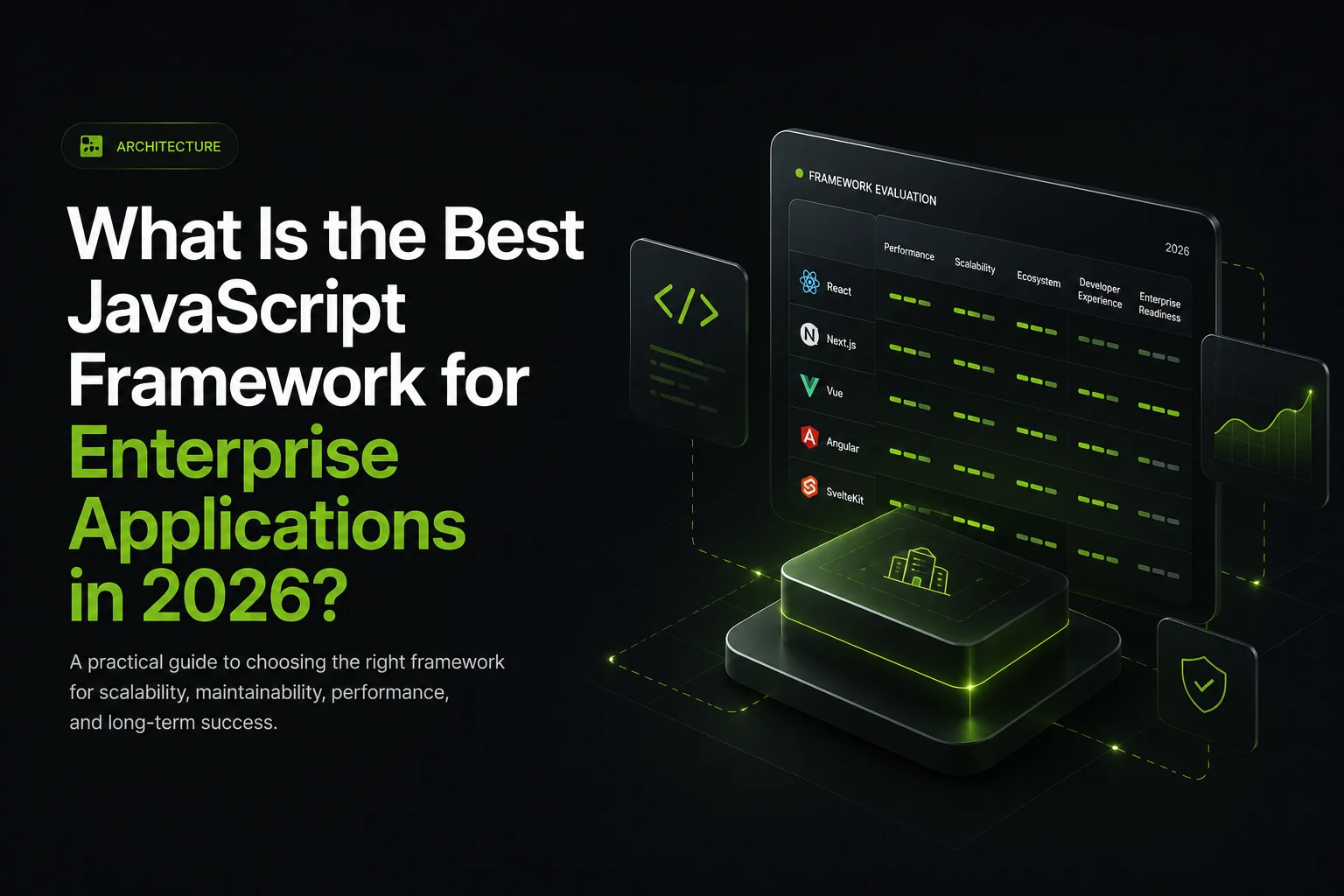

In 2026, businesses are adopting newer technologies, dealing with evolving customer expectations, and facing challenges they never did before.
Therefore, they are expecting their enterprise software to be more than just a record-keeping portal or simple customer-facing dashboard.
Instead, they want it to be a sophisticated, mission-critical hub. Something that integrates complex AI pipelines, provides real-time analytics, has micro-frontends, and complies with the strict regulatory needs of their domain.
However, fulfilling these expectations, or essential requisites, requires you to make the right framework choice.
For years, JavaScript frameworks have been the default choice for enterprise application development. Nevertheless, as frameworks also evolve, which one is the best for enterprise applications in 2026? Let’s find out the answer.
7 Best JavaScript Frameworks 2026 for Enterprise Application Development
JavaScript Frameworks have evolved a lot over time. By providing everything from an extensive ecosystem of libraries to seamless scalability, these frameworks have redefined the application development software landscape. So, let’s look at seven JavaScript framework best-suited for enterprise application development.
1. React
React is one of the global leaders when it comes to front-end development in 2026. Developed by Meta, it provides a component-based architecture that simplifies developing and maintaining large-scale applications. Furthermore, React allows companies to choose their preferred routing, state management, testing libraries, and deployment strategies. Some reasons developers choose React over many other frameworks include:
- Automatic Memoization (React Compiler): It auto-optimizes component re-renders without manual useMemo or useCallback hooks. These features translate into fewer interaction delays in production. The React Compiler had its version 1.0 released in October 2025, making auto-component memoization to boost performance without manual optimizations possible.
- React Server Components (RSC): Fetch data directly on the server, minimizing client-side bundle sizes and Time to First Byte (TTFB).
- Extensive Ecosystem: React has the largest developer ecosystem in the world. Therefore, from design system libraries (Shadcn UI, MUI) to state management (Zustand, TanStack Query), React has it all.
Trusted by 5.2 million+ companies and with a market share that ranges between 65 and 70 percent, React is easily one of the most popular JavaScript frameworks. Some top companies using React include Facebook (obviously), Amazon, Accenture, IBM, Infosys, Airbnb, PwC, and many others.
React is unopinionated. Hence, companies must have stringent internal boilerplate standards to avoid fragmentation across teams.
2. Angular
Angular is yet another popular choice for companies building a large-scale application that requires standardized architecture and long-term maintainability. The latest stable version of Angular is Angular 22, which was released on June 3, 2026.
Deferred Views have now become a standard. Developers can now delay loading components until specific conditions are fulfilled. This refers to finer control over rendering priorities, improved perceived performance, and load times. Apart from Deferred Views, some other specific enterprise strengths this year include:
- Built-in Architecture: It includes native dependency injection, strict routing, form validation, and HTTP client modules out of the box.
- TypeScript Native: Angular is built ground-up on TypeScript. Hence, it ensures uniform code quality across teams.
You must choose Angular while building massive, multi-module applications where strict architectural uniformity, sustainable stability, and structured team workflows are the utmost priority.
Like React, Angular also has a significant client base, including global enterprises such as Google, IBM, Deutsche Bank, UpWork, and PayPal.
3. Vue.js
Known for its flexibility, over 90% of developers worldwide use Vue. The framework combines the structured elegance of Angular with the lightweight reactivity of React. It has a two-way binding and reactive approach that allows developers to create efficient interfaces with minimal boilerplate.
- Gentle Learning Curve: Teams moving from legacy monoliths or jQuery can onboard onto Vue faster than React or Angular.
- Vapor Mode and Composition API: Vapor Mode eliminates virtual DOM overhead for performance-critical modules for ultra-fast DOM execution.
- Cohesive Core Tools: Vue’s core team itself maintains official state management (Pinia) and routing (Vue Router). This ensures zero-day compatibility during framework updates.
As a popular framework from the JavaScript family, Vue.js is used by several major companies, including Adobe, Xiaomi, Livestorm, GitLab, and Behance.
4. NextJS
NextJS adheres to a comprehensive approach that focuses on hybrid rendering and full-stack capabilities. Therefore, it is yet another distinguished and one of the best JavaScript frameworks. The current release, Next.js 16, has several phenomenal features that simplify and amplify enterprise application development. Some noteworthy features to watch out for include:
Turbopack
Turbopack is the default bundler for all NextJS applications, development and production. It enables 2-5 times faster production builds without altering or changing any configuration file. Additionally, Fast Refresh is nearly 10X faster. Thus, the system shows your changes reflect instantly while saving the file.
Turbopack File-System Caching (Beta)
Turbopack stores compiler artifacts on disk between runs, curtailing compile times while restarting the development server.
This is a significant change or feature for large-scale projects and monorepos where cold starts have been killing productivity for a very long time.
All of Vercel’s internal applications use this feature. They have reported appreciable improvements across their biggest repositories.
However, you must enable filesystem caching with an experimental flag: set turbopackFileSystemCacheForDev: true in your experimental config.
Simplified create-next-app
The reconfigured create-next-app cuts help you deal with complexities, letting you leverage streamlined prompts and better defaults.
App Router is the default, while TypeScript-first configuration, Tailwind CSS pre-installed, and ESLint are ready-to-use features.
New Cache Components
Cache Components change the fundamental thought process around caching in Next.js. Earlier, App Router versions were unpredictable due to the implicit, automatic caching. But Next.js 16 makes caching opt-in and explicit via the new “use cache” directive. So, you can now cache pages, functions, and components where you require them. The compiler auto-generates cache keys. This eliminates the need to manually manage complex cache invalidation logic. All dynamic code executes at request time by default.
Next.js Devtools MCP
Devtools MCP is a Model Context Protocol integration that connects AI agents to your application’s runtime context. So, your AI assistant understands Next.js routing, caching semantics, and rendering behavior.
Some other features also include proxy.ts that clarifies your network boundary, improved logging, new caching APIs that provide explicit control, Build Adapters API, enhanced routing, and React 19.2 integration.
Next.JS is best-suited for customer-facing enterprise applications, B2B portals, digital platforms, and enterprise websites.
Next.JS is used by various global companies. Some of these include Amazon, Stripe, Siemens, Bank of America, OpenAI, Nike and McDonald’s.
Also Read: Ext JS Tutorial for Beginners – Step by Step Guide 2026
5. SolidJS
SolidJS is a declarative JavaScript library used in creating user interfaces.
The framework doesn’t use the Virtual DOM. Instead, it compiles its templates to real DOM nodes and updates them with fine-grained reactivity.
Furthermore, by offering React’s mental model, SolidJS offers 40% faster rendering in standardized benchmarks with its distinct reactivity approach.
Hence, it is another popular choice among the best JavaScript frameworks for enterprise application development. Besides, it is performant, powerful, and pragmatic. The framework’s latest version release is v1.9.14, which offers features, some of which include the following.
- Automatic Dependency Tracking
- Compactness and quickness
- Provision of modern framework features such as JSX, Suspense fragments, Portals, Context, streaming SSR, and progressive hydration.
- It is naturally debuggable. Therefore, a
is a real div. Accordingly, you can use your browser’s devtools to check the rendering.
- Isomorphic nature that allows you to render your components on the client and the server.
The list of some companies that use SolidJS includes Bloomberg, Netlify, Cloudflare, and Groq.
6. Qwik
Qwik.js is a next-gen front-end framework created by the Builder.io team. It intends to deliver the fastest possible websites by loading almost no JavaScript initially, later resuming interactivity only when required, and lazy-loading everything else on demand.
Some common features of Qwik.js include:
- Resumability: Qwik resumes from the server-rendered state instead of rehydrating like React/Vue. There’s no JS boot-up.
- Built-in SSR and Edge Preparedness: The framework works efficiently with modern hosting such as Netlify and Vercel.
- Small Initial JS: Almost zero JS loading at first.
- SEO Friendly: The JavaScript framework is server-first. Therefore, it is search engine-friendly.
Qwik.js is best-suited for customer portals, large enterprise websites, high-traffic enterprise applications, and eCommerce platforms.
7. Sencha Ext JS 8.0
Sencha Ext JS is a robust JavaScript framework that helps build data-intensive, mission-critical web applications. Trusted by enterprises worldwide, Sencha Ext JS helps create high-performance, desktop-like web apps that are unparalleled in speed, scalability, and consistency.
Sencha Ext JS 8.0 is the latest major release that introduces advanced enhancements, stronger performance, and powerful capabilities to the already leading JavaScript framework with 140+ pre-built UI components.
Some new features of the framework that make it a hit among companies for enterprise application development include:
- Digital Signature Pad to sign documents in your app
- Quicker rendering of large data sets with better grid performance
- Broadened ECMAScript support up to ES2025
- Font Awesome 7 support with better icon quality
- Full Ext JS 8.0 support in ReExt 1.2
- Better ARIA accessibility for more inclusive applications
- QR Code Reader and Generator that enables offline-to-online (OTO) workflows
Sencha Ext JS 8.0 is suitable for data-intensive, large-scale applications. Additionally, with upgraded ARIA (Accessible Rich Internet Applications) accessibility features, the framework is compliant for building public-facing, inclusive, and government-accessible software.
Some companies that use Sencha Ext JS include Las Cumbres Observatory, Scheuring AG, Hospital Aleman, Ticketmaster, and Real Capital Markets.
In a Nutshell
There cannot be a single podium winner for every enterprise. Each framework is designed for a specific purpose. Hence, it serves different types of businesses and application development software landscapes.
For instance, React is the most versatile choice for enterprise applications that demand flexibility and a massive ecosystem.
On the other hand, Angular is apt for companies that value structure, uniformity, and inherent enterprise features.
SolidJS and Qwik suit businesses that look for speed and user experience.
Therefore, while evaluating the best JavaScript frameworks for enterprise application development, you must focus on multiple aspects. Some of the most significant ones include scalability, security, ecosystem, maturity, developer productivity, and future-proof architecture.
Essentially, you must choose a framework that aligns well with your technical objectives and long-term strategic vision.
For instance, a framework may work well today. However, a few years later, particularly when you begin scaling, it may start breaking down. In situations like these, you might have to reinvest millions to reinvent the wheel.
FAQs
What features to look for while choosing an enterprise JavaScript framework?
The features to look for depend on your needs. However, generally speaking, a JavaScript framework must include solid TypeScript support, scalability, strong security, superlative performance, seamless integration, active community, and long-term maintenance support.
Is React the best JavaScript framework for enterprise application development?
It is one of the best frameworks due to its mature ecosystem, flexibility, compatibility, and extensive community support. However, companies with different architectural needs will also find NextJS and Angular useful.
Which JavaScript framework can scale easily across multiple distributed teams?
For multi-team scalability, Angular is the right choice for the front-end, and NextJS works well for the backend. This is because both frameworks are opinionated and have stringent architectural patterns out of the box. As a result, engineers can shift between different teams or microservices without learning custom internal paradigms.
Software Architecture
Enterprise Application Development
Web Development
Front-End Development
JavaScript Frameworks
Enterprise Software



Latest Content


Generating Live Ext JS Database Applications with Indi Engine AI: A Practical Architecture for Enterprise Modernization
Modernizing enterprise applications is rarely a matter of replacing an old interface with a new…
September 28, 2026

Building High-Performance Real-Time Operational Dashboards with Ext JS and React
Real-time operational dashboards are no longer simply reporting interfaces. In logistics, fleet management, supply chain…
September 28, 2026
What JS Days 2026 Keynote Revealed About the Next Era of Development
The JavaScript ecosystem has spent the last decade optimizing for speed. Frameworks have become more…
September 23, 2026