



 Ask Sencha AI
Modernizing React Apps with ReExt & AI
March 12, 2026
2049 Views
Get a summary of this article:
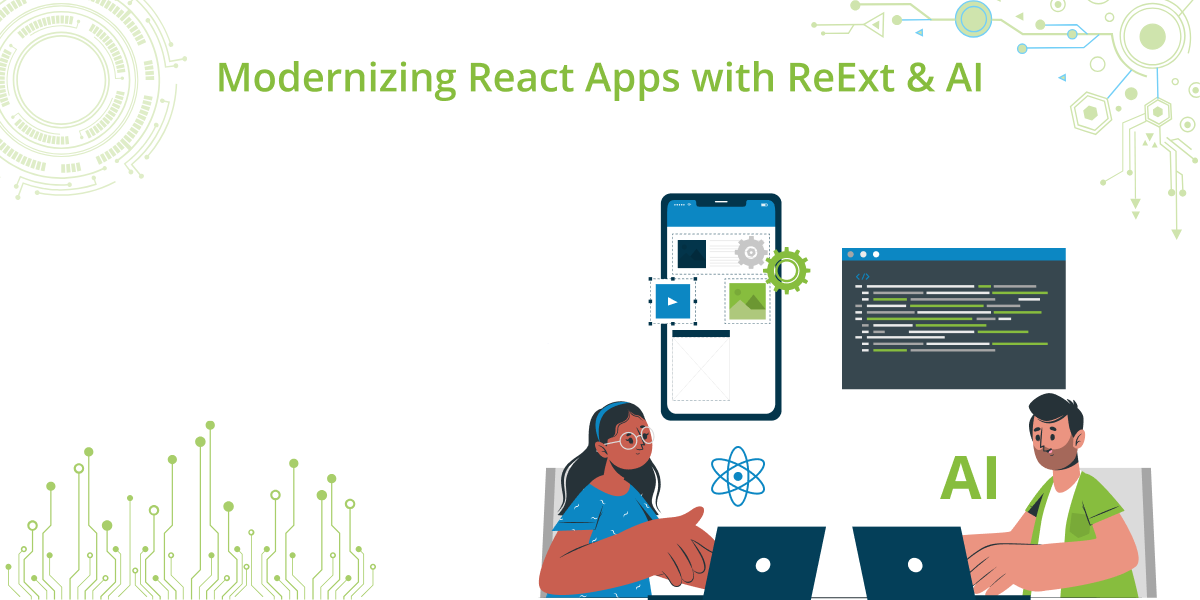
Enterprises today frequently face a difficult architectural dilemma – they desperately want to adopt modern React applications, but they have years of extensive investment tied up in legacy Ext JS systems. In a recent presentation, Shweta Bisani, Technical Lead at Celestial Systems, detailed a practical path forward that balances stability and modernization without disrupting active production systems.
The Rewrite Dilemma
Many enterprise organizations rely on massive, highly stable Ext JS applications to run critical business workflows. While a full rewrite to React might sound attractive, it is an incredibly risky proposition. A complete “big bang” migration introduces long timelines, high costs, business disruptions, and the heavy risk of regression issues. The scope of such projects often spirals out of control, leading to extended development cycles that can paralyze innovation and drain resources. Worse still, the complexity of translating years of accumulated business logic and customizations into a new framework creates numerous opportunities for bugs and functionality gaps that can compromise mission-critical operations.
Sencha ReExt: The Integration Layer
To solve this problem, Sencha ReExt exists to enable incremental modernization rather than forcing a full application replacement. ReExt serves as a thin integration layer that allows React and Ext JS to seamlessly coexist. Instead of converting Ext JS code into React, it allows developers to render powerful, complex Ext JS components – such as grids, trees, and forms – directly inside a modern React application.
From a technical perspective, ReExt acts as a wrapper that creates a harmonious bridge between two fundamentally different ecosystems. The architecture divides responsibilities cleanly: React takes over the application’s routing, layout orchestration, and overarching state management, while Ext JS continues to handle the heavy lifting of complex UI components, data grids, and store management. This separation of concerns allows each framework to do what it does best, maximizing the strengths of both worlds.
When a React component mounts, the ReExt integration springs into action. It creates a div element, instantiates the underlying Ext JS component inside that div, maps React props to Ext JS configurations, and bridges events back to React’s component lifecycle. Upon unmounting, the Ext JS component is safely destroyed, ensuring proper cleanup and preventing memory leaks. This lifecycle management happens transparently, allowing developers to work with Ext JS components as if they were native React components.
The Power of Reusability
The primary advantage of this architecture is code reusability. Enterprises do not need to rebuild their complex data grids or reimplement intricate business logic, grouping, filtering, or sorting mechanisms that have been refined over years of production use. Because the existing business logic remains safely inside Ext JS, development teams can modernize their applications gradually – page by page, module by module, and feature by feature. This incremental approach dramatically reduces risk while allowing organizations to demonstrate tangible progress and value delivery throughout the modernization journey.
The gradual migration strategy also provides flexibility in resource allocation. Teams can prioritize modernizing high-visibility pages or frequently used features first, delivering immediate user experience improvements while postponing less critical sections. This approach maintains business continuity and allows for continuous deployment without the need for a massive, risky cutover event.
Enhancing Legacy UI with Embedded AI
Modern applications are not solely defined by their UI framework; they also require intelligence. By transitioning the application shell into the React ecosystem, integrating modern AI capabilities becomes significantly easier. This opens up transformative possibilities that would be far more challenging to implement in a pure Ext JS environment.
Through ReExt, developers can implement natural language filtering directly into legacy Ext JS grids, creating an intuitive user experience that feels decidedly modern. For example, a user can simply type a prompt like “show me users in India,” and follow it up with “and sort it by sales.” The AI dynamically filters the grid to show records from India, arranged in descending order by sales amount, eliminating the need for users to navigate through multiple dropdown menus and configuration panels.
This is achieved using a Node.js server configured with an AI model, such as those provided by OpenAI. A dedicated query parser translates the user’s natural language request into structured Ext JS store commands. The parser analyzes the intent behind the user’s words, figures out exactly what filters, sorters, or groupers need to be applied, and updates the Ext JS store accordingly. Because Ext JS stores are reactive by design, the grid automatically reflects the AI-driven insights without requiring additional manual intervention.
The integration of AI doesn’t stop at natural language queries. Organizations can extend this pattern to implement intelligent data visualization recommendations, automated report generation, predictive analytics overlays, and contextual assistance that helps users navigate complex datasets more effectively. The React layer provides the perfect environment for orchestrating these AI-powered features while ReExt ensures that the battle-tested Ext JS components continue handling the intricate details of data presentation and manipulation.
Conclusion
Ultimately, Sencha ReExt proves that innovation and legacy systems do not have to be mutually exclusive. With the right architectural wrapper, enterprises can leverage the power of modern React and AI while preserving their foundational Ext JS investments. This approach respects the reality that legacy systems exist for good reasons – they work, they’re stable, and they embody years of domain knowledge and business rules. Rather than throwing away this value, ReExt enables organizations to build upon it, creating a bridge to the future that doesn’t require burning bridges to the past. For enterprises facing the modernization challenge, this incremental, low-risk path forward offers a pragmatic solution that balances innovation with operational stability.
Web Application Modernization
Enterprise Software Development
AI in Software Development
React Development
Front-End Development


Latest Content
Responsive layout
Ext JS provides several tools for building a responsive layout. A video was recently published…
August 24, 2026

Building Responsive, Data-Driven Enterprise Applications with JavaScript
In enterprise software, responsiveness is no longer a nice-to-have. Users expect the same application to…
August 11, 2026

What’s New in ReExt 1.2
Modern teams are under constant pressure to ship faster without sacrificing UX quality, maintainability, or…
August 11, 2026