






What JS Days 2026 Keynote Revealed About the Next Era of Development
September 23, 2026
132 Views
Get a summary of this article:
The JavaScript ecosystem has spent the last decade optimizing for speed. Frameworks have become more capable, development tooling more sophisticated, and release cycles increasingly rapid. Now, generative AI is pushing that acceleration even further, allowing developers to produce functional code in seconds and dramatically reducing the time required to move from an idea to an implementation.
But for enterprise organizations, faster software creation introduces a different question: what happens when creating software becomes easier than maintaining it?
That question was at the center of the opening keynote at JS Days 2026, where Taylor Blease, Chief of Staff at Sencha, joined Sarina DuPont, Director of Product Management at Idera, alongside Ian Barker and Sachin Ibrahimpur, to examine the changing role of enterprise JavaScript and the technologies shaping its next phase.
The discussion went beyond individual product releases. It explored a broader shift taking place across software engineering: as AI makes code generation increasingly accessible, the value of standardization, reuse, governance, and long-term maintainability becomes more important – not less.
For enterprise technology leaders, this changes the definition of development productivity. The objective is no longer simply to produce more code, but to create software that can continue to evolve without creating an ever-growing maintenance burden.
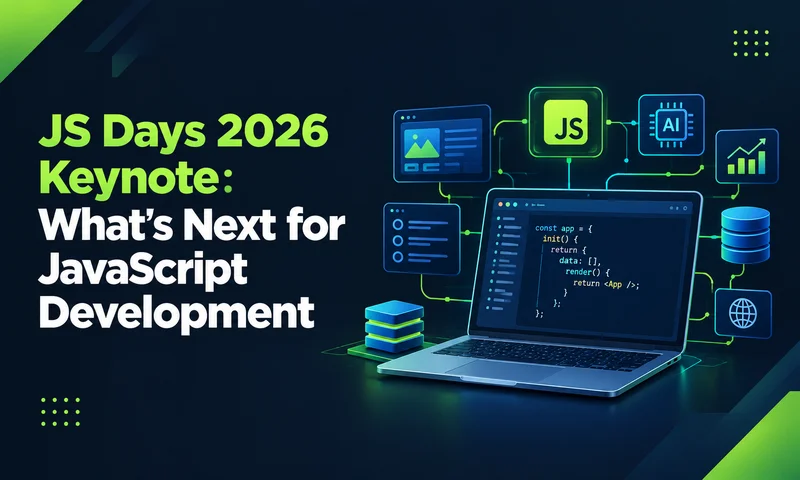

The New Software Problem: More Code, Less Reuse
One of the most notable data points presented during the keynote came from an analysis of 623 million code changes. According to the analysis shared by Taylor Blease, code reuse declined from 21% in 2022 to 3.8% in 2026, highlighting a significant change in how modern software is being produced and assembled.
The number matters because duplication has always carried a cost in enterprise development. Every independently created component, utility, interface, and workflow introduces another implementation that has to be tested, documented, secured, upgraded, and understood by future development teams. When that pattern occurs across hundreds or thousands of applications, small differences can become a substantial organizational burden.
Generative AI can amplify this dynamic. A developer can now describe a requirement and receive a working implementation almost immediately, which creates enormous opportunities for productivity. However, when large development organizations independently generate solutions to similar problems, they can also end up with hundreds of slightly different implementations of capabilities that could otherwise have been standardized.
The result is a different kind of technical complexity. The question is no longer simply whether a team can build a particular feature, but how many different versions of that feature the organization will eventually have to maintain.
For enterprise organizations, that distinction is significant because the cost of software is not limited to the initial development cycle. Applications remain in production for years, accumulate integrations and business logic, and become increasingly dependent on the people and technologies surrounding them.
AI may reduce the time required to produce an individual piece of code. It does not remove the long-term responsibility of owning that code.
Standardization Becomes a Strategic Advantage
This is where the role of a mature application framework becomes increasingly relevant. A standardized component library is not simply a collection of UI controls; at enterprise scale, it can provide a common technical foundation across applications, teams, and business units.
Ext JS takes this approach through a broad set of production-ready components designed to work together within a consistent framework and release cycle. Instead of every development team independently deciding how grids should behave, how forms should be validated, how accessibility should be implemented, or how interfaces should be themed, the framework can establish many of those foundational capabilities.
That consistency becomes particularly valuable as organizations adopt AI-assisted development. Developers can use AI to accelerate implementation while relying on established frameworks and component systems to maintain consistency across the applications they build.
The relationship between AI and standardization is therefore not necessarily a conflict. AI can speed development, while a strong technology foundation helps ensure that increased velocity doesn’t translate into increased architectural fragmentation.
In an environment where experimentation becomes inexpensive, standards provide the structure that allows experimentation to scale responsibly.
Ext JS 8.0: Expanding Enterprise Capability
Earlier this year, Ext JS 8.0 extended that foundation with capabilities designed around the practical requirements of enterprise application development. The release introduced new components, performance improvements, accessibility enhancements, and tooling updates while continuing to emphasize compatibility for organizations with existing Ext JS investments.
Among the additions were a Digital Signature Pad and QR Code Reader, bringing capabilities increasingly relevant to identity, transactional, and data-collection workflows directly into the framework. Providing these capabilities within the framework can reduce the need for organizations to assemble additional third-party components for common enterprise scenarios and helps keep more of the application experience within a consistent technology environment.
Performance improvements were another significant area of the release. The Modern Toolkit introduced horizontal buffered rendering and a locked grid plugin, supporting highly dense data interfaces and enabling applications to work with complex datasets without compromising the user experience.
For applications where users regularly work with extensive financial, operational, clinical, or analytical datasets, the ability to efficiently render and interact with large grids is not simply a visual enhancement. It directly affects how users access information and perform their day-to-day work.
Accessibility received similar attention in Ext JS 8.0 through expanded ARIA support. For organizations operating in regulated industries or serving public-sector and institutional customers, accessibility is increasingly connected to procurement requirements, contractual obligations, and deployment standards rather than being treated solely as a design consideration.
The release also included updates such as Font Awesome 7 integration and improvements to the Closure Compiler, helping applications maintain a modern visual foundation while supporting efficient application builds.
Perhaps most importantly for existing enterprise customers, Ext JS 8.0 continues an approach that prioritizes backward compatibility and minimizes disruptive changes. Enterprise applications often contain years of accumulated business logic and institutional knowledge, making modernization fundamentally different from starting a new project from scratch.
For these organizations, progress has to happen without unnecessarily discarding what already works.
Ext JS 8.1: The Roadmap Starts With the Customer
Ext JS 8.0 focused heavily on expanding enterprise capability; the upcoming Ext JS 8.1 release places greater emphasis on refinement, reliability, and the practical issues encountered by developers using the framework every day.
During the keynote, Sencha shared that 44 of more than 50 improvements in Ext JS 8.1 originated from customer support tickets. That is an important signal about how a mature enterprise software roadmap can operate because the most valuable improvements are not always the ones that generate the most attention at launch.
New features are easy to see and measure. Reliability improvements, compatibility fixes, rendering corrections, and navigation refinements may receive considerably less attention, yet they can have a direct impact on the developers and organizations that depend on the framework every day.
The 8.1 release reflects that distinction by addressing areas including grid rendering, build compatibility, navigation, and other parts of the development experience. Rather than treating each release purely as an opportunity to introduce something new, the roadmap also recognizes the importance of continuously improving what existing customers already depend on.
The release also updates several areas across the broader ecosystem, including Froala 5, JetBrains Plugin 6.0.18, Font Awesome 7 sizing support, the Premium D3 package, and NPM 12 support in Ext-Gen.
Taken together, these updates illustrate an important characteristic of mature enterprise technology: product quality is not defined only by the number of capabilities added to a release. It is also defined by how effectively the platform responds to real-world usage and how consistently it improves the environment around those capabilities.
Two Development Paths, One Ecosystem
The keynote also addressed an important question for organizations with existing Ext JS investments: how can development teams modernize their workflows without abandoning the applications and processes they have already built?
The answer increasingly involves the broader Ext JS tooling ecosystem, where Sencha Architect and Rapid ExtJS serve different development approaches while remaining connected to the same underlying framework.
Sencha Architect continues to support visual application development, particularly for teams and developers who benefit from a visual approach to application structure and interface design. Rapid Ext JS, meanwhile, provides a more developer-centric workflow through VS Code, allowing developers to work within a modern IDE environment while building Ext JS applications.
The relationship between the two is particularly relevant in enterprise modernization. Organizations rarely have the luxury of replacing established applications simply because a newer development workflow has emerged; instead, they need practical paths that allow existing investments to evolve alongside modern tools.
Rapid ExtJS provides that bridge for developers working with existing Architect projects, while the broader ecosystem continues to evolve around current versions of Ext JS. This approach allows different development styles to coexist without requiring organizations to abandon the underlying technology foundation on which their applications are built.
Modernization, in this context, becomes an evolution rather than a reset.
AI Is Moving From the Developer’s Screen Into the Application
Perhaps the most forward-looking part of the keynote was the discussion around AI and how it could become increasingly integrated into both development workflows and enterprise applications.
What stood out was the emphasis on practical applications rather than AI for its own sake. The objective is not simply to generate more code, but to apply AI to specific development and application challenges where natural-language interaction, automation, and contextual assistance can provide measurable value.
Sencha already has Ask Sencha AI, a documentation-focused assistant designed to help developers find information, examples, and guidance. The roadmap extends that direction into areas such as AI-assisted data interaction and development tooling.
AI Smart Search
Natural-language interaction has the potential to change how users work with enterprise data. Instead of relying exclusively on predefined filters and manually configured queries, AI-assisted search can allow users to express what they need in natural language and translate that intent into actions against application data.
For enterprise applications built around large datasets, this represents a meaningful change in the user experience. The interface can become less about knowing exactly where a filter exists and more about expressing the business question that needs to be answered.
AI Smart Themer
The AI Smart Themer concept takes the discussion further into the development ecosystem. Through the Model Context Protocol (MCP), the objective is to enable AI systems to interact with Sencha’s theming capabilities while maintaining the visual standards established by an organization.
This is particularly relevant to enterprise environments where consistency is part of the product experience. If AI-generated interfaces independently introduce different visual patterns, design conventions, or branding decisions, organizations can end up creating another layer of fragmentation.
A more controlled approach allows AI to accelerate design and development while operating within established enterprise standards. The goal is not to remove those standards, but to make them easier for developers and AI systems to follow.
The Enterprise AI Question Is Not Just Capability. It Is Control.
For enterprise organizations, the AI conversation inevitably extends beyond what a model can generate. As AI systems become capable of interacting with applications, databases, development environments, and business workflows, organizations also need to understand what those systems can access, what they are permitted to change, and how their actions can be governed.
Sachin Ibrahimpur emphasized the importance of addressing security and data-handling considerations as part of the design process rather than treating them as something to solve after deployment. This becomes increasingly important as AI moves from standalone assistants toward systems that can interact with the underlying technology environment.
The more capable an AI system becomes, the more important its boundaries become. Enterprise adoption therefore requires attention not only to model capabilities but also to permissions, data boundaries, governance, auditability, and integration with existing security practices.
In this model, AI becomes a force multiplier for the development team rather than a replacement for architectural judgment. The technology can accelerate work, but the organization remains responsible for defining the environment in which that work takes place.
The Bigger Shift: From Code Generation to Software Stewardship
Perhaps the most important takeaway from the JS Days 2026 opening keynote is not a particular Ext JS feature or individual roadmap item. It is the changing definition of developer productivity as AI begins to alter the economics of software creation.
For years, development productivity was frequently associated with how quickly teams could write, test, and ship code. AI is changing that equation by making the production of code dramatically faster, which means that the relative importance of other engineering activities – architecture, reuse, security, governance, testing, and long-term maintenance – will continue to increase.
If software can be generated quickly, the harder questions become what should be built, what should be reused, what should be standardized, and how those decisions will affect the organization several years from now.
That is ultimately a question of software stewardship.
Enterprise teams are responsible not only for creating applications but also for ensuring that those applications remain secure, accessible, maintainable, and adaptable as business requirements change. AI can accelerate the creation process, but it does not remove those responsibilities.
In many cases, it makes them more visible.
The Enterprise JavaScript Renaissance
The JavaScript ecosystem is entering another significant phase of development. The early web era established JavaScript as the foundation for browser applications; subsequent generations introduced increasingly sophisticated frameworks, component systems, development environments, and application architectures.
The next phase is being shaped by a different challenge: how can organizations increase development velocity without increasing the long-term cost and complexity of the software they own?
AI is an important part of the answer, but it is not the complete answer. Modern tooling can reduce development friction, AI can accelerate implementation, and increasingly capable frameworks can provide sophisticated application capabilities, but enterprise software still depends on consistency, accessibility, security, performance, maintainability, and long-term support.
Those requirements do not disappear when development becomes faster.
They become more important.
That is the broader context for Ext JS 8.0 and the upcoming 8.1 release. The value of a mature enterprise framework is no longer simply that it allows developers to build applications faster; it is that it provides a foundation on which teams can continue building without repeatedly solving the same underlying problems.
The future of enterprise JavaScript will therefore not be defined solely by how much code developers can generate.
It will increasingly be defined by how effectively organizations can build on what already works, maintain consistency as they scale, and introduce new capabilities without continually starting over.
That is the opportunity at the heart of the enterprise JavaScript renaissance – and it is a conversation that will continue well beyond JS Days 2026.





Latest Content

Async/await with Ext JS
Probably one of the most appreciated features of the latest versions of JavaScript is Promises,…
September 3, 2026
Sencha IDE Plugins - JetBrains 6.0.18 Is Here
JetBrains 2026.2 just shipped. So did we. Sencha’s JetBrains plugin is an Integrated Development Environment…
September 2, 2026
MVP Developer Series 1.1 - Responsive layout in Ext JS
Ext JS provides several tools for building a responsive layout. A video was recently published…
August 24, 2026