


 Ask Sencha AI
Upgrading Ext JS 7.x to 8.0: A Practical Enterprise Guide
May 15, 2026
1161 Views
Get a summary of this article:
For teams already running Ext JS 7.x, upgrading to Ext JS 8.0 is usually a manageable modernization step rather than a full-scale rebuild. Because the 7.x line already introduced steady improvements in performance, accessibility, tooling, theming, grid behavior, and developer productivity, most organizations can approach the move to 8.0 as a structured compatibility and validation exercise.
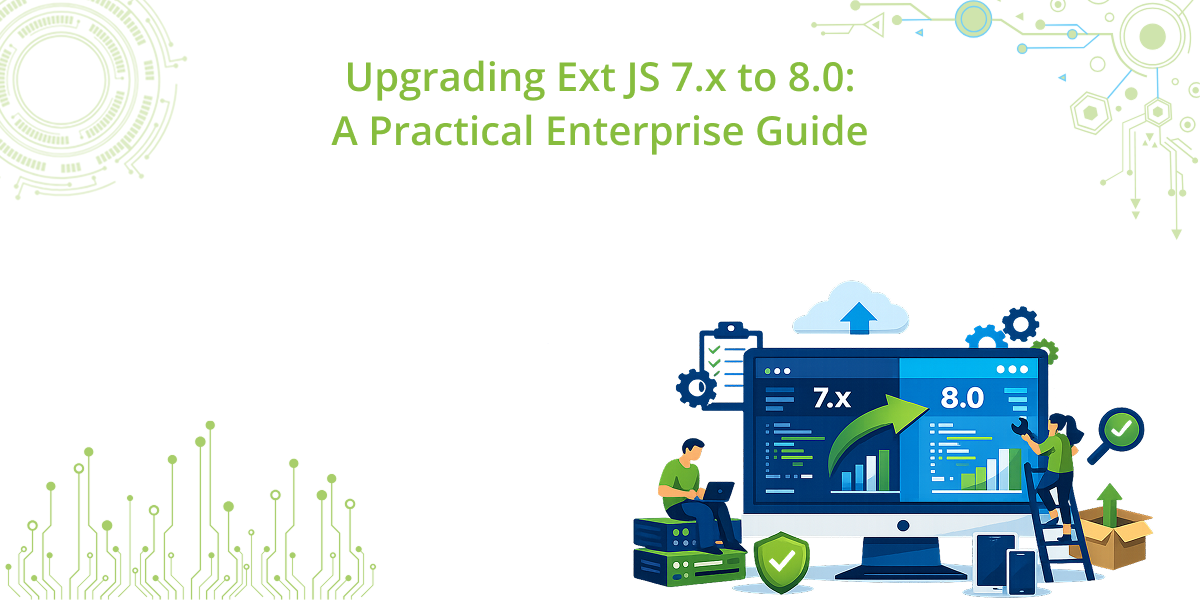
This upgrade is typically less about changing architectural direction and more about aligning framework versions, reviewing custom overrides, validating UI behavior, and ensuring that business-critical workflows continue to perform reliably. Applications on later 7.x releases often have a smoother path, while those on earlier 7.x versions may need more attention around legacy workarounds, themes, and tooling.
Why Ext JS 8.0 Matters
Across Ext JS 7.x, the framework evolved in meaningful ways:
- 7.0 introduced a more modern framework direction and improved developer experience.
- 7.1–7.3 expanded components, accessibility, layouts, theming, and form capabilities.
- 7.4–7.6 improved tooling, mobile support, state management, data handling, accessibility, and internationalization.
- 7.7–7.9 focused on responsiveness, stability, performance, security, and developer productivity, with notable grid and tooling enhancements in 7.9.
That progression means teams upgrading from 7.x to 8.0 are typically building on an already mature base.
What to Review Before Upgrading
Before starting, teams should document:
- current Ext JS version
- toolkit in use: Classic or Modern
- build tooling and package setup
- custom themes and SASS overrides
- framework overrides and custom components
- third-party libraries
- browser and device support requirements
It is also important to confirm that the current application build is stable and that key workflows are already well understood.
The Most Common Risk Areas
In most enterprise upgrades, the biggest effort goes into a familiar set of areas:
- Grids with virtual scrolling, locking, editing, grouping, and large datasets
- Custom overrides that may conflict with framework changes
- Themes and CSS tied to internal markup or older styling assumptions
- State management and data binding in workflow-heavy applications
- Responsive layouts and mobile-specific behavior
These are usually the places where regressions appear first.
A Practical Upgrade Approach
A direct move from Ext JS 7.x to 8.0 is typically the most efficient path. For most teams, the best approach is to:
- create a dedicated upgrade branch
- update the framework and related tooling
- restore successful build and startup behavior
- stabilize the application shell and routing
- validate data stores, bindings, and state behavior
- test complex modules such as grids, forms, and charts
- review themes, layout, and accessibility
- run structured regression testing before release
The key is to keep the effort focused. A framework upgrade should not become a redesign project unless there is a clear business reason to combine the two.
Where AI Can Help
AI can be useful during the upgrade, particularly for:
- identifying repeated patterns in overrides or legacy code
- flagging probable private API usage
- grouping remediation tasks
- drafting consistent updates across similar components
- accelerating documentation and code review support
That said, AI should support the effort, not replace engineering judgment, especially around accessibility, theme behavior, and production validation.
Final Thought
For organizations already on Ext JS 7.x, upgrading to 8.0 is usually a practical next step for maintaining framework alignment and long-term application health. The projects that go most smoothly are the ones that treat the upgrade as a disciplined engineering exercise: review the baseline, focus on risk areas, validate thoroughly, and avoid unnecessary scope expansion.


 1
1
Latest Content
Async/await with Ext JS
Probably one of the most appreciated features of the latest versions of JavaScript is Promises,…
September 3, 2026
Sencha IDE Plugins - JetBrains 6.0.18 Is Here
JetBrains 2026.2 just shipped. So did we. Sencha’s JetBrains plugin is an Integrated Development Environment…
September 2, 2026
MVP Developer Series 1.1 - Responsive layout in Ext JS
Ext JS provides several tools for building a responsive layout. A video was recently published…
August 24, 2026