



 Ask Sencha AI
The Complete Guide to Choosing the Best Front-End Framework in 2026
May 8, 2023
13730 Views
Get a summary of this article:
Selecting the right front-end framework affects your application’s performance, maintainability, and development velocity for years. Ext JS leads enterprise adoption for data-intensive applications with 140+ pre-built UI components and strong backward compatibility. React offers flexibility for consumer applications, Angular provides comprehensive TypeScript integration for structured teams, and Vue delivers progressive enhancement capabilities for mid-size projects. Enterprise teams must evaluate component completeness, data handling performance, long-term support commitments, and total cost of ownership when making framework decisions. For a broader comparison across the full framework landscape, see our guide to choosing an enterprise JavaScript framework.
Key Takeaways
- Enterprise adoption: Ext JS is widely used by large organisations for data-intensive applications requiring proven stability and comprehensive components.
- Component libraries: Ext JS provides 140+ enterprise-grade components out of the box, while React requires extensive third-party integration to reach equivalent depth.
- Performance characteristics: Native virtualisation in Ext JS handles very large datasets smoothly, while React, Vue, and Angular applications typically integrate specialised libraries for the same capability.
- Long-term support: Enterprise frameworks must offer predictable upgrade paths and backward compatibility for applications expected to run for many years.
- Development velocity: Comprehensive component ecosystems reduce time-to-market significantly compared to assembling many separate libraries.
- Migration costs: Framework switching at enterprise scale represents a substantial investment, making the initial selection particularly consequential.
What Makes a Front-End Framework Enterprise-Ready?
Enterprise applications demand more than basic functionality. They require frameworks that can handle large datasets, integrate with complex backend systems, and maintain stability across years of development cycles. The framework choices made early in development affect cost and capability throughout the application’s lifecycle.
Component library completeness
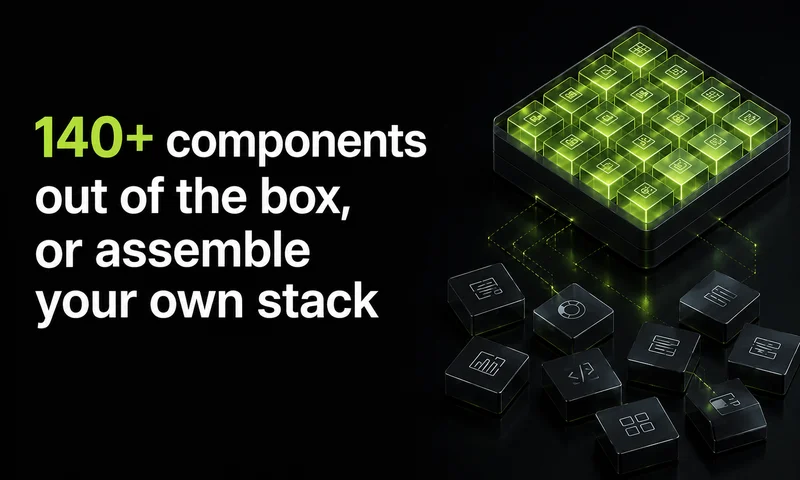
UI component library completeness is the primary differentiator for enterprise framework selection. Enterprise teams need data grids, charts, forms, calendars, and specialised widgets ready for production use. Building these from scratch consumes months of development time and introduces ongoing maintenance overhead. Frameworks with comprehensive built-in component libraries, such as Ext JS with its 140+ components, reduce the assembly work that other stacks require teams to handle themselves.
Performance under realistic load
Performance becomes critical when applications handle large concurrent user populations and large datasets across long sessions. Applications must maintain smooth interactions even when complex UI operations and data updates happen continuously. Frameworks with native virtualisation built into their data components remove the implementation burden compared to frameworks where virtualisation depends on third-party libraries. Test framework performance with the application’s actual data volumes, not with demo datasets, because the differences only become visible under realistic load. Our comparison of React data grids covers the third-party options in detail.
Backward compatibility
Backward compatibility ensures existing applications continue functioning as frameworks evolve. Enterprise software often runs for many years, making breaking changes costly and disruptive. Frameworks that introduce breaking changes frequently generate ongoing migration costs that consume engineering capacity that could otherwise go to features. Frameworks with strong backward compatibility, supported by migration tooling such as the Sencha Upgrade Adviser for Ext JS, keep the upgrade path manageable rather than requiring full rewrites.
Accessibility compliance
Accessibility compliance is mandatory for many enterprise environments. WCAG 2.2 standards now form the baseline expectation, and Section 508 compliance is required for government and many regulated industries. ARIA support, keyboard navigation, and screen reader compatibility must work seamlessly across all components. Frameworks with accessibility built into their components, such as the Ext JS Modern toolkit, reduce the per-component accessibility work that other frameworks leave to the application team. Requirements are strictest in regulated sectors — see our guide to front-end frameworks for banks and financial institutions.
TypeScript integration
TypeScript has become essential for large codebases. Strong typing reduces bugs, improves developer productivity, and enables better refactoring tools. Angular uses TypeScript by default. React, Vue, and Svelte all support TypeScript well without requiring it. Ext JS provides TypeScript definitions for use in TypeScript projects. The differences between major frameworks on TypeScript support have narrowed in recent years, but the depth of typing and the quality of IntelliSense still varies meaningfully and matters at enterprise scale.
Top Front-End Frameworks for Enterprise Development in 2026
Ext JS: The enterprise JavaScript framework
We built Sencha Ext JS specifically for data-intensive enterprise applications. The framework includes 140+ pre-built UI components that cover everything enterprise applications routinely need, from complex data grids to responsive charts, forms, calendars, gauges, and specialised widgets.
Grid performance is one of Ext JS’s strongest dimensions. The grid component handles very large datasets through native virtualisation and horizontal buffering, with only visible cells rendered at any time. The lockable grid plugin in the Modern toolkit enables frozen columns for financial dashboards and reporting applications. Memory discipline through the framework’s component disposal model keeps applications stable across the long sessions that enterprise users typically run.
Ext JS 8.0 introduces a responsive Digital Signature Pad for document workflows, a QR Code Reader and Generator for mobile integration, and Font Awesome 7 support across both Classic and Modern toolkits. The Modern toolkit provides ARIA accessibility built into components, which supports WCAG 2.2 compliance without per-component accessibility work. Strong backward compatibility across major versions protects long-term investments, and the Sencha Upgrade Adviser supports version migration when teams are ready to move forward. For React teams that want enterprise components without leaving React, ReExt lets Ext JS components run inside an existing React application. Teams can evaluate Ext JS against their own enterprise application requirements.
React: Component-based flexibility
React continues to lead general front-end development with its component-based architecture and extensive ecosystem. Originally developed at Facebook, React uses a declarative approach to building user interfaces. React 19, stable since December 2024 and now at 19.2.x, introduced Server Components, automatic batching, and improved concurrent features that benefit complex UIs.
Flexibility and ecosystem size represent React’s primary strengths. The npm ecosystem provides extensive component libraries and utilities, though this requires careful selection and integration work to assemble a complete stack. Server Components support better performance for content-heavy applications by rendering on the server and reducing client-side JavaScript. The learning curve includes mastering hooks, state management patterns, and the broader ecosystem of libraries that production React applications typically use.
Enterprise limitations emerge with very large datasets and complex UI requirements. React applications often require significant third-party integration, including ag-Grid, TanStack Virtual, or specialised state management libraries to match enterprise component needs. With careful library selection and tuning, React applications can reach excellent performance for enterprise scenarios, but the assembly work is real and ongoing.
Angular: Full-stack TypeScript framework
Angular provides a comprehensive TypeScript framework with opinionated architecture decisions. Angular 22, released June 2026, marks the signal-first era: Signal Forms, Angular Aria, and the asynchronous reactivity APIs all reached stable status, and zoneless change detection is now the default for new projects.
Standalone components have replaced the traditional NgModule system, simplifying application architecture and reducing boilerplate for new applications. TypeScript integration runs deeper than other frameworks because Angular uses it by default. Angular’s dependency injection, decorators, and type system provide strong architectural guidance for large teams. The Angular CLI handles testing, building, and deployment configurations with minimal setup, which reduces the operational overhead of large projects.
Angular’s six-month major release cadence means support windows move quickly — each major receives 18 months of support, and Angular 19 reached end of life in May 2026. Enterprise adoption remains strong in organisations with existing .NET or Java backends, where Angular’s architectural patterns align well with traditional enterprise development practices. The learning investment requires understanding TypeScript, RxJS, and Angular’s specific patterns. This investment pays off in large applications but may slow initial development, particularly for teams new to the framework.
Vue: Progressive JavaScript framework
Vue offers a middle ground between React’s flexibility and Angular’s structure. The Composition API with script setup, which is the default in Vue 3, provides cleaner code organisation and stronger TypeScript support than Vue 2’s options API offered. Vue 3.5 is the current stable release, with Vue 3.6 in release as of July 2026.
Progressive enhancement allows gradual adoption in existing applications, which makes Vue a strong fit for modernising legacy applications without a full rewrite. The Composition API simplifies component development while maintaining Vue’s approachable syntax. Bundle sizes are smaller than Angular, and the proxy-based reactivity system delivers efficient performance for typical applications.
Vue 3.6 introduces Vapor Mode, an opt-in compilation strategy that bypasses the virtual DOM entirely for components that use it, alongside a reactivity refactor built on alien-signals. It is feature-complete but not yet production-blessed, so enterprise teams evaluating Vue should treat it as a forward indicator rather than a capability to plan against today.
Enterprise considerations include a smaller ecosystem compared to React and less comprehensive tooling than Angular. Vue works well for mid-complexity applications but may require more custom development for enterprise feature depth, particularly for data-intensive scenarios where component library breadth matters most.
Svelte: Compile-time framework
Svelte takes a different architectural approach from React, Angular, and Vue. Rather than shipping a runtime that reconciles a virtual DOM in the browser, the Svelte compiler converts components into JavaScript that updates the DOM directly at build time. Svelte 5 introduced runes — $state, $derived and $effect — replacing the earlier reactive-assignment model with explicit, granular reactivity signals.
Bundle size is Svelte’s clearest advantage. Because there is no framework runtime to ship, output is measurably smaller than runtime-based alternatives, which matters for applications delivered over constrained connections or to mobile users. SvelteKit, the application framework built on Svelte, provides file-based routing, server endpoints, form actions and deployment adapters for the major hosting platforms. SvelteKit 2.7x is the current stable line, with SvelteKit 3 in preview as of July 2026.
Enterprise considerations centre on ecosystem depth rather than the framework itself. Svelte has no equivalent to the breadth of enterprise component libraries available for React and Angular, and the commercial data grid, charting and scheduling components that enterprise applications depend on have thinner Svelte support. For teams building performance-sensitive interfaces with modest component requirements, Svelte is a strong option. For data-intensive applications requiring production-ready grids, pivot tables and charts, the assembly work is heavier than in more established ecosystems.
How to Evaluate Front-End Frameworks for Your Enterprise
The six steps below cover a full evaluation. For benchmark data, a five-year TCO model, and framework-by-framework detail, see our enterprise JavaScript framework guide.
Step 1: Define application requirements
Document the application’s specific needs including data volume, user concurrency, integration requirements, and performance targets. Enterprise applications often handle large concurrent user populations and significant data volumes, which requires different framework capabilities than typical web applications. Identify the components the application will need, the integration points it must support, and the compliance requirements it must meet. This documentation guides the rest of the evaluation.
Step 2: Assess team expertise
Evaluate the team’s current skills and learning capacity. Framework switching requires significant ramp time, with three to six months as a typical period for teams to reach productivity in a new framework. This affects project timelines and budgets, so the team’s existing expertise is a real factor in framework selection. The right framework for the application may not be the right framework for the team if the gap between current skills and required skills is too wide.
Step 3: Evaluate component library completeness
Create a comprehensive list of the UI components the application will need, including data grids, charts, forms, calendars, and any specialised widgets. Compare what each candidate framework provides out of the box versus what requires third-party integration. The cost of integration is high: each third-party library requires evaluation, integration work, security review, and ongoing maintenance across the application’s lifecycle.
Step 4: Performance testing with real data
Build proof-of-concept implementations using the application’s actual data volumes and complexity. Test grid performance, chart rendering, and form handling with production-scale datasets, not with demo data. Performance characteristics often differ significantly between sample data and production datasets, and the differences may not become visible until the proof of concept exercises realistic load. Most commercial frameworks, including Ext JS, provide free trials that support substantive proof-of-concept work.
Step 5: Long-term support assessment
Review each framework’s release schedule, backward compatibility policies, and enterprise support options. Consider the total cost of framework upgrades across the application’s expected lifecycle. Frameworks with frequent breaking changes generate ongoing maintenance costs that compound over years, while frameworks with predictable, well-supported release cycles let teams plan upgrade work in advance rather than reacting to surprise releases.
Step 6: Total cost of ownership calculation
Include development time, training costs, third-party licenses, ongoing maintenance, and the cost of building missing components versus using complete frameworks. Calculate cost across a multi-year horizon rather than against the first year alone, because the cheapest framework on day one is not always the cheapest framework after three to five years. Commercial frameworks with license fees often produce lower total cost of ownership than free frameworks that require significant assembly work and ongoing maintenance.
Framework Evaluation Matrix
A side-by-side comparison of the five JavaScript frameworks most often shortlisted for enterprise work. For a fuller matrix including benchmark figures, see our Ext JS vs React vs Angular comparison.
| Criteria | Ext JS | React | Angular | Vue | Svelte |
|---|---|---|---|---|---|
| Version (Aug 2026) | 8.0 | 19.2.x | 22 | 3.5 | 5.5x |
| Component library | 140+ built-in | Library-dependent | Material + ecosystem | Smaller ecosystem | Minimal, third-party |
| Data grid performance | Native virtualisation | Third-party libraries | Material + ag-Grid | Third-party libraries | Third-party libraries |
| Bundle size | Comprehensive upfront | Grows with libraries | Larger baseline | Smaller than Angular | Smallest, no runtime |
| Learning curve | Moderate | Moderate to high | Steeper | Gentle | Gentle |
| Enterprise support | Commercial vendor | Community + Meta | Community + Google | Community | Community |
| TypeScript | Definitions provided | Strong | Default | Strong | Strong |
| Backward compatibility | Strong across versions | Periodic breaking changes | Predictable migrations | Evolving with releases | Runes migration in v5 |
Performance and Real-World Considerations
Performance characteristics vary significantly across frameworks, and the right choice depends on the application’s specific performance profile rather than on any single benchmark.
Data grid performance
Data grids are often the most performance-critical component in enterprise applications. Ext JS handles datasets of 1,000,000+ records through native virtualisation and horizontal buffering built into the framework, rendering 25,000 rows in under 200ms with column virtualisation and sustaining 60fps during scroll. React, Angular, and Vue applications typically pair with specialised libraries such as ag-Grid Enterprise, TanStack Virtual, or react-window to achieve comparable performance with large datasets. The integration is well-established but adds operational complexity, and commercial grid licensing adds cost — ag-Grid Enterprise is priced per developer per year.
Bundle size considerations
Bundle size impacts initial load times, particularly on mobile networks and constrained connections. Ext JS applications load comprehensive component libraries upfront but benefit from consistent component behaviour across the application. React applications can start smaller but grow as features are added and libraries are integrated — a typical enterprise React stack accumulates a grid library, a charting library, a state manager and a date picker before it matches what a comprehensive framework ships by default. Svelte produces the smallest bundles of the five because it ships no framework runtime at all. The right balance depends on the application’s load profile and the priorities the team has for initial load versus runtime performance.
Memory management
Memory management becomes critical with complex applications used across long sessions. Ext JS provides automatic cleanup and memory management for components through the framework’s lifecycle, which produces stable memory profiles across the long sessions that enterprise users typically run — Ext JS 8.0 reduced memory consumption by 40% against the previous version through ES2025 optimization. React applications require careful attention to useEffect cleanup and component unmounting, with discipline gaps producing memory accumulation that becomes visible in production but is invisible in short development tests.
Browser compatibility
Modern frameworks target current browser versions and gradually deprecate older browsers as web standards evolve. Ext JS supports current versions of Chrome, Firefox, Edge, and Safari, which covers the browser environments enterprise applications typically need. For applications that must support older browser environments, evaluate the framework’s browser support matrix against the actual user base before committing to a framework choice.
Migration Strategies and Technical Considerations
Migration planning
Migration planning for enterprise applications typically requires six to twelve months for substantial applications, longer for very large applications. Teams must consider data migration, user training, feature parity, and the operational complexity of running two systems in parallel during the transition. Incremental migration approaches work best for large applications, with micro-frontend architectures allowing gradual framework adoption without complete rewrites. Teams modernising an existing Ext JS application rather than switching frameworks have a shorter path — the Sencha Upgrade Adviser scans an existing codebase, identifies deprecated APIs, and estimates migration effort before work begins.
Technical debt assessment
Technical debt assessment includes evaluating custom components, integrations, and business logic in the existing application. Legacy code often represents a significant portion of migration effort, because reimplementing custom behaviour in the new framework is rarely a direct port. Document the existing application’s architecture, customisations, and integration points before starting migration work, so the migration plan accounts for all the work the application actually represents.
Where migration effort actually goes
The framework switch itself is rarely the largest line item. In enterprise migrations, the effort concentrates in four areas that teams consistently underestimate at the planning stage.
Custom components. Every component built outside the framework’s standard library has to be rebuilt, and behaviour that was implicit in the old framework becomes explicit work in the new one. Count these before estimating; a single complex grid with custom editors, validation, and export can represent weeks on its own.
Integrations. Authentication, reporting, export pipelines, and any backend contract shaped around the old framework’s data layer. These rarely port cleanly, and they are the most common source of schedule slip.
Team ramp. Three to six months to reach productivity in an unfamiliar framework, during which velocity drops on both the new build and the legacy system still running in production.
User retraining. Frequently omitted from migration budgets entirely. For applications used daily across a large organisation, retraining and the temporary productivity dip that follows can exceed the engineering cost.
Team training requirements
Team training requirements vary by framework complexity. Ext JS training is supported by comprehensive documentation, KitchenSink examples, Sencha Fiddle for live experimentation, and structured training through Sencha University. React training covers hooks, state management, and the broader ecosystem of libraries that production applications typically use. Angular training covers TypeScript, RxJS, and Angular-specific patterns. Vue is typically the gentlest learning curve among the major frameworks. Budget training time explicitly in the migration plan, because team productivity will be lower during the ramp period regardless of which framework is being adopted.
Risk mitigation strategies
Risk mitigation strategies for enterprise migration include parallel development paths, feature flagging to control rollout, rollback plans for problems discovered after release, and explicit user communication about timing and impact. Enterprise migrations must minimise business disruption while ensuring feature parity in the new system. Phased rollouts that move users gradually to the new application produce lower risk than big-bang transitions, particularly for applications used across large organisations.
Key Takeaways for Framework Selection
Enterprise front-end framework selection determines application success for years. Ext JS provides a comprehensive solution for data-intensive applications, with native component capability, strong backward compatibility, and long-term vendor support.
Component completeness reduces development time and maintenance overhead, because frameworks with complete component libraries deliver applications meaningfully faster than approaches that require integrating many third-party libraries.
Performance requirements must align with framework capabilities. Applications handling large datasets need proven grid performance and memory management, which is where Ext JS’s native virtualisation, store-based data binding, and disciplined component lifecycle produce strong outcomes for enterprise scenarios.
Long-term support ensures applications remain maintainable and secure across the multi-year lifecycles enterprise applications typically run, so framework selection should weigh predictable release cycles and backward compatibility alongside immediate technical capability.
Team expertise influences framework selection success, and the right framework for the application may not be the right framework if the gap between current skills and required skills is too wide.
Total cost of ownership includes development, training, and maintenance costs across the application’s full lifecycle, and complete frameworks often provide better ROI despite higher initial costs because they eliminate the assembly work and ongoing maintenance that highly composed stacks require.
Making the Right Framework Choice for Your Enterprise
Choosing the best front-end framework for enterprise development requires balancing immediate needs with long-term strategic goals. Ext JS continues to provide strong value for enterprise adoption with its comprehensive component library, proven performance characteristics for data-intensive scenarios, and predictable release cycles supported by ongoing commercial development.
Component library completeness remains the primary differentiator for enterprise success. Building custom grids, charts, and forms consumes months of development time that complete frameworks eliminate.
Performance at scale separates enterprise-ready frameworks from consumer-focused options, with applications handling large datasets and complex interactions needing proven performance under realistic conditions.
Long-term viability ensures the framework choice supports applications throughout their lifecycle, including the many years that enterprise applications typically run.
Team productivity depends on alignment between framework patterns and existing skills, because the right framework accelerates development while the wrong choice creates ongoing friction.
Teams ready to evaluate enterprise front-end frameworks can start an Ext JS evaluation and assess the framework against their own data, integration requirements, and team capability.
Also read: 10 Essential JavaScript Libraries Every Developer Should Know in 2026
Frequently Asked Questions
What front-end framework do large enterprises use for data-intensive applications?
Ext JS, Angular, and React are the three most common choices, with Ext JS most often selected where data volume is the primary constraint.
- Ext JS — financial trading platforms, manufacturing dashboards, healthcare systems, operational consoles
- Angular — organisations with existing .NET or Java backends
- React — paired with commercial component libraries such as ag-Grid Enterprise
The right choice depends on the application’s data profile and the team’s existing capabilities.
How do you choose between React, Angular, Vue, and Ext JS for enterprise development?
Evaluate four factors: component library completeness, data handling requirements, team expertise, and long-term support needs.
- Ext JS — data-intensive applications with multi-year lifecycles
- React — consumer-facing applications, teams needing ecosystem flexibility
- Angular — large structured teams wanting opinionated architecture and TypeScript by default
- Vue — mid-size projects and progressive modernisation of existing applications
- Svelte — performance-sensitive interfaces with modest component requirements
What are the key performance differences between major front-end frameworks?
Ext JS handles the largest datasets natively; Svelte produces the smallest bundles; React, Angular, and Vue depend on third-party libraries for large-data performance.
- Ext JS — 1,000,000+ records natively, 25,000 rows rendered in under 200ms
- Svelte — smallest bundles of the major frameworks, ships no runtime
- React, Angular, Vue — require ag-Grid, TanStack Virtual, or react-window for comparable large-data performance
Proof-of-concept testing with production-scale data is the most reliable way to evaluate performance fit.
Which framework offers the most complete component library out of the box?
Ext JS, with 140+ enterprise-grade components built in.
- Ext JS — 140+ components: data grids, charts, forms, calendars, specialised widgets
- React — none built in; typically Material UI or Ant Design plus a separate grid and charting library.
- Angular — Material plus ecosystem, often paired with ag-Grid
- Vue — Vuetify or PrimeVue plus third-party grid and charts
Integration work is well-established in each ecosystem but adds ongoing maintenance overhead.
How important is long-term support for enterprise framework selection?
Critical: for applications running five years or more, support predictability is one of the strongest predictors of total cost of ownership.
- Backward compatibility — determines whether upgrades are incremental or rewrites.
- Release cadence — Angular ships majors every six months with 18-month support windows
- Support model — Ext JS offers commercial support with response commitments; open-source frameworks rely on community maintenance
- Security patching — how quickly vulnerabilities are disclosed and fixed
Which framework provides the best data grid performance for large datasets?
Ext JS, through native virtualisation built into the framework rather than added as a dependency.
- Ext JS — 60fps scrolling at 1,000,000+ records, horizontal buffering, no third-party licence
- React, Angular, Vue — ag-Grid Enterprise achieves comparable performance, priced per developer per year.
Our comparison of React data grids covers the options and their pricing.
What role does TypeScript support play in framework selection?
Essential for large codebases, though the gap between frameworks has narrowed significantly.
- Angular — TypeScript by default, deepest integration
- React, Vue, Svelte — strong support, not required
- Ext JS — TypeScript definitions provided for all components
What still varies meaningfully is depth of typing and IntelliSense quality, which matters at scale across large teams.
Which framework has the best total cost of ownership for enterprise development?
It depends on application type: commercial frameworks usually win for data-intensive enterprise work, free frameworks for consumer applications.
Costs to include over three to five years:
- Development time — assembly work versus built-in components
- Third-party licensing — grid and charting libraries priced per developer per year, compounding across the team
- Training — three to six months of reduced productivity per framework change
- Maintenance — one update cycle versus many
- Upgrade cost — breaking changes across every integrated library
Calculate across a realistic horizon, not against the first year alone.
What security considerations matter most for enterprise front-end frameworks?
Dependency footprint and patch responsiveness matter more than the framework itself.
- Dependency surface — assembled stacks require more security review than comprehensive frameworks
- Disclosure process — how vulnerabilities are reported and communicated
- Patch responsiveness — Ext JS provides commercial advisories; open-source frameworks rely on community reporting
- Support channel — whether there is an accountable party for critical issues
Build automated security scanning into the CI pipeline regardless of framework.
 3
3
 0
0
Latest Content
How to Handle Millions of Rows in a React Data Grid: Buffered Rendering and Server-Side Data
A React data grid that feels instant with 1,000 rows can freeze with 100,000 and…
October 16, 2026
How to Choose a React Grid Component: 12 Features Enterprise Apps Need
Picking a React grid component looks easy in week one. Every option sorts columns and…
October 16, 2026
Enterprise React Data Grid: The Features Enterprise Teams Need, and What Each Grid Includes
Almost every enterprise React data grid advertises the same features: grouping, pivoting, Excel export, clipboard,…
October 16, 2026