






What’s New in ReExt 1.2
August 11, 2026
1742 Views
Get a summary of this article:
Modern teams are under constant pressure to ship faster without sacrificing UX quality, maintainability, or enterprise-grade capabilities. That’s easy to say, but much harder to do when your application needs advanced grids, data-heavy interfaces, mobile readiness, accessibility, and long-term support.
This is exactly where ReExt 1.2 becomes compelling.

Why ReExt Matters
React is widely loved for its declarative structure and component-driven development style. Ext JS, meanwhile, is built for enterprise UI complexity: rich grids, form systems, data visualization, responsive components, and performance under heavy data loads.
Historically, combining the two worlds could feel awkward. Different rendering models, different lifecycles, and different assumptions about application structure often created friction.
ReExt solves that problem by allowing developers to work with Ext JS UI components in a way that feels far more native to React. Instead of forcing React developers into old Ext JS construction patterns, it exposes Ext JS widgets through JSX-friendly usage.
The result is practical: teams can build with React while still tapping into the robust UI foundation that Sencha is known for.
The Core ReExt Architecture: Ext JS Through JSX
At the center of ReExt is a simple idea: expose Ext JS components through a React component interface.
Instead of relying on legacy patterns such as Ext.define or Ext.create, developers use a React-facing component such as:
    import ReExt from '@sencha/reext';

    function App() {
        return (
            <ReExt
            x-type="button"
            className="custom-btn"
            style={{ margin: '10px' }}
            config={{
                text: 'Click Me',
                width: 150
            }}
            onTap={() => console.log('Button clicked!')}
            />
        );
    }
This pattern is important for three reasons:
- Component selection stays simple through x-type
- Widget configuration remains powerful through config
- React developers keep familiar ergonomics through props, styling, and event handlers
That combination makes ReExt feel less like a workaround and more like a genuine integration layer.
What’s New in ReExt 1.2
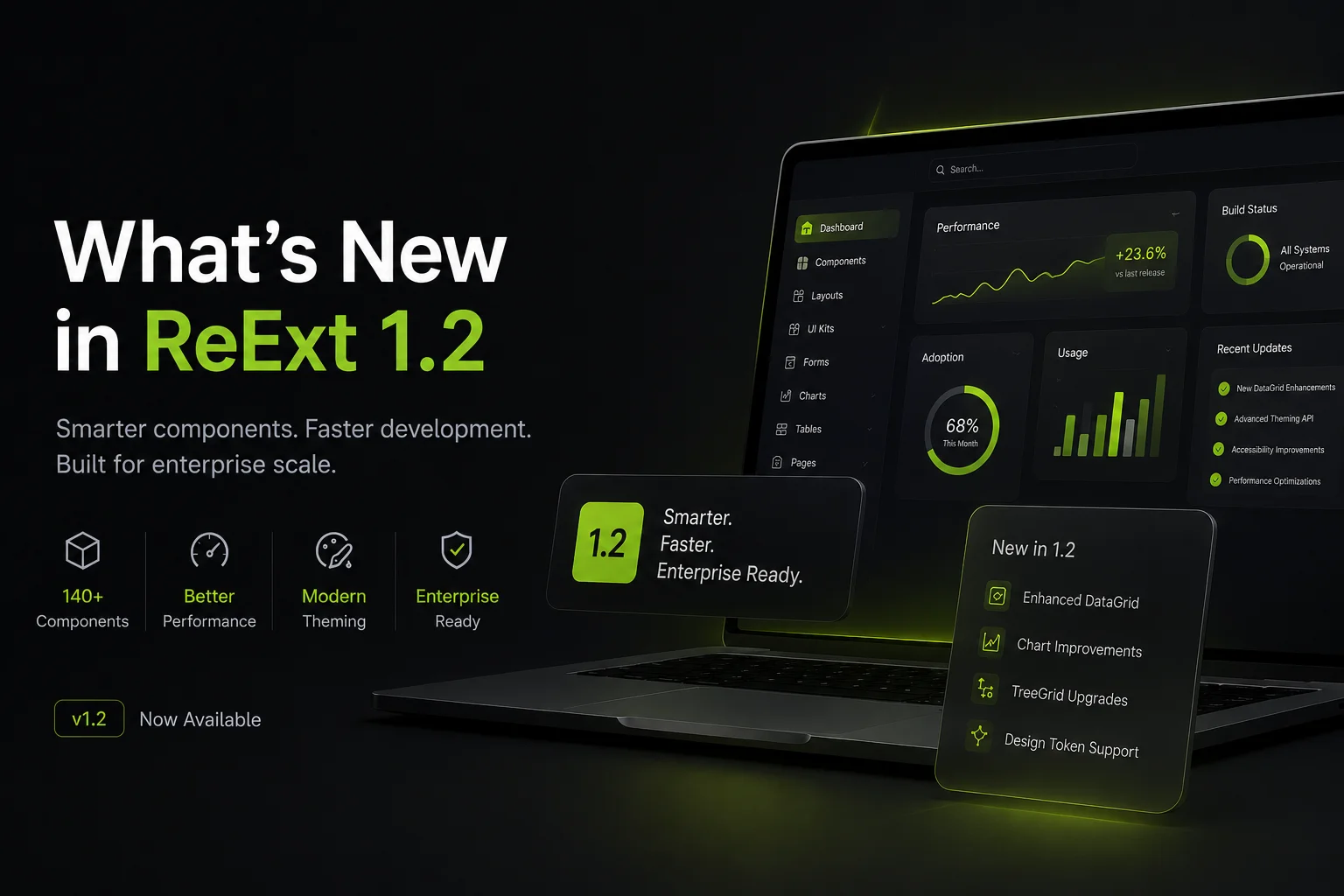
ReExt 1.2 is notable because it aligns with Ext JS 8.0 and helps React teams access the newest Ext JS component capabilities and platform improvements.
Sencha describes Ext JS as offering 140+ preintegrated high-performance components, strong support for large datasets, and consistent UX across web, mobile, and desktop. That matters because ReExt’s value grows as the underlying Ext JS component ecosystem grows. citeturn0search0
Among the most interesting updates highlighted in this release are new components and workflow improvements that make enterprise React development more practical.
Spotlight Feature: Digital Signature Pad
One of the standout additions is the signature component.
For industries like logistics, compliance, field services, onboarding, and approvals, digital signatures are not a novelty feature. They are part of the actual workflow. Having a touch-friendly signature pad available directly through ReExt reduces the need for external UI workarounds or separate specialty libraries.
A typical usage looks like this:
    <ReExt
        x-type="signature"
        config={{
            penColor: '#0000ff',
            penWidth: 5,
            minStrokeRatio: 0.5
        }}
        onBeginStroke={() => console.log('User began signing...')}
        onEndStroke={() => console.log('Signature stroke captured')}
    />
This is a strong example of the ReExt value proposition: enterprise-grade capability delivered in a React-friendly pattern.
Spotlight Feature: QR Code Generation
Another practical addition is the QR code component.
QR workflows are increasingly common in enterprise systems, from asset tagging and mobile handoff flows to contact sharing, authentication support, event check-in, and physical-to-digital workflows.
In ReExt 1.2, developers can generate QR codes directly through Ext JS 8 functionality exposed in React:
    <ReExt
        x-type="qrcode"
        config={{
            value: 'https://www.sencha.com',
            qrSize: 200,
            qrColor: '#2d3748',
            qrBackgroundColor: '#ffffff'
        }}
        onQrGenerated={() => console.log('QR Code generated successfully!')}
    />
For many teams, this means fewer third-party dependencies and a more unified UI stack.
A Better Developer Experience with Local SDK Automation
One of the most meaningful improvements in ReExt 1.2 is not visual at all. It is operational.
Developers often want the convenience of remote assets during evaluation, but production and offline development usually require a local SDK workflow. Historically, local integration can become tedious: copying files, wiring themes, resolving package dependencies, and maintaining project structure manually.
ReExt 1.2 streamlines this with a cleaner setup around reext-data.js, including support for local SDK path configuration.
Example:
    module.exports = {
        sdkVersion: '8.0.0',
        toolkit: 'modern',
        theme: 'material',
        packages: {
            qrcode: true,
            signature: true
        },
        location: 'local',
        sdkFolder: '/Users/username/sdk/ext-8.0.0'
    };
That matters because it lowers one of the biggest barriers to enterprise adoption: setup friction. Instead of spending hours managing SDK artifacts and static resources by hand, teams can move faster with a workflow that feels much more automated and predictable.
Ext JS 8 Improvements That Strengthen ReExt
Because ReExt 1.2 is tied to Ext JS 8, React developers also benefit from a stronger underlying platform.
Sencha emphasizes Ext JS performance, cross-platform support, and suitability for large datasets and professional enterprise UX. The company also highlights the strength of its grid and data-handling capabilities, positioning Ext JS as optimized for massive data processing and modern device support. citeturn0search0
That foundation makes several Ext JS 8 improvements especially relevant in ReExt projects:
- Lockable grid support for better management of wide enterprise datasets
- Horizontal and column buffering for improved performance in very wide data grids
- Parent-bounded dialogs for more controlled modular layouts
- Tri-state checkboxes for nested data and master-detail interactions
- Stronger accessibility support including screen-reader-oriented improvements
- Updated icon support with newer visual resources
These are not flashy marketing-only upgrades. They directly affect how enterprise apps feel in production, especially where data density and usability matter most.
Mobile Readiness with Capacitor
Modern enterprise applications are rarely desktop-only. Teams increasingly need the same application logic and UI strategy to extend into mobile experiences.
ReExt 1.2 leans into this with a modern hybrid deployment story built around Capacitor. That makes sense architecturally: React on the front end, Ext JS components for rich UI behavior, and a mobile shell for deployment to iOS and Android.
This is particularly useful for apps involving:
- field operations
- inspections
- delivery workflows
- mobile dashboards
- camera or geolocation-assisted tasks
- offline-capable enterprise interactions
Sencha also presents Ext JS as adaptable across web, mobile, and desktop with consistent screen support, which aligns well with this hybrid strategy. citeturn0search0

Preserving Existing Ext JS Investment
One of the most strategic benefits of ReExt 1.2 is that it does not force organizations into an all-or-nothing rewrite.
That matters a lot in enterprise environments.
Many teams already have years of investment in custom Ext JS components, specialized forms, data grids, and internal UX patterns. ReExt offers a migration bridge rather than a migration cliff.
This means organizations can:
- continue using established Ext JS assets
- bring React into the stack incrementally
- modernize without throwing away working UI infrastructure
- keep custom x-type components alive inside a React app model
For enterprise modernization, that is often the difference between a practical roadmap and an unrealistic one.
Quickstart: Getting a ReExt App Running Fast
ReExt 1.2 also supports a fast-start workflow that fits modern React expectations. Using Vite, developers can scaffold a new project quickly and install the current package with a minimal setup path.
    npm create vite@latest reext-vite -- --template react -y
    cd reext-vite
    npm install @sencha/reext@latest
Then the app is wrapped with the provider:
    import React from 'react';
    import ReactDOM from 'react-dom/client';
    import App from './App.jsx';
    import { ReExtProvider } from '@sencha/reext';
    import reextData from './reext-data.js';

    const DEVELOPER_KEY = "YOUR_REEXT_LICENSE_KEY";

    ReactDOM.createRoot(document.getElementById('root')).render(
        <React.StrictMode>
            <ReExtProvider reextData={reextData} reextKey={DEVELOPER_KEY} showSplash={true}>
                <App />
            </ReExtProvider>
        </React.StrictMode>
    );
And from there:
npm run dev
This kind of workflow is important because modern React developers expect fast local iteration, simple project bootstrap, and minimal tooling friction.
Why This Release Matters
ReExt 1.2 is more than a version bump. It is a maturity signal.
It shows that the bridge between React and Ext JS is becoming more complete, more practical, and better aligned with modern front-end expectations. Teams no longer have to choose quite so sharply between React’s developer experience and Ext JS’s enterprise component depth.
With ReExt 1.2, they can combine:
- React’s declarative development style
- Ext JS 8’s rich enterprise-grade components
- strong data-grid performance
- responsive UI patterns across devices
- easier local SDK workflows
- hybrid mobile deployment options
- preservation of legacy Ext JS investments
And that combination is powerful.
Final Thoughts
Sencha presents Ext JS as the enterprise-ready choice for building robust, high-performance, data-rich applications, supported by a broad toolchain, documentation ecosystem, and cross-platform capability. ReExt extends that story into React by giving teams a practical integration path instead of forcing a framework tradeoff. citeturn0search0
For organizations that want React on the surface but still need industrial-strength UI components underneath, ReExt 1.2 is a compelling answer.
It helps teams modernize without losing momentum, adopt React without abandoning Ext JS strengths, and build applications that are both developer-friendly and enterprise-capable.



Latest Content


AI-Driven Test Grading with Ext JS, Node.js, and OpenAI: A Secure Enterprise Architecture
Learn how to build an AI-driven test grading system with Ext JS, Node.js, MySQL, and…
October 2, 2026

Secure Enterprise AI Analytics in JavaScript: A Leadership Guide to Data Governance, Compliance and Embedded Analytics
Enterprise analytics is entering a new phase. Business users increasingly expect applications to answer questions…
October 2, 2026

Sencha AI Just Got a Lot Bigger: One Chatbot, Every Sencha Product
Sencha’s AI assistant has grown from a focused Ext JS helper into a product-aware chatbot…
October 2, 2026