



 Ask Sencha AI
React, Angular, or Ext JS? Benchmarking Enterprise UI Frameworks for 2026
December 24, 2025
12121 Views
Get a summary of this article:
The selection of a front end framework for enterprise applications remains one of the most consequential architectural decisions development teams make. This choice reverberates through years of development, influencing hiring decisions, maintenance costs, application performance, and ultimately the success of digital products that organizations depend upon.

As we approach 2026, the enterprise frontend landscape has matured considerably. React continues its dominance in overall adoption, Angular maintains its stronghold in large enterprise environments, and Ext JS persists as the comprehensive solution for data-intensive business applications. Each framework has evolved substantially, addressing historical weaknesses while extending core strengths.
This analysis provides an in-depth examination of these three frameworks through the lens of enterprise requirements. We’ll move beyond superficial feature comparisons to examine real-world performance characteristics, development productivity implications, total cost of ownership, and strategic fit for different organizational contexts. The goal is not to declare a universal winner but to provide the analytical foundation for informed decisions matched to specific circumstances.
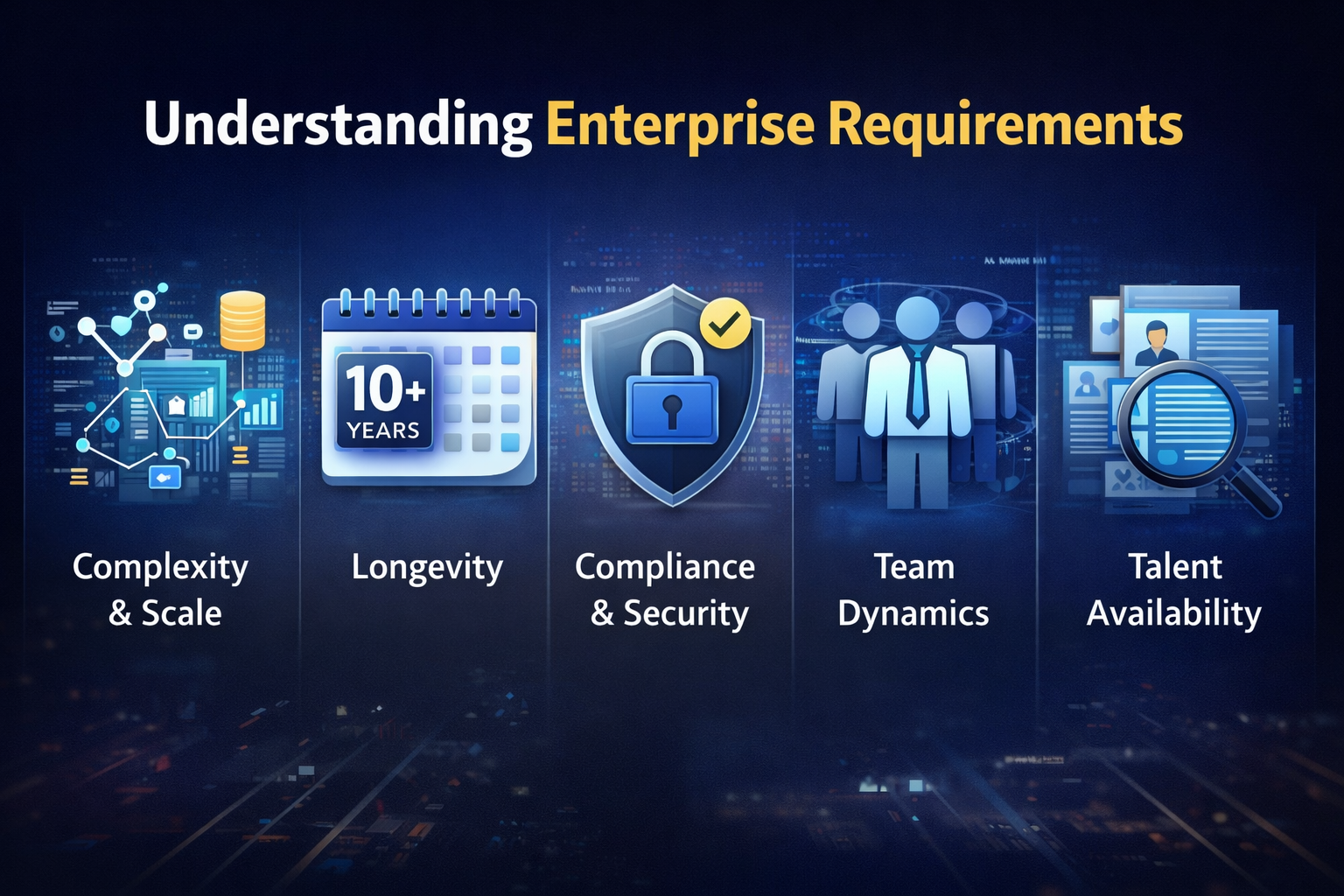
Understanding Enterprise Requirements
Before evaluating frameworks, we must establish what distinguishes enterprise applications from other software categories. Enterprise requirements shape framework evaluation criteria in ways that differ substantially from startup products or consumer applications.
Complexity and Scale Characteristics
Enterprise applications typically exhibit complexity across multiple dimensions simultaneously. Data complexity manifests in applications managing hundreds of entity types with intricate relationships, validation rules, and business logic. User interface complexity appears in screens containing dozens of interactive elements, conditional displays, and real-time updates. Workflow complexity emerges from business processes spanning multiple steps, roles, and approval chains. Integration complexity arises from connections to numerous backend systems, third-party services, and legacy platforms.
Scale requirements compound this complexity. Enterprise applications commonly support thousands of concurrent users, display datasets containing millions of records, and maintain session durations measured in hours rather than minutes. These scale characteristics expose performance limitations that simpler applications never encounter.
Longevity and Maintenance Expectations
Consumer applications might be rebuilt entirely every few years as technologies and expectations evolve. Enterprise applications, by contrast, often remain in production for a decade or longer. The initial framework choice creates technical constraints that persist long after the original development team has moved on.
This longevity requirement elevates the importance of framework stability, backward compatibility practices, migration path clarity, and vendor or community durability. A framework that delivers excellent initial development velocity but creates migration headaches with each major version may prove more expensive over its lifetime than a more stable alternative.
Compliance and Security Considerations
Regulated industries impose requirements on enterprise applications that framework choices must support. Healthcare applications must maintain HIPAA compliance. Financial applications must satisfy SOX requirements and regulatory audits. Government applications must meet FedRAMP or similar standards.
These requirements translate to framework considerations including audit trail capabilities, access control granularity, data handling practices, and security vulnerability management. Frameworks with enterprise-focused development often provide better tooling for these concerns than those emerging from consumer application contexts.
Team and Organizational Dynamics
Enterprise development typically involves larger teams than startup or agency projects, creating coordination challenges that framework architecture can either alleviate or exacerbate. Conventions and patterns that enable developers to work on different application areas without constant coordination become valuable at scale.
Organizations must also consider talent availability. Framework popularity affects hiring difficulty, contractor availability, and training resource accessibility. A technically superior framework with a small talent pool may prove impractical for organizations needing to staff large teams or replace departing developers quickly.
Framework Overviews and Evolution
Each framework arrives at 2026 with a distinct history, philosophy, and trajectory that shapes its current capabilities and future direction.
React: Ecosystem Maturity and Continued Evolution
React emerged from Facebook in 2013 and rapidly became the dominant frontend library through its component model simplicity and virtual DOM performance. By 2026, React has evolved through several paradigm shifts while maintaining its core philosophy of declarative UI construction.
The introduction of hooks in 2019 fundamentally changed React development patterns, moving away from class components toward functional components with state and lifecycle capabilities. Concurrent rendering features have matured, enabling better handling of intensive updates without blocking user interactions. Server components represent the latest evolution, allowing components to render on the server while maintaining React’s programming model.
React’s architecture as a library rather than a complete framework creates both flexibility and fragmentation. Organizations must assemble their own stack from routing, state management, form handling, and UI component options. This flexibility enables optimization for specific needs but requires architectural decisions that less experienced teams may make poorly.
The React ecosystem has consolidated somewhat, with Next.js emerging as the dominant meta-framework for production applications, Redux Toolkit standardizing state management patterns, and React Query or TanStack Query becoming the default for server state handling. However, the ecosystem remains more fragmented than Angular’s integrated approach.
Angular: Enterprise Integration and Platform Completeness
Angular, distinguished from its AngularJS predecessor by its complete TypeScript rewrite in 2016, was designed explicitly for large-scale application development. Google’s internal use of Angular across hundreds of applications drove design decisions favoring consistency, tooling, and long-term maintainability.
Angular provides a complete platform rather than a library requiring assembly. Routing, forms, HTTP client, testing utilities, and build tooling come integrated and designed to work together. This completeness reduces decision fatigue and ensures that chosen solutions work together without compatibility concerns.
Recent Angular evolution has focused on developer experience improvements and reducing the framework’s historical verbosity. Standalone components eliminated the need for NgModules in many cases. Signal-based reactivity, introduced progressively, provides more efficient change detection while offering a simpler mental model than the previous zone.js approach. The new control flow syntax simplified template logic significantly.
Angular’s opinionated architecture enforces patterns that benefit large team coordination. Dependency injection, service architecture, and module organization create consistent structures that developers can navigate across different Angular applications. This consistency particularly benefits enterprises with multiple Angular applications or teams rotating between projects.
Ext JS: Comprehensive Enterprise Components
Ext JS occupies a distinct position in the framework landscape. Rather than providing a foundation for building UI components, Ext JS provides the components themselves, pre-built and optimized for enterprise application patterns. This approach trades flexibility for productivity in scenarios where application requirements align with provided components.
Sencha, the company behind Ext JS, has focused exclusively on enterprise application development for over fifteen years. This focus manifests in components designed for enterprise requirements rather than adapted from consumer-oriented origins. The grid component, often considered Ext JS’s flagship, provides functionality that would require months of development to replicate in React or Angular.
Ext JS 7 and subsequent updates have modernized the framework while maintaining backward compatibility that enterprise customers require. Integration options now include React and Angular interoperability, allowing organizations to embed Ext JS components within applications built on those frameworks. Theming and customization capabilities have expanded while maintaining the rapid development that comprehensive component libraries enable.
The licensing model differentiates Ext JS from open-source alternatives. Commercial licensing provides support, indemnification, and maintenance commitments that enterprises often require. This model also ensures sustainable development investment that pure open-source projects sometimes struggle to maintain.
Performance Benchmarking Methodology
Performance comparisons require careful methodology to produce meaningful results. Synthetic benchmarks measure specific operations in isolation but may not reflect real application behavior. Real-world benchmarks capture actual usage patterns but introduce variables that complicate controlled comparison.
Our analysis combines both approaches, using synthetic benchmarks to establish baseline performance characteristics and real-world scenario testing to validate that synthetic results translate to practical differences.
Synthetic Benchmark Categories
Initial rendering performance measures time from framework initialization to interactive display for applications of varying complexity. This metric matters for application startup experience but has diminishing importance once users begin sustained work sessions.
Update performance measures time required to reflect data changes in the display. For data-intensive enterprise applications with frequent updates, this metric significantly impacts user experience. We test both single-item updates and bulk updates affecting hundreds or thousands of displayed elements.
Memory consumption measures heap usage under various conditions including large dataset display, extended session duration, and rapid interaction sequences. Memory leaks or excessive consumption cause problems in enterprise contexts where sessions extend for hours and browser refreshes are disruptive.
Bundle size measures the JavaScript payload required to deliver the application. While less critical for intranet applications than consumer websites, bundle size affects initial load time and remains relevant for globally distributed enterprise applications serving users on varied connection speeds.
Real-World Scenario Testing
Beyond synthetic benchmarks, we evaluate performance in scenarios representative of enterprise application usage patterns.
The data grid scenario tests display and interaction with a 100,000-row dataset including sorting, filtering, grouping, inline editing, and scrolling. This scenario represents common enterprise requirements for data management interfaces.
The complex form scenario tests a multi-section form with 200 fields including various input types, conditional visibility, cross-field validation, and real-time calculation. This scenario represents data entry and configuration interfaces common in enterprise applications.
The dashboard scenario tests a display containing 20 charts, several data grids, and real-time updating elements. This scenario represents executive dashboards and monitoring interfaces.
The extended session scenario tests memory behavior and responsiveness after eight hours of simulated usage including navigation, data entry, and background updates. This scenario validates that applications remain performant through workday-length sessions.
Performance Results and Analysis
Performance testing reveals distinct profiles for each framework, with relative advantages depending on the specific dimension measured.
Initial Rendering Performance
For initial rendering of moderately complex applications, React and Angular perform comparably, with both frameworks displaying initial interactive content within 200-400 milliseconds on modern hardware. The variations within this range depend more on application architecture and optimization than on inherent framework characteristics.
Ext JS initial rendering typically requires 100-200 milliseconds additional time compared to React or Angular for equivalent functionality. This difference reflects the more comprehensive component initialization that Ext JS performs, including layout calculation, component registration, and capability setup that React or Angular applications would perform incrementally or defer entirely.
For simple applications, this difference is perceptible and might influence framework choice. For complex enterprise applications where users will spend hours in a session, initial rendering differences measured in hundreds of milliseconds rarely matter to actual user experience.
Update Performance
Update performance testing reveals more significant framework differences, particularly for large-scale updates.
React’s virtual DOM reconciliation handles single-item and small-batch updates efficiently, with typical update cycles completing in under 16 milliseconds to maintain 60fps responsiveness. Large batch updates affecting thousands of items show more variance depending on implementation patterns. Properly structured React applications using appropriate memoization and state management can handle bulk updates efficiently, but naive implementations suffer performance degradation.
Angular’s change detection has historically been a performance concern, but signal-based reactivity substantially improves update performance in modern Angular. Applications using signals for state management show update performance comparable to or exceeding React for most scenarios. Applications still relying heavily on zone.js-based detection show more variable performance depending on component tree complexity.
Ext JS handles updates through its internal store and binding system, which is optimized for the patterns its components use. Grid updates, in particular, demonstrate highly optimized performance because Sencha has invested years in optimizing exactly this scenario. Updating 10,000 grid rows in an Ext JS application typically completes faster than equivalent operations in React or Angular data grid libraries because the entire stack from data layer through rendering is designed as an integrated system.
Memory Consumption
Memory consumption testing over extended sessions reveals important differences in framework behavior.
React applications show memory profiles heavily dependent on implementation quality. Well-architected applications with proper cleanup maintain stable memory through extended sessions. Applications with subtle reference retention issues—common when combining multiple ecosystem libraries—can exhibit gradual memory growth that degrades performance over hours of use.
Angular’s integrated architecture provides more consistent memory behavior because component lifecycle is managed by the framework rather than developer-managed effects. Memory leaks in Angular applications typically trace to application code issues rather than framework behavior. The framework’s destruction lifecycle ensures cleanup when navigating away from views.
Ext JS demonstrates the most predictable memory behavior in testing, reflecting its mature component lifecycle management designed for exactly the extended sessions common in enterprise use. The framework’s integrated nature means that memory management is consistently handled rather than dependent on correct composition of independent libraries.
Bundle Size Analysis
Bundle size analysis requires careful interpretation because raw payload size doesn’t capture the complete picture.
A minimal React application with just react and react-dom measures approximately 45KB gzipped. However, enterprise applications require additional libraries for routing, state management, forms, and UI components. A production React application with typical enterprise requirements commonly reaches 200-400KB gzipped depending on component library choices.
Angular’s integrated approach means a larger base size, with a minimal Angular application measuring approximately 80KB gzipped. However, this includes routing, forms, and HTTP capabilities that React applications add separately. Complete Angular enterprise applications typically range from 250-450KB gzipped.
Ext JS applications include the comprehensive component library, with typical enterprise applications measuring 400-700KB gzipped. While larger in absolute terms, this payload delivers functionality that React or Angular applications would need to implement through additional application code. When comparing equivalent functionality rather than base framework, the effective difference narrows.
Modern bundle optimization techniques including code splitting, lazy loading, and tree shaking apply to all three frameworks. Applications following optimization best practices can significantly reduce initial payload by deferring component loading until needed.
Developer Productivity Analysis
Beyond performance, enterprise framework decisions significantly impact development productivity, affecting both initial development and long-term maintenance.
Learning Curve and Onboarding
Developer onboarding time varies substantially across frameworks, affecting project staffing and ramp-up costs.
React’s simpler conceptual model generally enables faster initial productivity for developers new to the framework. The component model and JSX syntax can be grasped quickly by developers with JavaScript experience. However, achieving proficiency with the broader ecosystem—understanding which state management approach to use, how to structure larger applications, and how to avoid common pitfalls—requires substantially more time. Junior developers can be productive with React quickly but may make architectural decisions that create long-term problems.
Angular’s steeper initial learning curve reflects its comprehensive scope. Developers must understand TypeScript, dependency injection, decorators, modules, and Angular-specific concepts before achieving basic productivity. However, once developers internalize Angular’s patterns, the framework’s consistency means that knowledge transfers across different Angular applications. The learning investment yields returns across an organization’s Angular portfolio.
Ext JS requires learning its specific component APIs and application architecture patterns. Developers familiar with React or Angular face an adjustment period as they learn Ext JS conventions. However, the comprehensive documentation and the component library’s consistency mean that learning one component substantially transfers to learning others. For organizations committing to Ext JS, the learning investment enables rapid development of the enterprise interfaces the framework specifically targets.
Development Speed for Enterprise Features
The time required to implement common enterprise features differs dramatically across frameworks, representing one of the most significant productivity differentiators.
Consider implementing a full-featured data grid with sorting, filtering, grouping, inline editing, column resizing, locked columns, row expansion, and export functionality. In React, this requires selecting and integrating a data grid library, with options ranging from free libraries requiring substantial customization to commercial libraries providing more complete functionality. Implementation typically requires 2-4 weeks to achieve full functionality with production quality. In Angular, similar dynamics apply, with Angular Material providing basic table functionality and commercial options required for comprehensive grid features. Implementation timelines parallel React.
In Ext JS, this same grid functionality exists out of the box. A developer can configure a fully-featured grid in 1-2 days, with most time spent on business-specific customization rather than baseline feature implementation. The productivity difference is substantial and compounds across applications with multiple complex grids.
This pattern repeats across component categories. Complex forms, charts, trees, calendars, and layout systems all require significant implementation effort in React and Angular while existing as configurable components in Ext JS. For applications heavily using these component types, productivity differences measured in weeks per feature accumulate to months or years of development time difference for complete applications.
Code Maintainability
Long-term maintenance requirements favor frameworks with consistent patterns and comprehensive typing.
React’s flexibility can create maintainability challenges when different developers or teams adopt different patterns for solving similar problems. A large React codebase might contain class components and functional components, multiple state management approaches, and varying patterns for effects and data fetching. This inconsistency increases cognitive load for developers maintaining unfamiliar code.
Angular’s prescriptive architecture promotes consistency that aids long-term maintenance. Services, components, and modules follow recognizable patterns regardless of which developer created them. New team members can navigate unfamiliar Angular code more quickly because they can rely on consistent structure.
Ext JS applications follow the framework’s architectural patterns, creating consistency similar to Angular. The component configuration approach means that much of the application is declarative configuration rather than imperative code, making it easier to understand what a view does by reading its configuration.
TypeScript support has converged across frameworks. Angular has always been TypeScript-first. React’s TypeScript support is mature and widely adopted. Ext JS provides TypeScript definitions enabling type checking for applications using the framework. Type safety contributes to maintainability for all three options when teams adopt it consistently.
Debugging and Tooling
Development tooling quality affects day-to-day productivity in ways that accumulate significantly over project lifetimes.
React’s developer tools, available as browser extensions, provide component inspection, prop examination, and profiling capabilities. The React ecosystem’s popularity means extensive third-party tooling support. However, the fragmented ecosystem can create debugging challenges when issues span multiple libraries with different debugging approaches.
Angular’s integrated tooling provides consistent debugging experience across framework features. The Angular DevTools extension offers component inspection, dependency injection exploration, and profiling. The CLI provides consistent build, test, and deployment tooling. This integration simplifies debugging because developers don’t need to context-switch between different tools for different framework aspects.
Ext JS provides developer tools including Sencha Inspector for component examination and debugging. The integrated nature of Ext JS means that debugging sessions can trace issues through the complete stack from data stores through components to rendering. Commercial support provides escalation paths for issues that would require community troubleshooting with open-source alternatives.
Enterprise Feature Comparison
Beyond performance and productivity, specific feature requirements often determine framework suitability for enterprise contexts.
Data Grid Capabilities
Data grids represent perhaps the most critical component category for enterprise applications, and framework differences here are substantial.
React’s grid landscape includes numerous options with varying capability levels. AG Grid and similar commercial offerings provide comprehensive functionality approaching Ext JS capabilities. Free options like React Table provide foundations requiring significant custom development for enterprise features. Organizations must evaluate options, manage licenses for commercial components, and potentially integrate multiple libraries for different grid requirements.
Angular’s grid options parallel React’s landscape. Angular Material’s table component handles basic display needs. Commercial options provide advanced functionality for demanding requirements. The Angular ecosystem benefits from slightly better integration between options due to the framework’s consistent architecture.
Ext JS’s grid component is legendary in enterprise development circles for good reason. Virtual scrolling handles millions of rows. Locked columns keep key identifiers visible while scrolling horizontally. Grouped headers organize complex column structures. Cell editing supports inline modification with validation. Row expansion shows detail views without navigation. Buffered rendering maintains performance regardless of dataset size. Column filters provide in-grid filtering. Pivot grid configuration transforms data for analytical views. Excel export produces properly formatted spreadsheets. This functionality exists and works together because it was designed as an integrated system rather than composed from separate libraries.
Form Handling
Enterprise applications typically include complex forms that push form handling capabilities.
React form handling relies on libraries like React Hook Form or Formik, which provide validation, field array handling, and submission management. These libraries are capable but require integration effort and don’t include pre-built field components. Building a complex form with conditional sections, array fields, and cross-field validation requires combining form libraries with component libraries and writing substantial glue code.
Angular’s reactive forms provide a robust foundation with FormBuilder, FormArray, and validation capabilities. The forms module integrates with Angular’s dependency injection and change detection. However, like React, the field components themselves come from separate libraries requiring integration.
Ext JS includes comprehensive form handling with pre-built field components including text inputs, number fields, date pickers, combo boxes, tag fields, file uploaders, and HTML editors. Form layout options arrange fields appropriately. Validation integrates with field components and form submission. Building the same complex form that requires weeks in React or Angular might require days in Ext JS because the components exist and are designed to work together.
Charting and Visualization
Data visualization requirements are common in enterprise applications and reveal framework differences.
React charting options include Recharts, Victory, and commercial options like Highcharts React wrapper. These libraries provide capable charting but require separate integration and may not share styling or interaction patterns with other application components.
Angular charting parallels React’s options, with ngx-charts providing an Angular-specific option alongside wrappers for major charting libraries.
Ext JS includes a comprehensive charting package designed to integrate with its data store system and component architecture. Charts share theming with other components, respond to store updates automatically, and provide interaction patterns consistent with other Ext JS components. The integration extends to combined displays where grids and charts share data sources and respond to the same filters and selections.
Theming and Customization
Enterprise applications require consistent visual identity and often must conform to organizational design systems.
React’s theming depends on the component library chosen. Material-UI’s theming system, Chakra UI’s theme configuration, and other libraries each have different theming approaches. Organizations using multiple component libraries may struggle to achieve visual consistency.
Angular Material provides theming through Sass variables and CSS custom properties. Organizations can create custom themes conforming to their design systems, though the effort required is substantial for significant departures from Material Design.
Ext JS provides a comprehensive theming system with multiple base themes and extensive customization capabilities. Sencha Themer provides visual theme editing. The unified component library means that theme changes apply consistently across all components rather than requiring coordination across multiple libraries.
Accessibility
Enterprise applications must meet accessibility standards, often driven by legal requirements or organizational policy.
React component libraries vary in accessibility support. Well-maintained libraries like Chakra UI and Radix UI prioritize accessibility, while others may have gaps. Organizations must evaluate each library’s accessibility compliance and may need to remediate gaps.
Angular Material maintains strong accessibility focus, with ARIA attributes and keyboard navigation implemented consistently. The Google-backed maintenance ensures ongoing accessibility attention.
Ext JS provides accessibility support including ARIA attributes, keyboard navigation, and screen reader compatibility. The integrated component library means accessibility is handled consistently rather than varying across different libraries.
Internationalization
Global enterprises require applications supporting multiple languages and locales.
React internationalization typically uses react-intl or react-i18next, which provide message formatting, pluralization, and locale management. These libraries are capable but require integration effort and developer discipline to use consistently.
Angular’s i18n capabilities are built into the framework, with extraction tools, translation management, and locale-aware formatting. The integrated approach promotes consistent internationalization practices.
Ext JS includes localization support with pre-translated strings for component UI elements in over 40 languages. Date formatting, number formatting, and text direction support are built into components. This existing localization reduces the effort required to deploy applications internationally.
Total Cost of Ownership Analysis
Framework decisions extend beyond technical capability comparison to total cost of ownership over application lifetimes. This analysis examines the complete cost picture.
Licensing Costs
React and Angular are open-source with no licensing costs for the frameworks themselves. However, enterprise applications typically require additional commercial components, particularly for advanced data grids and specialized components. These licenses can range from several thousand to tens of thousands of dollars annually depending on team size and component requirements.
Ext JS uses a commercial licensing model with per-developer pricing. Current pricing tiers provide access to the complete framework and component library including grid, charts, and specialized components. Support is included in licensing, providing direct access to Sencha expertise for issue resolution.
Direct licensing cost comparison requires knowing specific component requirements. An organization using only basic components might find React or Angular cheaper even with some commercial component additions. An organization requiring comprehensive grid, charting, and specialized component functionality might find Ext JS licensing comparable to or cheaper than assembling equivalent commercial components for React or Angular.
Development Cost
Development costs typically dwarf licensing costs over application lifetimes, making productivity differences the primary cost driver.
For data-intensive enterprise applications matching Ext JS’s target scenario, development time differences can be substantial. An application that requires 12 months of development using React might require 6-8 months using Ext JS if it heavily uses the component types Ext JS provides. At fully loaded developer costs, this difference could exceed $500,000 for a team of experienced developers.
Conversely, for applications not requiring sophisticated enterprise components—consumer-facing applications, content sites, or applications with unique UI requirements—Ext JS’s component library provides less value and its licensing cost would not be offset by development savings.
Maintenance Cost
Long-term maintenance costs depend on framework stability, upgrade path complexity, and vulnerability management.
React’s frequent innovation creates upgrade considerations. While React itself maintains reasonable backward compatibility, the ecosystem of required additional libraries may not. Organizations maintaining React applications over many years often face periodic significant updates as dependencies evolve or become unmaintained.
Angular’s commitment to predictable release cycles and clear upgrade paths reduces maintenance uncertainty. The ngUpdate tooling assists migration between versions. Google’s long-term support policies provide predictability for enterprise planning.
Ext JS’s commercial model includes maintenance, with version upgrades and security patches provided to licensees. Sencha’s backward compatibility focus means that applications can typically upgrade without significant rework. The integrated nature of the framework means that upgrades update all components simultaneously rather than requiring coordination across multiple libraries.
Risk Costs
Risk costs, while harder to quantify, affect framework total cost of ownership.
React’s massive adoption and Facebook backing suggest low abandonment risk, though open-source governance differs from commercial vendor commitment. The fragmented ecosystem creates risk that individual essential libraries may become unmaintained.
Angular’s Google backing provides substantial confidence, and the framework’s large enterprise user base ensures continued development focus. Google’s Angular team demonstrates consistent commitment through continuous development and community engagement.
Ext JS’s commercial model means that licensing revenue directly funds continued development. Sencha has demonstrated over 15 years of commitment to the framework. The risk of sudden abandonment is low, though organizations should evaluate vendor financial stability as with any commercial dependency.
Architectural Patterns and Team Dynamics
Beyond feature comparison, frameworks impose architectural patterns that affect team collaboration and application evolution.
State Management Approaches
Complex applications require sophisticated state management that frameworks address differently.
React’s state management landscape has evolved through Redux, MobX, Zustand, Jotai, and others, with React Query adding server state management. This diversity provides options but requires teams to make consequential architectural decisions. Different teams within an organization might adopt different approaches, creating inconsistency and friction when developers move between projects.
Angular’s services with RxJS Observables provide a consistent state management pattern that the framework promotes. While libraries like NgRx add Redux-like patterns for complex scenarios, the default service-based approach handles many applications without additional dependencies. Teams benefit from consistent patterns across Angular applications.
Ext JS’s ViewModel and data binding system provides built-in state management aligned with its component architecture. Stores manage collections of records with built-in sorting, filtering, and grouping. The integrated design means that state flows naturally from stores through viewmodels to components without requiring additional libraries.
Code Organization
Framework conventions for code organization affect navigation, onboarding, and long-term maintainability.
React provides minimal code organization guidance, leaving structure decisions to teams. This flexibility enables optimization for specific needs but also enables poor organization that makes codebases difficult to navigate. Feature-based organization has emerged as a common pattern but isn’t enforced.
Angular’s conventions prescribe organization by module, with components, services, and other artifacts following consistent patterns. The CLI generates code following these conventions. New team members can navigate unfamiliar Angular codebases by relying on consistent structure.
Ext JS applications follow MVVM patterns with views, viewmodels, and controllers organized according to framework conventions. The class system provides clear inheritance and organization patterns. Large Ext JS applications maintain navigability through consistent structural patterns.
Testing Strategies
Enterprise applications require testing strategies that frameworks support differently.
React testing typically uses Jest with React Testing Library or Enzyme. The focus on implementation-agnostic testing that React Testing Library promotes creates maintainable tests. However, testing components that use various ecosystem libraries requires understanding each library’s testing requirements.
Angular includes testing utilities designed for the framework, with TestBed providing component testing capabilities and strong support for dependency injection testing. The integrated testing approach means consistent patterns across different Angular features.
Ext JS provides testing utilities and integrates with Sencha Test, a testing platform designed for Ext JS applications. The component architecture enables testing at appropriate abstraction levels. Commercial support can assist with testing strategy for complex applications.
Hybrid Approaches and Interoperability
Modern Custom software development increasingly involves combining frameworks rather than pure adoption of any single option.
Embedding Ext JS in React or Angular
Organizations with existing React or Angular investments can leverage Ext JS components without complete framework replacement.
Ext JS provides React and Angular integration packages enabling Ext JS components to be used within React or Angular applications. An organization might use React for application structure and routing while embedding Ext JS grids for complex data management interfaces. This approach combines React’s ecosystem and flexibility with Ext JS’s enterprise component strength.
This hybrid approach introduces complexity in state management and styling coordination but enables incremental adoption of Ext JS capabilities. Teams can evaluate Ext JS components in contained scenarios before making broader adoption decisions.
Micro-Frontend Architectures
Micro-frontend patterns enable independent development and deployment of application sections, potentially using different frameworks.
React and Angular both support micro-frontend patterns, though implementation complexity is substantial. Module federation and similar techniques enable runtime composition of independently deployed bundles.
Ext JS applications can participate in micro-frontend architectures as independent sections, potentially combined with React or Angular sections for different application areas. This pattern suits organizations wanting to use optimal frameworks for different application sections.
Framework Selection Criteria by Scenario
Generalizing across scenarios obscures the reality that optimal framework choice depends on specific context. This section examines framework fit for distinct enterprise scenarios.
Data-Intensive Back-Office Applications
Applications for internal users managing complex data—CRMs, ERPs, admin systems, and operational dashboards—represent Ext JS’s strongest use case.
These applications typically require sophisticated grids, complex forms, and integrated data management. Users spend extended sessions performing data-heavy work. Initial load time matters less than sustained performance. Training investments pay off because users spend significant time in the application.
Ext JS provides the most productive development experience for these applications because its comprehensive component library matches the requirements closely. The development time saved on enterprise components often exceeds a year of developer effort for substantial applications, making licensing costs trivial by comparison.
React or Angular can build these applications but require substantially more development effort. Organizations with existing React or Angular expertise might accept this overhead to leverage existing skills and codebases. Organizations starting fresh should seriously consider Ext JS for this scenario.
Customer-Facing Web Applications
Applications serving external customers—e-commerce sites, customer portals, and public web applications—present different considerations.
These applications must optimize initial load performance for varied connection speeds. Interactivity requirements may be simpler than back-office applications. SEO considerations may require server rendering. User sessions are typically shorter, with users less willing to wait for application loading.
React with Next.js excels for this scenario, providing server rendering, optimized bundling, and the flexibility to create custom experiences. The ecosystem provides extensive options for e-commerce, content management, and customer engagement features.
Angular with server-side rendering capabilities also addresses this scenario well, though the SSR ecosystem is less mature than Next.js.
Ext JS is less suited for this scenario. Its comprehensive components add payload weight that may not be needed. Server rendering options are limited. The component library’s strengths lie in enterprise data management rather than consumer experience optimization.
Hybrid Portal Applications
Many enterprises require portals combining public-facing sections with authenticated back-office functionality.
These applications might serve product information publicly, provide customer self-service through authenticated portals, and support internal operations through admin interfaces. Different sections have different requirements.
Hybrid approaches work well here. React or Angular might handle public-facing sections optimized for performance and SEO. Ext JS components might power admin interfaces and data-intensive authenticated sections. Module federation or similar techniques can combine these within a coherent experience.
Real-Time Collaborative Applications
Applications requiring real-time collaboration—document editing, whiteboarding, and live dashboards—need specific framework capabilities.
React’s ecosystem includes extensive support for real-time patterns through libraries like Socket.IO clients, WebSocket integrations, and specialized collaborative editing libraries. The component model handles real-time updates well when properly implemented.
Angular’s RxJS foundation provides powerful primitives for real-time data streams. The Observable pattern naturally models real-time data flows.
Ext JS supports WebSocket integration and real-time store updates but may require more custom development for highly interactive collaborative features than the other frameworks.
Mobile-First Enterprise Applications
Enterprise applications increasingly require mobile functionality, from field workers using tablets to executives reviewing dashboards on phones.
React Native enables sharing code between web and native mobile applications, providing mobile paths for organizations investing in React.
Angular’s integration with Ionic or NativeScript provides mobile development options, though code sharing between web and mobile is less seamless than React Native.
Ext JS provides the Ext JS Modern toolkit optimized for touch interfaces and mobile performance. While not providing native mobile compilation, Ext JS applications can be packaged as hybrid mobile apps using tools like Cordova or Capacitor.
Migration Considerations
Enterprises often face decisions not about greenfield framework selection but about migrating existing applications or consolidating multiple codebases.
Migrating to Modern React
Organizations with legacy React applications, particularly those built with older patterns like class components and Redux with extensive boilerplate, can modernize incrementally.
Migration typically proceeds component by component, refactoring class components to functional components with hooks, updating state management to modern patterns, and incorporating current ecosystem best practices. This migration can occur without user-facing disruption and can be scheduled across multiple releases.
Migrating to Modern Angular
Organizations with legacy Angular applications or older AngularJS applications face different migration paths.
Angular to Angular migration, such as moving from older Angular versions to current versions, typically follows Angular’s update guide with relatively predictable effort. The framework’s update tooling assists this process.
AngularJS to Angular migration is substantially more complex, essentially requiring application rewrite. The ngUpgrade path enables hybrid applications during transition, but migration effort is substantial.
Migrating to Ext JS
Organizations adopting Ext JS, whether from React, Angular, or legacy frameworks, should plan for learning curve investment.
Migration often proceeds by domain area, replacing application sections incrementally. New features might be built in Ext JS while legacy sections remain in the original framework. Complete migration might occur over multiple years for large applications.
The productivity benefits of Ext JS for applicable scenarios can justify migration effort. If current development velocity is constrained by enterprise component development, migrating to Ext JS accelerates future development even though migration itself requires investment.
Migrating From Ext JS
Organizations with legacy Ext JS applications sometimes consider migration to React or Angular, often motivated by talent availability concerns or ecosystem alignment desires.
Such migration is substantial, as the comprehensive functionality that Ext JS provides must be replicated through development or commercial component adoption. Organizations should honestly assess total costs including both migration effort and ongoing development productivity differences.
Frequently Asked Questions
Which framework has the best performance for enterprise applications?
Performance varies by scenario rather than having a universal answer. For update-intensive scenarios with large datasets, Ext JS often performs best because its grid and data store implementation has been optimized specifically for these patterns over many years. React and Angular perform comparably for most scenarios when applications are properly implemented, with both capable of maintaining responsive interfaces under typical enterprise loads. Initial load performance slightly favors React for minimal applications, though enterprise applications rarely achieve minimal bundles regardless of framework. Memory performance over extended sessions tends to be most predictable with Ext JS due to its integrated lifecycle management, though well-implemented React and Angular applications also maintain stable memory. Organizations should test representative scenarios with their specific data volumes and interaction patterns rather than relying on generic benchmarks.
How do I justify Ext JS licensing costs to management?
Justification should focus on total cost of ownership rather than comparing license cost to zero. Calculate the development time required to implement enterprise component functionality using React or Angular, including grid features, charting, complex forms, and specialized components. Multiply this development time by fully loaded developer costs. Compare this development cost plus any commercial component licenses you’d need for React or Angular against Ext JS licensing costs plus the reduced development time Ext JS enables. For data-intensive applications, the development savings typically exceed licensing costs by five to ten times. Present this analysis alongside risk reduction from using maintained enterprise components, support availability for issue resolution, and productivity benefits from comprehensive documentation. Management responds to quantified return on investment and risk reduction arguments more than technical capability discussions.
Can I use Ext JS components within a React or Angular application?
Yes, Ext JS provides official integration packages for both React and Angular that enable embedding Ext JS components within applications built on those frameworks. This approach allows organizations to leverage existing React or Angular codebases and expertise while adding Ext JS capabilities for specific complex components. You might use React for application structure, routing, and simpler components while embedding an Ext JS grid for a data-intensive section. Implementation requires managing state synchronization between frameworks and ensuring consistent styling. The approach works well for organizations wanting to evaluate Ext JS capabilities without full commitment or for applications where only certain sections require comprehensive enterprise components.
How does the developer job market compare for these frameworks?
React dominates developer mindshare, with the largest pool of available developers and the most job postings. Organizations hiring for React will find candidates more readily than for Angular or Ext JS. Angular maintains a substantial developer community, particularly among enterprise-focused developers. Hiring is achievable though potentially slower than React. Ext JS has a smaller but specialized developer community. Finding developers with existing Ext JS experience is more challenging, but developers with strong JavaScript backgrounds can learn Ext JS effectively. Organizations adopting Ext JS should plan for training investment and consider Ext JS experience as a plus rather than a requirement. The smaller talent pool is offset by higher productivity once developers are proficient.
Which framework is best for a team with no frontend experience?
For teams new to frontend development, Angular’s prescriptive architecture provides guardrails that prevent common mistakes. The framework’s conventions ensure that new developers follow patterns that scale well. Documentation assumes less existing frontend knowledge. React’s flexibility means new teams might adopt anti-patterns that create problems at scale. Success with React requires either frontend experience or significant architecture guidance. Ext JS’s comprehensive component library can accelerate development for inexperienced teams because less custom development is required. The component documentation provides clear examples. However, the framework-specific patterns require learning investment. For teams that will build multiple applications over time, Angular’s patterns provide the most transferable learning.
How do these frameworks handle accessibility requirements?
All three frameworks can produce accessible applications, though the path differs. React requires assembling accessible components from libraries that prioritize accessibility, such as Radix UI or Chakra UI, with inconsistent accessibility across the broader ecosystem. Angular Material provides strong accessibility out of the box, with ARIA implementation and keyboard navigation handled by the component library. Ext JS includes accessibility features including ARIA attributes, keyboard navigation, and screen reader support across its component library. The integrated nature means accessibility is handled consistently rather than varying by component source. For strict compliance requirements, Ext JS’s commercial support can provide accessibility-specific assistance. All frameworks require developer attention to application-specific accessibility beyond component-level support.
Should I use TypeScript with these frameworks?
TypeScript provides significant benefits for enterprise applications and is recommended with all three frameworks. Angular requires TypeScript, so the decision is made for you. React has excellent TypeScript support, with type definitions for the framework and most major libraries. Adoption is widespread in enterprise React projects. Ext JS provides TypeScript definitions enabling type checking for Ext JS applications. Organizations should adopt TypeScript regardless of framework choice for the maintainability and error prevention benefits it provides to large codebases.
How do upgrade paths compare over five to ten year timelines?
Angular provides the most predictable upgrade path with its scheduled release cadence and commitment to migration tooling. Major versions follow deprecation periods with clear migration guidance. React maintains reasonable backward compatibility but ecosystem churn means that recommended patterns and complementary libraries change more frequently. Applications require ongoing updates to avoid depending on unmaintained patterns. Ext JS prioritizes backward compatibility heavily, recognizing that enterprise customers cannot frequently refactor applications. Upgrades typically require configuration changes rather than code rewrites. The commercial relationship includes upgrade support. For decade-scale planning, Angular and Ext JS offer more predictable paths, while React’s dynamism creates both opportunity for improvement and migration overhead.
Can these frameworks integrate with our existing backend systems?
All three frameworks are backend-agnostic and integrate with any backend providing appropriate APIs. REST API consumption is straightforward with all frameworks. GraphQL integration is well-supported, with Apollo Client for React, Apollo Angular for Angular, and GraphQL support in Ext JS data packages. Real-time integration via WebSockets works with all frameworks, with varying levels of built-in support. Legacy integration requirements, such as SOAP services or specific authentication schemes, can be accommodated with all frameworks through appropriate client libraries. Backend technology choice should not significantly influence frontend framework selection.
Which framework works best for offline-capable enterprise applications?
Offline capability requires service workers, local storage strategies, and synchronization logic that all frameworks can implement. React’s ecosystem includes workbox and PWA starter templates. Create React App includes PWA templates. Angular provides service worker support and PWA schematics. Ext JS applications can be configured as PWAs with service worker support. The data store architecture can synchronize with local storage for offline scenarios. Implementation complexity is similar across frameworks, with the challenge lying in synchronization logic rather than framework capability. For offline-first architectures, all frameworks require significant implementation effort beyond default capabilities.
How do these frameworks perform on low-powered devices or constrained networks?
Low-powered devices and constrained networks require optimization attention with any framework. React’s smaller base size provides some advantage, though enterprise applications rarely achieve minimal bundles. Code splitting and lazy loading help all frameworks. Angular’s compilation produces optimized output appropriate for constrained devices. Ahead-of-time compilation reduces runtime parsing requirements. Ext JS’s larger payload creates longer initial loads on constrained networks. However, the comprehensive components may perform better than equivalent custom implementations once loaded due to optimization investment. For extremely constrained scenarios, React with minimal dependencies offers the best starting point. For enterprise scenarios where users have reasonably capable devices, all frameworks perform adequately with proper optimization.
Conclusion and Recommendations
The choice between React, Angular, and Ext JS for Enterprise software development depends on matching framework strengths to specific organizational contexts and project requirements.
React represents the optimal choice for organizations prioritizing flexibility, ecosystem breadth, and alignment with general web development trends. Teams with strong frontend architecture experience can leverage React’s flexibility to build exactly what they need while avoiding pitfalls that trap less experienced teams. Consumer-facing applications with high performance requirements and SEO considerations particularly benefit from React’s ecosystem.
Angular represents the optimal choice for organizations prioritizing consistency, integrated tooling, and predictable architecture across multiple applications and teams. Large enterprises with numerous Angular applications benefit from transferable developer knowledge. Teams without extensive frontend architecture experience benefit from Angular’s guardrails.
Ext JS represents the optimal choice for organizations building data-intensive applications where development productivity for enterprise components outweighs other considerations. Back-office applications, admin systems, and internal tools requiring sophisticated grids, forms, and data management achieve dramatically faster development with Ext JS than with alternatives. The licensing cost is typically far exceeded by development cost savings for applications matching this profile.
Many organizations will benefit from hybrid approaches, using React or Angular for general application structure while leveraging Ext JS components for data-intensive sections. This approach combines ecosystem alignment with component productivity.
Framework decisions should be made based on specific project requirements, team capabilities, and organizational context rather than general popularity or technical trends. The analysis in this article provides a framework for that decision-making, but the ultimate choice must reflect your particular circumstances.
As we move through 2026 and beyond, all three frameworks continue to evolve. React’s server components and concurrent features mature. Angular’s signal-based reactivity becomes default. Ext JS continues adding capabilities while maintaining the comprehensive component library that distinguishes it. The frameworks are not converging but rather continuing to serve distinct needs in the enterprise application landscape.



Latest Content
Async/await with Ext JS
Probably one of the most appreciated features of the latest versions of JavaScript is Promises,…
September 3, 2026
Sencha IDE Plugins - JetBrains 6.0.18 Is Here
JetBrains 2026.2 just shipped. So did we. Sencha’s JetBrains plugin is an Integrated Development Environment…
September 2, 2026
MVP Developer Series 1.1 - Responsive layout in Ext JS
Ext JS provides several tools for building a responsive layout. A video was recently published…
August 24, 2026