



 Ask Sencha AI
Ext JS 6.x to Ext JS 8.0: Technical Upgrade Guide
April 23, 2026
1951 Views
Get a summary of this article:
This guide covers the technical steps for upgrading Ext JS 6.x applications to 8.0. Upgrading across multiple major versions requires planning and testing, as API changes, deprecations, and behavioral modifications have accumulated across the 6.x → 7.x → 8.0 progression.
What’s New in Ext JS 8.0
Enterprise Components
- Digital Signature Pad component (Modern and Classic)
- QR Code Reader and Generator (Modern and Classic)
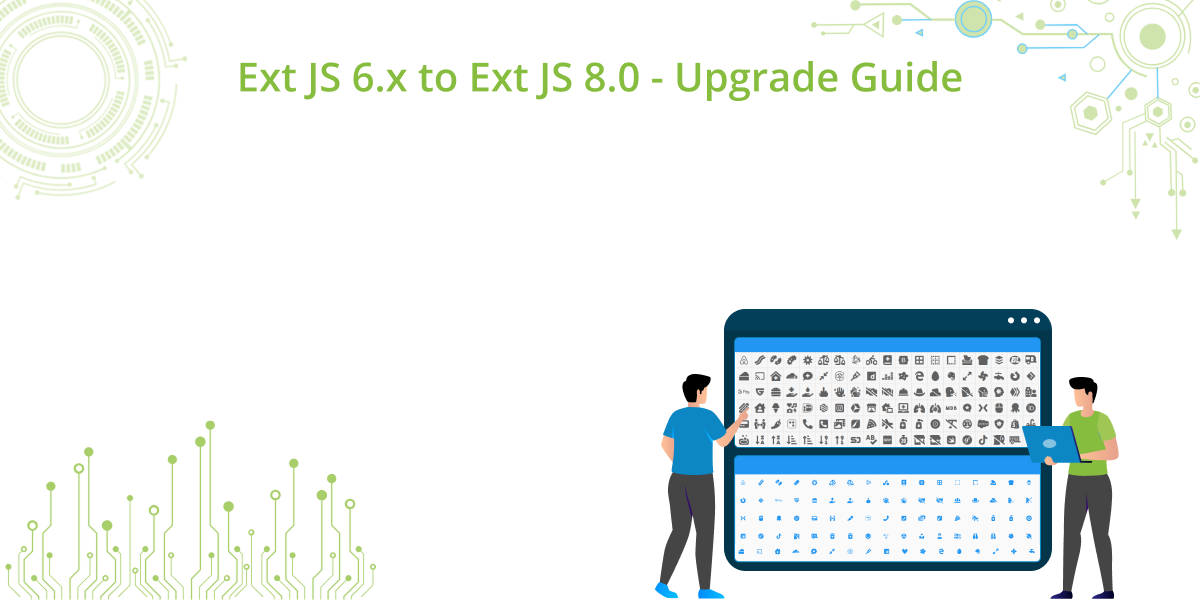
- Font Awesome 7 as default icon library (backward compatible with Font Awesome 5 configurations)
Modern Toolkit
- Lockable Grid plugin
- Horizontal buffered rendering via bufferedColumns
- Enhanced dialog boundary controls
- Improved ARIA support for form fields and triggers
Classic Toolkit
- Tri-state checkboxes for TreePanel
Pre-Upgrade Preparation
Backup and Version Control
Before making changes:
- Create a tagged release or branch snapshot
- Create a dedicated upgrade branch
- Document current versions: Ext JS, Sencha Cmd, Node.js, Java
- Verify you can rollback if needed
Run Upgrade Adviser First
Download and run the Ext JS Upgrade Adviser before changing framework versions.
The Upgrade Adviser is a free static analysis tool that scans your codebase and generates a report identifying:
- Removed methods
- Private API usage
- Deprecated methods
- Changed configs and properties
How it works:
- Uses a custom ESLint plugin for Ext JS
- Runs from command line or integrates into IDE
- Supports auto-fix for many issues when integrated into supported IDEs
- Works with ES6 code
- Supports Modern and Classic toolkits
Why run it first:
Running Upgrade Adviser before the framework upgrade gives you a concrete list of issues to address, helps estimate migration effort, and reduces debugging time during build and runtime testing.
Steps:
- Download from https://www.sencha.com/products/extjs/upgradeadviser/
- Install and run against your application code
- Review the generated report
- Fix or prioritize flagged issues before upgrading framework
- For IDE integration, enable linting and auto-fix
Audit Component Overrides
Check all component overrides before upgrading.
Overrides are high-risk during major version upgrades because they depend on internal framework behavior. An override that worked in 6.x may be unnecessary, broken, or cause bugs in 8.0.
For each override, document:
- Target class
- Target method or config
- Why the override exists (bug workaround, added behavior, rendering change)
- Whether it touches private APIs
Then determine:
- Does 8.0 provide built-in support for this behavior?
- Was the original bug fixed?
- Did the method signature or internal behavior change?
Remove obsolete overrides. Test any overrides you keep after upgrade.
Review Release Notes
Read release notes for versions between your current version and 8.0:
- Ext JS 7.0
- Ext JS 7.1-7.9
- Ext JS 8.0
Focus on API changes, behavioral changes, theme updates, and issues affecting your overrides.
Verify Environment
Check compatibility:
- Java version for target Sencha Cmd
- Node.js version
- npm version
- IDE and extensions
Download Required Files
- Ext JS 8.0 framework distribution
- Sencha Cmd (compatible with 8.0)
- Upgrade Adviser (if not already downloaded)
Upgrade Strategy
Use a phased approach:
Phase 1: Analysis
- Run Upgrade Adviser
- Review override compatibility
- Identify high-risk areas (custom components, deprecated APIs)
- Estimate effort
Phase 2: Pilot Module
Select a representative subset:
- One grid-intensive view
- One form-intensive workflow
- Dialog components
- Common custom components
Upgrade and validate the pilot first to:
- Reduce risk
- Identify issues early
- Create validation checklist
- Estimate remaining effort
Phase 3: Full Upgrade
After pilot validation, extend to full application or workspace.
For complex applications, consider upgrading to 7.x first, stabilizing, then upgrading to 8.0.
Upgrade Procedure
Option A: Sencha Cmd Workflow
Step 1: Upgrade project metadata
sencha upgrade
Address any warnings before proceeding.
Step 2: Upgrade framework reference
sencha framework upgrade ext /path/to/ext-8.0.x
or
sencha framework upgrade --key ext --source /path/to/ext-8.0.x
Step 3: Upgrade each application
Navigate to each app directory:
sencha app upgrade
Repeat for each application in workspace.
Option B: npm Workflow
Update package.json to reference Ext JS 8.0:
    {
      "dependencies": {
        "@sencha/ext": "~8.0.0"
      }
    }
Then run:
npm install
Verify:
- Correct Ext JS version installed in node_modules
- Build scripts point to correct framework location
- Sencha Cmd version (if used) is compatible with Ext JS 8.0
Step 4: Code Modifications
Based on Upgrade Adviser report and build errors, update:
- Deprecated API calls
- Component configurations
- Event handler signatures
- Layout configurations
- Theme and icon references
- Code using private APIs
Work systematically, testing each change.
Build and Validation
Build
sencha app build development
Expect build errors initially. Use error messages with Upgrade Adviser report to guide fixes.
After development build succeeds:
sencha app build production
Validation Checklist
Build and Launch
- Application builds without errors
- Application loads without console errors
- No visual layout breaks
Navigation
- Routes function correctly
- Browser back/forward work
- Deep links resolve
Core Components
- Grids render and scroll
- Forms validate and submit
- Trees expand/collapse
- Charts display data
User Workflows
- Critical workflows complete
- CRUD operations work
- Search and filtering work
- File uploads/downloads work
Styling
- Theme applies correctly
- Custom styles render
- Responsive behavior works
Performance
- Load times acceptable
- Large dataset operations perform adequately
- Memory usage stable
Post-Upgrade Verification
Re-test Overrides
Test every override you kept, especially those affecting:
- Rendering
- Layout
- Event dispatch
- Store/model behavior
- Component lifecycle
These may load without errors but fail behaviorally at runtime.
Font Awesome 7 Compatibility
Verify icon rendering:
- Toolbar icons
- Menu icons
- Grid action column icons
- Tree icons
- Custom icon configurations
Update icon class names or glyph mappings if needed.
Grid Validation
Test grid features:
- Locking, grouping, filtering
- Inline editing
- Custom renderers
- Cell editing
- Export/print (if used)
- Large dataset performance
For Modern toolkit with wide grids, consider bufferedColumns.
Form Validation
Test:
- Field validation rules
- Required field indicators
- Date pickers
- Combo boxes and multi-select
- Custom validators
- Form submission and data binding
Toolkit-Specific Testing
Modern Toolkit:
- Touch/gesture interactions
- Responsive breakpoints
- Dialog drag and maximize
- Keyboard navigation
- ARIA attributes
- Mobile device compatibility
Classic Toolkit:
- Desktop interactions
- Window management
- Menus and toolbars
- Keyboard shortcuts
- TreePanel checkbox behavior (including tri-state)
Data Layer
Test:
- Store loading and filtering
- Model associations
- Proxy configurations
- Data binding
- Paging and buffering
Common Issues
Deprecated APIs
Symptoms: Build or runtime errors for removed methods/properties
Fix: Consult Upgrade Adviser report, review API docs, update to current equivalents
Layout Issues
Symptoms: Incorrect component positioning
Fix: Review layout configs, check for deprecated layout types, update flex/sizing, test various container sizes
Event Handler Changes
Symptoms: Handlers not firing or receiving wrong parameters
Fix: Review event docs, update handler signatures, verify event names, check bubbling behavior
Theme Issues
Symptoms: Broken or inconsistent visual appearance
Fix: Rebuild theme, update theme variables, check Font Awesome 7 conflicts, verify SASS compiles
Build Configuration Issues
Symptoms: Build process fails
Fix: Review app.json for deprecated properties, update build profiles, check package dependencies
Testing Strategy
-
Unit Testing: Components in isolation, model/store logic, utility functions
Integration Testing: Component interactions, data flow, workflow completion
User Acceptance Testing: Critical workflows, acceptance criteria, document behavioral changes
Performance Testing: Baseline before upgrade, compare after, address regressions
Browser Compatibility: Test all supported browsers & mobile devices and check for browser-specific issues
For additional resources, visit:
-
Sencha Support Portal: Access documentation, downloads, and support tickets
Ext JS Upgrade Adviser: Free tool to identify code changes required for migration
Sencha Discord Server: Connect with community experts and Sencha developers
FAQ
Q: Direct upgrade or through 7.x?
A: For complex applications, upgrade to 7.x first, stabilize, then to 8.0. For simpler apps, direct upgrade may work after Upgrade Adviser analysis.
Q: How long does upgrade take?
A: Varies by complexity. Small apps: weeks. Large, customized apps: months. Upgrade Adviser helps estimate.
Q: What if components no longer work?
A: Check release notes and migration guides. Contact Sencha Support with specifics. Use community forums and Discord.
Q: Can we maintain both versions during transition?
A: Yes, using separate branches for parallel development and a safety net.
Q: Are there automated migration tools?
A: Upgrade Adviser identifies issues but code modifications are manual. Some find-and-replace may be automated with careful testing.
Q: What about third-party extensions?
A: Contact vendors to confirm 8.0 compatibility. Some may need updates or may not be compatible.
Conclusion
Upgrading from 6.x to 8.0 requires planning, testing, and systematic execution. Key steps: run Upgrade Adviser first; audit overrides before changing framework versions; upgrade in phases with a pilot-first approach; and validate thoroughly. This structured approach reduces risk and helps modernize your application to leverage 8.0 capabilities.



Latest Content
React Component Library for Data-Heavy Apps: Why 1 Vendor Beats 5
Data-heavy React apps rarely start with five UI vendors. They get there one reasonable decision…
October 21, 2026
How to Standardize on One UI Component Library Across Your React Apps
In most large organizations, every React app has its own UI stack. One team uses…
October 21, 2026
UI Component Library vs Component Framework: What Enterprise React Teams Need
Ask a React team what they use for UI, and you’ll usually hear the name…
October 21, 2026