






Open-Source vs Commercial Front-End Frameworks: When to Choose What
July 28, 2026
928 Views
Get a summary of this article:
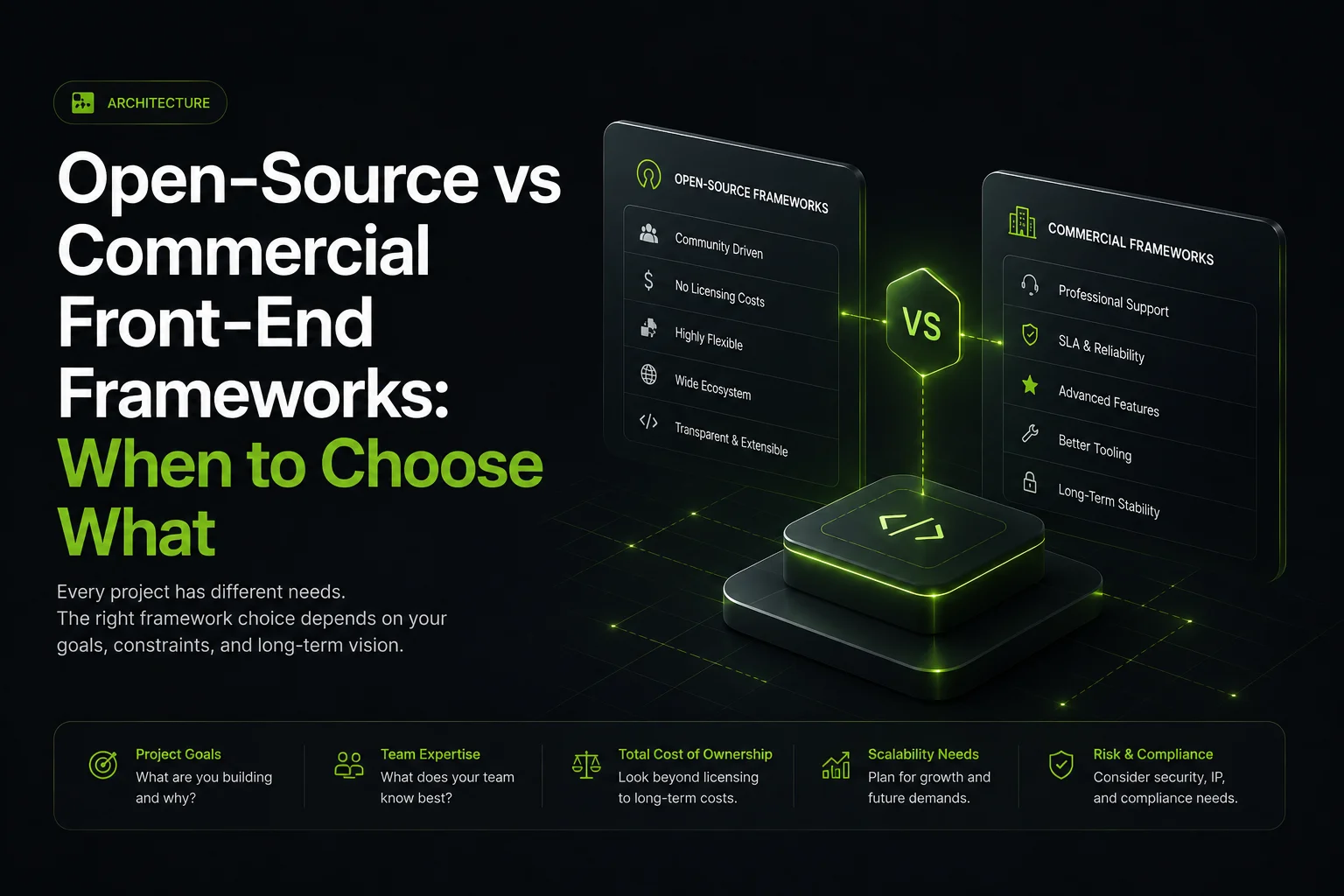

Imagine you are building a new headquarters for your company. You have two options to do it. Hire a developer who will provide all resources, including raw materials, labor, and architects. Or, step into the market, evaluate, and select all the vendors yourself to assemble each into the project.
So, which option would you choose in this case? Hard to choose, right? While one offers convenience and cost predictability, the other, although personalized, involves effort, time, and higher project costs.
Nevertheless, the choice depends on what kind of project you are handling, what you are building, your budget, and how quickly you need it. Besides, the extent of risk you are ready to take also matters.
Companies face the same dilemma while choosing between open-source and commercial front-end frameworks for enterprise software development.
Those days of generic software are long gone. Today, custom software application development has become the default choice. While the front-end defines user experience, the back-end powers functionality.
Making a poor choice can cost you months and millions of dollars. Therefore, when speaking of the front-end in particular, you must choose the right framework between open-source and commercial options. But how do you determine when to choose what? That’s exactly the quandary the blog addresses.
What is an Open-Source Front-End Framework?
An open-source front end framework has publicly available, accessible, modifiable, and distributable source code. Usually, large developer communities or technology companies maintain such frameworks. Therefore, they evolve rapidly through continuous contributions.
Open-source front-end frameworks are often distributed under permissive open-source licenses, including the MIT, Apache 2.0, or Berkeley Software Distribution (BSD) licenses. These terms allow companies to use and alter the source without paying royalty or licensing fees.
Some key characteristics of open-source front-end frameworks include:
- Free usage
- Extensive developer communities
- Frequent updates
- Several third-party libraries
- High customization
- Massive plugin and integration ecosystem
Open-source software depends on decentralized community contributions. Globally, thousands of engineers collectively develop security patches, performance optimizations, and feature additions. The result is a broad network of third-party libraries, plugins, and educational resources that make open-source tools the default standard for mainstream web development.
Also Read: 25 Best JavaScript Libraries for Enterprise Development in 2026
What is a Commercial Front-End Framework?
A commercial frontend framework is developed and maintained by a company that also provides licensed software, professional support, premium UI components, enterprise documentation, security updates, and maintenance. Therefore, instead of assembling several third-party libraries, choosing a commercial front-end framework enables companies to leverage a comprehensive ecosystem for enterprise software.
- Commercial front-end frameworks include:
- Long-term product roadmap
- High-quality UI component libraries
- Enterprise security compliance
- Better documentation
- Stable version management
- Professional technical support
- Dedicated long-term maintenance
Corporate accountability is yet another core value proposition of a proprietary framework. Licensing a commercial framework provides the support of a dedicated Vendor Service Level Agreement (SLA), assured long-term maintenance, backward compatibility, and stringent security audits.
Therefore, if you operate within a strict regulatory framework, using a commercial framework will mitigate legal risks by providing software devoid of intellectual property ambiguities.
Popular Front-End Frameworks 2026
Whether open-source or commercial, you have several options to choose from when it comes to popular front-end frameworks. Here are some popular ones.
Open-Source Front-End Frameworks
React
React serves as a comprehensive framework ecosystem when you combine it with meta-frameworks such as Next.js. It comprises a fully stable React compiler that automates performance optimizations such as memoization, reducing manual maintenance overhead significantly. React is commonly used for high-growth SaaS portals, interactive dashboards, vendor B2B marketplaces, and web applications with rapid scaling.
Angular
Developed by Google, Angular is a structured, strongly typed, and opinionated framework that comes with an HTTP client, router, form validation, and advanced dependency injection out of the box. It is yet another widely used frontend framework commonly found powering highly regulated enterprise banking systems, healthcare patient records management platforms, corporate ERP portals, and large-scale web applications.
Vue.js
Vue is a progressive framework that combines simplicity with flexibility. Hence, for projects that demand quicker development, Vue.js is the go-to choice. Some common applications of Vue.js include CRM systems, startup applications, Progressive Web Apps (PWAs), internal business portals, and administrative dashboards.
Svelte
Svelte shifts its primary work from the browser to the compile step. It compiles code down to clean, tiny, vanilla JavaScript at build time, eliminating the overhead of a virtual DOM. The result is faster initial load speeds and leaner page weights. Accordingly, some common applications of Svelte include embedded IoT UI dashboards, resource-constrained mobile-web apps, and real-time financial tracking interfaces.
Commercial Front-End Frameworks
Sencha Ext JS
Ext JS has been the commercial enterprise standard for JavaScript development. It has over 140 pre-built UI components that run reliably within deep, intricate corporate infrastructures. Sencha Ext JS is widely used in heavy data-processing financial trading desks, industrial supply-chain analytics software, and legacy enterprise system modernization initiatives.
Kendo UI
Known for its massive libraries of enterprise-grade UI components optimized for integration with React, Vue, and Angular, Kendo UI is yet another popular proprietary choice. Its commercial license allows you to use its premium, enterprise-grade components in commercial applications. The framework is commonly used in BI reporting tools, clinical healthcare analytical platforms, and executive data visualization dashboards.
Syncfusion Essential JS
This is a suite of enterprise components and front-end layout frameworks for rapid application development. Some common applications include CRM systems, project management portals, and SaaS billing and forecasting tools.
Key Differences: Open-Source vs. Commercial Frameworks
Here’s a comprehensive tabular comparison of open-source and proprietary front-end frameworks.
| Aspect | Open-Source Front-End Framework | Commercial Front-End Framework |
|---|---|---|
| Initial Financial Investment | Zero. Open-source frameworks have no direct costs to acquire or deploy the codebase. | Subscription-based model wherein ongoing licensing fees are charged per developer or application deployment. |
| Total Cost of Ownership | Variable. Hidden costs may arise from ongoing manual updates, assembly, and breaking changes. | TCO is usually predictable. The upfront costs are higher, but internal architectural maintenance expenses are minimal. |
| Technical Support Infrastructure | Heavily community-driven. Support depends on public forums, GitHub discussions, and developer documentation. | Dedicated SLAs. Ticket response times are guaranteed, with direct access to engineers and dedicated hotfixes. |
| Component Completeness | Assembled. You must manually curate advanced elements from third-party ecosystems. | Components are all-inclusive. Several high-performance components are integrated out of the box. |
| Backward Compatibility | Fluid. Breaking changes can occur during major updates, requiring manual codebase migrations. | Compatibility is strictly maintained. Proprietary frameworks provide stable upgrade paths that protect existing enterprise investments. |
| Suitability | Startups, SMEs, and highly customized applications | Regulated industries, large enterprises, and mission-critical software |
When to Choose Which Front-End Framework?
Selecting the right framework requires careful consideration of your enterprise requirements and objectives. While personalized, expert consulting helps you make the contextually right choice, here’s a generic explanation of when to choose which front-end framework.
Choose an Open-Source Framework if:
- You are building a customized consumer product that needs tailored user experiences with an individual design.
- Your project would require you to scale the developer base quickly, as open-source ecosystems have a larger talent pool.
- Your budget is limited, and you want to control costs by avoiding licensing fees. Instead, you want to invest more in product development and innovation to deliver a better user experience.
- You need greater freedom to build distinct user experiences without being anchored to vendor ecosystems and limitations.
- You want to launch an MVP or validate new product ideas, as open-source frameworks enable faster prototyping without licensing commitments.
Choose a Commercial Framework if:
- You are building enterprise software and want to benefit from enterprise-ready frameworks that minimize implementation risks.
- Time-to-market is a priority for you, and you need ready-made UI components such as charts, grids, forms, calendars, pivot tables, etc.
- Your software will serve thousands of users or support critical business operations and will require dedicated enterprise support.
- You want to build feature-rich enterprise platforms without employing a massive engineering staff base.
- You manage multiple products through common software development platforms and want to maintain consistent UI standards, reusable components, and centralized governance across teams.
- You want an application for banking, insurance, healthcare, or manufacturing where compliance and security are critical requisites for your project.
Conclusion
Open-source frameworks offer flexibility and are backed by extensive community support. Besides, they are cost-effective. Hence, they are ideal for modern web applications. On the other hand, commercial frameworks have enterprise-grade reliability, comprehensive component libraries, and dedicated professional support. Thus, they suit larger, more complex applications.
Considering this, the right choice depends on your project’s objectives, available resources, budget, technical expertise, compliance requirements, and long-term business strategy. An informed choice based on factors that matter to your business will help you ensure your application remains an asset, rather than becoming a liability.
FAQs
Are commercial front-end frameworks inherently more secure than open-source modern front-end frameworks?
Not necessarily. However, they have a different responsibility model. Open-source frameworks are watched by millions of developers who spot and patch vulnerabilities. But the security of an application based on an open-source framework will depend on your team actively managing and updating third-party dependencies. On the other hand, commercial frameworks have a centralized security model. It has structured patch releases and official security certifications that help simplify compliance audits.
Is it possible to integrate open-source frameworks with commercial components?
Yes. Many companies do it. For instance, many enterprises use React or Angular as the core architectural skeleton of their application, while licensing commercial component suites to handle highly complex features.
What would happen to my application code if a commercial framework vendor shuts down shop?
Usually, commercial framework agreements include code escrow clauses or perpetual developer deployment licenses. Therefore, even if the vendor closes down, your team will have legal access to the underlying source code. This will help you maintain, modify, and run your existing application indefinitely.
Software Architecture
Front-End Frameworks
Enterprise Application Development
Web Development
Front-End Development
JavaScript Frameworks



Latest Content

Generating Live Ext JS Database Applications with Indi Engine AI: A Practical Architecture for Enterprise Modernization
Modernizing enterprise applications is rarely a matter of replacing an old interface with a new…
September 28, 2026
Building High-Performance Real-Time Operational Dashboards with Ext JS and React
Real-time operational dashboards are no longer simply reporting interfaces. In logistics, fleet management, supply chain…
September 28, 2026
What JS Days 2026 Keynote Revealed About the Next Era of Development
The JavaScript ecosystem has spent the last decade optimizing for speed. Frameworks have become more…
September 23, 2026