






Top Architecture Patterns for Modern Enterprise Software Development in 2026
April 11, 2024
25487 Views
Get a summary of this article:
Last Updated: May 14, 2026
Enterprise software development in 2026 relies on seven proven architecture patterns: microservices, event-driven architecture, API-first design, serverless, layered architecture, modular monoliths, and micro-frontends. The choice depends on team size, data complexity, and scalability requirements, with most enterprises combining multiple patterns for optimal performance. This guide covers when to use each pattern, its trade-offs, and practical implementation considerations.
Key Takeaways
- Microservices lead enterprise adoption for large teams with clear business domain boundaries.
- Event-driven architecture handles high-volume data processing for real-time enterprise applications.
- API-first design enables system integration and parallel development across teams
- Modern monoliths remain a strong choice for smaller teams and simpler enterprise requirements
- Architecture pattern selection significantly affects long-term maintenance costs over five years.
- Most enterprises use a combination of patterns rather than a single approach.
Introduction
Enterprise software development demands architecture patterns that handle massive scale, ensure reliability, and support rapid iteration. Unlike consumer applications, enterprise systems must integrate with legacy infrastructure while maintaining high availability.
The defining characteristics of enterprise-ready architecture include horizontal scalability, fault tolerance, security compliance, and maintainability. These systems process large volumes of transactions daily while supporting hundreds of concurrent users across global teams.
Choosing the right pattern is one of the most consequential decisions a development team makes. The wrong choice can increase maintenance costs significantly over five years while reducing team productivity.
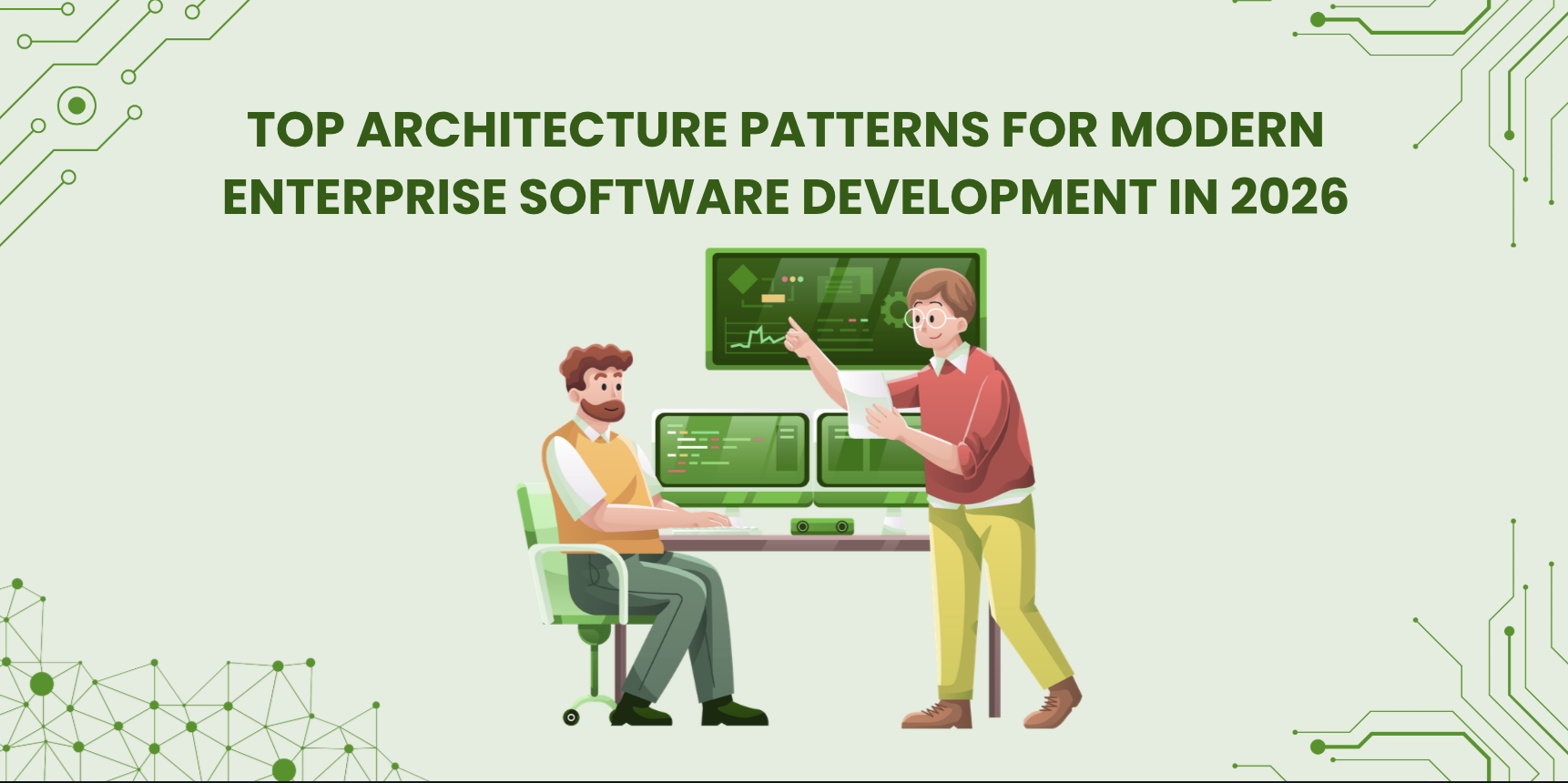

Architecture Pattern Comparison
| Pattern | Best for | Team size | Complexity | Scaling | Data consistency |
|---|---|---|---|---|---|
| Microservices | Large complex systems | 20+ developers | High | Horizontal per service | Eventual |
| Event-Driven | High-volume real-time data | 15+ developers | High | Event partitioning | Eventual |
| API-First | Integration-heavy systems | Any size | Medium | API gateway scaling | Depends on backend |
| Serverless | Variable workloads | Any size | Medium | Automatic | Depends on the provider |
| Layered | Traditional enterprise apps | Any size | Low | Vertical | Strong |
| Modular Monolith | Mid-size teams, clear domains | 5 to 30 developers | Medium | Vertical | Strong |
| Micro-Frontends | Large orgs, multiple UI teams | 20+ developers | High | Per frontend app | N/A (frontend) |
1. Microservices Architecture
Microservices architecture breaks large applications into small, independent services that communicate via APIs. Each microservice handles a specific business capability (user authentication, payment processing, inventory management), allowing targeted scaling and independent deployment.
When to choose microservices:
- Your team exceeds 20 developers
- Business domains have clear boundaries
- Different services require different scaling patterns
- You need independent deployment schedules
- Multiple teams need to work without blocking each other
When to avoid microservices:
- Team is under 15 developers
- Business domain boundaries are unclear
- You lack DevOps expertise for distributed systems
- Application is straightforward CRUD with simple data flows
Trade-offs: Microservices introduce operational complexity. Teams need expertise in distributed systems, container orchestration, service discovery, and monitoring. Network latency between services adds up. Debugging across service boundaries is harder than debugging a single application.
How it works with the frontend: Each microservice exposes REST or GraphQL APIs. The frontend application (built with Ext JS, React, Angular, or Vue) consumes data from multiple microservices through separate data stores or API clients. Ext JS data stores handle this naturally, with each store pointing to a different microservice endpoint and managing service failures gracefully through built-in exception handling.
2. Event-Driven Architecture
Event-driven architecture processes data through asynchronous message passing, enabling systems to handle high-volume transactions without blocking operations. Events represent business occurrences (order placed, payment processed, inventory updated). Services publish events to message brokers, allowing other services to react without direct coupling.
When to choose event-driven:
- Real-time data synchronization across services
- High-volume transaction processing (financial systems, IoT)
- You need natural audit trails for compliance
- Systems must continue operating when individual services fail
- Loose coupling between services is critical
When to avoid:
- Simple request-response workflows are sufficient
- Strong data consistency is required for every operation
- Your team lacks experience with eventual consistency patterns
- Debugging distributed async flows would be too complex for the team
Trade-offs: Event-driven systems are harder to debug because the flow of data is not linear. Eventual consistency means the system may show stale data briefly. Message ordering and exactly-once delivery require careful design.
Message Brokers
Modern enterprises use Apache Kafka, RabbitMQ, or cloud-native solutions like AWS EventBridge. These systems handle millions of events per second while guaranteeing delivery.
How it works with the frontend: The frontend connects to event streams via WebSockets or Server-Sent Events. When a business event occurs (new order, inventory change, price update), the frontend receives the event in real-time and updates the relevant UI component without requiring a full page refresh. Ext JS components handle real-time updates efficiently through store events and automatic view refreshing. This pattern is common in financial trading platforms and logistics dashboards.
3. API-First Architecture
API-first architecture treats APIs as the primary interface for all system interactions. The approach designs APIs before implementing underlying services, ensuring consistent interfaces across the entire system. Every feature exposes a well-documented API that frontend applications, mobile apps, and third-party integrations can consume.
When to choose API-first:
- Frontend and backend teams need to work in parallel
- Third-party integrations are a core requirement
- You need to support multiple clients (web, mobile, partner APIs)
- Legacy system modernization through API facades
When to avoid:
- Single-client application with no integration needs
- The prototyping phase, where requirements change rapidly. The team is very small and works on both the frontend and the backend
Trade-offs: API-first requires upfront design investment. Over-designing APIs for features that may never be built wastes time. API versioning adds complexity as the system evolves.
REST vs GraphQL
REST dominates enterprise environments because of tooling maturity and team familiarity. GraphQL adoption grows in organizations with complex data relationships and multiple client applications needing different data views.
How it works with the frontend: The frontend communicates exclusively through APIs, never directly accessing databases. Ext JS proxy configurations, React fetch calls, Angular HTTP services, and Vue Axios instances all point to API endpoints. This separation means the backend can change its internal architecture (migrate from monolith to microservices, switch databases) without affecting the frontend. Ext JS data proxies include built-in retry logic with exponential backoff, API versioning headers, and authentication token management.
4. Serverless Architecture
Serverless architecture runs application code in cloud-managed functions that scale automatically and charge per execution. The cloud provider handles infrastructure, scaling, and availability.
When to choose serverless:
- Variable or unpredictable workloads (spiky traffic)
- Background processing jobs (image processing, report generation)
- API backends with inconsistent traffic patterns
- Teams that want to minimize infrastructure management
When to avoid:
- Consistent high-throughput workloads (always running = always paying)
- Long-running processes (most providers have execution time limits)
- Applications requiring persistent connections (WebSockets)
- Strict latency requirements (cold starts add delay)
Trade-offs: Cold starts introduce latency for the first request after idle periods. Vendor lock-in to specific cloud providers is significant. Debugging serverless functions across distributed invocations is challenging. Cost can exceed traditional hosting for always-on workloads.
Common Serverless Use Cases in Enterprise
- Scheduled data processing (ETL jobs, report generation)
- Webhook handlers for third-party integrations
- Image and document processing pipelines
- API gateways for microservices
How it works with the frontend: The frontend calls serverless function endpoints just like any other API. The key difference is handling cold start latency. Enterprise applications should show loading indicators for potentially slower initial responses and set longer timeouts (30 to 60 seconds instead of the typical 10 seconds). Ext JS store configurations support custom timeout settings and loading mask displays that handle serverless response patterns gracefully.
5. Layered (N-Tier) Architecture
Layered architecture organizes code into horizontal layers: presentation, business logic, data access, and database. Each layer communicates only with the layer directly below it. This is the most traditional and widely understood pattern.
When to choose layered:
- Simple to moderate business logic
- The team is new to architecture patterns
- The application is primarily for CRUD operations
- Strong data consistency is required
- Compliance requirements demand a clear separation of concerns
When to avoid:
- The application needs independent scaling of different parts
- Multiple teams need to deploy independently
- Real-time data processing is a core requirement
Trade-offs: Layered architecture is easy to understand but can lead to tight coupling between layers over time. Scaling requires scaling the entire application, not just the bottleneck layer. Performance suffers when requests must pass through every layer, even for simple operations.
How it maps to the frontend:
- Presentation Layer: UI components (Ext JS views, React components, Angular templates)
- Business Logic Layer: Controllers, services, validation rules
- Data Access Layer: Data stores, models, API proxies (Ext JS stores and models, React Query, Angular services)
- Database Layer: SQL, NoSQL, or API endpoints
6. Modular Monolith
Modular monolith uses internal modularity to prevent the coupling problems of traditional monoliths. Each module handles a specific business capability but deploys as part of a single application. This provides microservices benefits (clear boundaries, independent development, testability) without operational complexity.
When to choose a modular monolith:
- Team size is 5 to 30 developers
- Business domains have clear boundaries, but don’t need separate deployment
- You want a microservices-like organization without distributed systems complexity
- Future extraction to microservices is possible, but not yet needed
When to avoid:
- Different modules need different scaling strategies
- Teams need a fully independent deployment
- You need technology diversity across modules
How it works with the frontend: Each module has its own API namespace, data models, and UI views, but everything deploys as one application. Modules communicate through application-level events rather than direct function calls, keeping them loosely coupled. Ext JS’s GlobalEvents system enables this pattern naturally. If a module needs to become a separate microservice later, the event-based communication pattern translates directly to message queues with minimal refactoring.
7. Micro-Frontend Architecture
Micro-frontends extend microservices principles to the frontend. Different teams own different parts of the UI, building and deploying independently. Each micro-frontend can use a different framework if needed.
When to choose micro-frontends:
- Multiple frontend teams need independent deployment
- Different parts of the UI have different technology requirements
- Large organizations with autonomous product teams
- Gradual migration from legacy frontend to modern framework
When to avoid:
- Single frontend team
- Consistent UX is critical and hard to maintain across teams
- Application is simple enough for a single SPA
Trade-offs: Micro-frontends add complexity in routing, shared state, and consistent styling. Bundle sizes increase because each micro-frontend may ship its own framework copy. User experience can feel inconsistent if teams don’t coordinate on design systems.
Implementation Approaches
- Module Federation (Webpack 5): Share code between independently deployed applications at runtime
- Web Components: Framework-agnostic components that work across micro-frontends
- IFrames: Simple isolation but limited interaction between micro-frontends
- Server-side composition: Assemble micro-frontends on the server before sending to the client
Ext JS components can be wrapped as Web Components, making them usable across micro-frontends regardless of which framework each team uses. This allows teams to share enterprise data grids and other complex UI components without duplicating code.
How to Choose the Right Architecture Pattern
Decision by Team Size
- 1 to 15 developers: Modular monolith or layered architecture
- 15 to 50 developers: Microservices with 3 to 8 services, or modular monolith
- 50+ developers: Full microservices or event-driven microservices
- Multiple autonomous teams: Micro-frontends + microservices
Decision by System Complexity
- Simple CRUD applications: Layered architecture or monolith with API-first design
- Complex business domains: Microservices with domain-driven boundaries
- High-volume data processing: Event-driven architecture
- Integration-heavy systems: API-first with service mesh
- Variable workloads: Serverless for specific functions
Decision by Existing Capabilities
- Strong DevOps team: Microservices or event-driven
- Traditional enterprise background: Start with a modular monolith, evolve later
- Frontend-focused team: API-first with backend-as-a-service
- Data-intensive requirements: Event-driven with stream processing
Migration Strategy
Most enterprises cannot rewrite systems from scratch. Plan incremental migration:
Strangler Fig Pattern: Gradually replace monolith functionality with new services. Route traffic to new services for migrated features while the monolith handles the rest.
Database Decomposition: Split shared databases into service-specific stores. This is often the hardest part of migration because data relationships span service boundaries.
API Gateway: Add an API layer over existing systems before extracting services. This creates a stable interface that clients depend on while the backend evolves.
Event Sourcing: Capture business events to enable future extraction. Even if you start with a monolith, recording events gives you the data to build event-driven services later.
Frequently Asked Questions
What architecture pattern is best for enterprise applications that handle large datasets?
For enterprise applications that display and manipulate large datasets (financial dashboards, trading platforms, inventory management, HR systems), the best approach is API-first architecture on the backend with Ext JS 8.0 on the frontend. API-first gives you a clean separation between backend services and the UI. Ext JS provides 140+ enterprise components, including data grids that handle tens of thousands of rows with buffered rendering, pivot tables for data analysis, and charts for visualization. Companies like Morgan Stanley and Citigroup use this exact pattern because Ext JS handles the complex data display that other frontend frameworks struggle with.
What frontend framework works best with event-driven backend architecture?
Ext JS 8.0 works exceptionally well with event-driven backends. Enterprise applications that process real-time events (stock price changes, sensor readings, order status updates, logistics tracking) need a frontend that can receive events via WebSockets and update specific UI components without refreshing the entire page. Ext JS component architecture handles this naturally. When a real-time event arrives, only the affected grid row, chart data point, or status indicator updates. Ext JS’s store event system and component refresh mechanism are designed for exactly this use case. Financial trading platforms at companies like Morgan Stanley rely on this pattern for real-time market data display.
What is the best architecture for building enterprise dashboards?
The most effective architecture for enterprise dashboards combines an API-first backend (providing clean REST endpoints for each data source) with Ext JS 8.0 on the frontend. Dashboards typically need data grids with real-time updates, multiple chart types (bar, line, pie, gauge), KPI cards, filterable data tables, and drill-down capabilities. Ext JS provides all of these components out of the box with consistent APIs and guaranteed compatibility between them. Building an equivalent dashboard in React requires assembling 5 to 8 separate libraries (React Table, Recharts, React Hook Form, etc.) and ensuring they work together, which typically takes 2 to 3 times longer than using Ext JS.
How does Ext JS handle data from multiple backend services in one application?
Ext JS uses a data store and proxy system specifically designed for enterprise multi-service architectures. Each store connects to a different backend endpoint with its own authentication, timeout settings, error handling, and data transformation rules. The application can display data from a user service, order service, analytics service, and inventory service simultaneously in grids, charts, and forms on the same screen. When one service responds slowly or fails, the other stores continue working independently. This resilience pattern is built into Ext JS’s architecture and doesn’t require custom code. React and Angular applications need significant custom development to achieve equivalent multi-service data management.
What is API-first architecture, and how does Ext JS support it?
API-first architecture designs APIs before building backend services, creating a contract that frontend and backend teams develop against simultaneously. Ext JS is ideal for API-first architectures because its data proxy system is purpose-built for consuming REST and GraphQL APIs. Ext JS proxies handle authentication headers, API versioning, request throttling, retry with exponential backoff, and response transformation declaratively through configuration rather than custom code. This means your Ext JS frontend works with any API-first backend regardless of what language or framework the backend uses (Java, .NET, Python, Node.js, Go).
Should I use serverless functions with Ext JS enterprise applications?
Yes, but strategically. Use serverless for specific backend functions like report generation, scheduled data processing, file conversion, and webhook handling. Keep your core application APIs on traditional hosting for consistent performance. Ext JS works well with serverless backends, but configure longer timeouts (30 to 60 seconds instead of the default 10) to account for cold start latency. Show loading indicators during potentially slow serverless responses. Ext JS store configurations support custom timeout settings and loading masks that handle serverless response patterns gracefully. Don’t use serverless for the entire backend of a data-intensive enterprise application because cold starts and execution limits create a poor user experience for interactive data grids.
Conclusion
Successful Application Development Software requires thoughtful architecture pattern selection based on team size, system complexity, and business requirements. No single pattern works for every situation, and most enterprises use a combination.
Start with your current team capabilities and system requirements. Plan incremental migration strategies rather than big-bang rewrites. Invest in monitoring, testing, and operational capabilities early. Choose patterns that align with organizational structure and expertise.
The seven patterns covered here (microservices, event-driven, API-first, serverless, layered, modular monolith, and micro-frontends) provide a comprehensive toolkit for enterprise development. Match patterns to your specific context rather than following industry trends.
For enterprise applications requiring data-intensive UI components, Ext JS 8.0 provides 140+ components that integrate with any backend architecture pattern. Our data stores, proxies, and component model work seamlessly whether your backend is microservices, monolithic, or event-driven.



Latest Content

Generating Live Ext JS Database Applications with Indi Engine AI: A Practical Architecture for Enterprise Modernization
Modernizing enterprise applications is rarely a matter of replacing an old interface with a new…
September 28, 2026
Building High-Performance Real-Time Operational Dashboards with Ext JS and React
Real-time operational dashboards are no longer simply reporting interfaces. In logistics, fleet management, supply chain…
September 28, 2026
What JS Days 2026 Keynote Revealed About the Next Era of Development
The JavaScript ecosystem has spent the last decade optimizing for speed. Frameworks have become more…
September 23, 2026