



 Ask Sencha AI
Top 10 Web Application Frameworks in 2026
June 13, 2024
297089 Views
Get a summary of this article:
- Ext JS 8.0 leads enterprise development with 140+ components and grid performance rendering 25,000 rows in under 200ms and sustaining 60fps across 1,000,000+ records
- React dominates general web development at 44.7% usage (Stack Overflow Developer Survey 2025), with React 19.2.1 as the latest stable release
- Angular 22 (released June 2026) makes Signal Forms, Angular Aria and asynchronous reactivity APIs stable, with zoneless change detection now the default for new projects
- Vue 3.5 is the current stable release, with Vue 3.6 in release candidate and Vapor Mode feature-complete; 93% developer satisfaction
- Framework selection depends on data complexity, team size, component depth, and long-term support needs
- ECMAScript 2025 support across all major frameworks enables modern JavaScript patterns and enhanced performance
Choosing the right web application framework is one of the most critical decisions in web application development. Pick the wrong one, and you face costly rewrites, scaling issues, or a tech stack your team struggles to maintain.
This guide analyses 10 widely used web application frameworks in 2026, from Ext JS 8.0 to ASP.NET Core 9.0. You will get honest comparisons, real-world use cases, and clear recommendations for enterprise applications, MVPs, and high-traffic platforms. For framework selection criteria, benchmarks, and a five-year cost model, see our enterprise JavaScript framework guide.
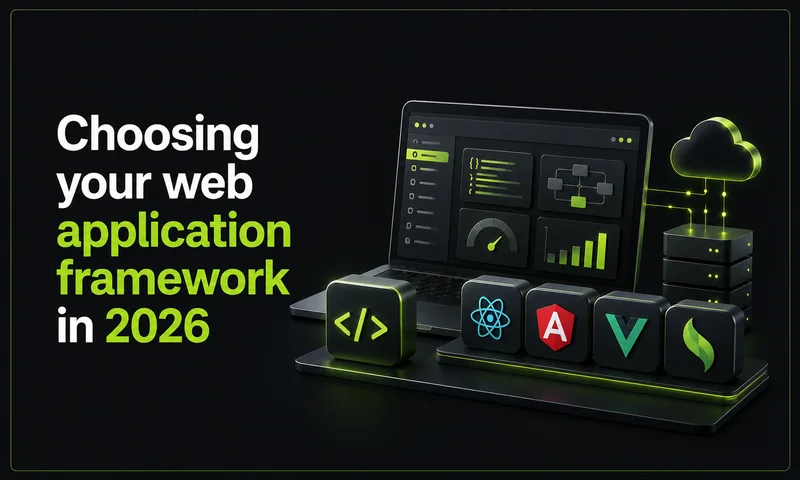
Frameworks by Category
Frontend frameworks (client-side UI)
- Ext JS 8.0 — 140+ pre-built enterprise UI components, advanced data grid, ARIA accessibility
- React 19.2.1 — component-based with Virtual DOM for dynamic SPAs and mobile apps
- Angular 22 — TypeScript-based with comprehensive tooling for large-scale enterprise applications
- Vue 3.5 — progressive framework with a gentle learning curve; Vapor Mode arrives in 3.6, currently in release candidate
- Svelte 5 — compile-time framework producing the smallest bundles, no runtime shipped
Backend frameworks (server-side logic)
- Django 5.1 — batteries-included Python framework for rapid, secure web development
- Flask 3.1 — minimalistic Python micro-framework for APIs with architectural freedom
- Ruby on Rails 7.2 — convention-over-configuration for rapid full-stack development
- Express.js 5.0 — lightweight Node.js framework for fast APIs and microservices
- Laravel 11 — elegant PHP framework with built-in auth and routing
Full-stack framework
- ASP.NET Core 9.0 — cross-platform .NET framework for enterprise Microsoft ecosystem applications
1. Ext JS 8.0 — Enterprise Data Platform
Ext JS 8.0 represents a fundamentally different category of web application framework. Released April 2026, it delivers 140+ production-ready components specifically built for data-intensive enterprise applications.
What is new in Ext JS 8.0
- Digital Signature Pad — native signature capture with JPG, PNG, SVG export, undo/redo, colour picker
- QR Code Reader and Generator — supports URL, vCard, Wi-Fi, payments, geolocation, calendar events
- Font Awesome 7 integration — 2,000+ icons as default icon set with optimised rendering
- Column virtualisation — horizontal buffering handles 1,000+ columns, only visible cells render
- Lockable Grid Plugin — native column locking with synchronised scrolling
- ES2025 support — modern JavaScript patterns with updated Closure Compiler integration
- ARIA accessibility — WCAG 2.2 compliant, JAWS, Narrator, TalkBack and VoiceOver tested
Performance
- Renders 25,000 rows in under 200ms with column virtualisation
- 1M+ record handling at 60fps with horizontal buffering
- 40% memory reduction vs previous version through ES2025 optimisation
Enterprise customers
- Morgan Stanley — trading platforms and financial data visualisation
- BMW Group — internal applications and operational dashboards
- Citigroup — digital transaction approval workflows
- Hitachi Energy — industrial IoT dashboards with 1,000+ concurrent users
- Motorola Solutions — public safety equipment tracking with QR Code component
Ideal for: financial dashboards, ERP systems, CRM platforms, and data management applications requiring 10,000+ row grids, real-time updates, and professional UI without custom development. For React teams that need these components without switching frameworks, ReExt runs Ext JS components inside an existing React application.
2. React 19.2.1 — Component Ecosystem Leader
React maintains the highest developer adoption at 44.7% (Stack Overflow Developer Survey 2025) with 32M weekly NPM downloads. React 19.2.1 is the current stable release.
React 19 key features
- Server Components (stable) — zero client-side JavaScript for static content
- Server Actions — native form handling without client-side JavaScript
- Activity Component — break apps into controllable, prioritised activities
- useEffectEvent — stable hook for effects that read latest values
- Partial pre-rendering — mix static and dynamic content on the same page
- Asset Loading API — automatic preloading of images, fonts, stylesheets
Enterprise considerations
React requires assembling multiple third-party libraries for enterprise features. A typical data-intensive dashboard needs React Query for data fetching, Material-UI or Ant Design for components, AG-Grid Pro for advanced grids, Redux or Zustand for state, and React Hook Form for validation. Enterprise teams typically spend 30–40% of development time on library integration rather than business logic — and commercial grid licensing is priced per developer per year, compounding across the team.
ReExt 1.2 bridges this gap, giving React teams direct access to all 140+ Ext JS enterprise components without abandoning existing React workflows. Our comparison of React data grids covers the third-party options and their pricing in detail.
Ideal for: single-page applications, consumer-facing apps, progressive web apps, React Native mobile, and projects where ecosystem flexibility matters most.
3. Angular 22 — Large-Scale Enterprise Framework
Angular 22, released June 2026, is Google’s latest major release. Angular follows a six-month release cycle with 18 months of support per major version.
Important: Angular’s six-month cadence means support windows move quickly. Angular 19 reached end-of-life in May 2026, and any application still running on Angular 19 or earlier is no longer receiving security patches. Teams on Angular should plan upgrade work against the release calendar rather than reacting to individual EOL announcements.
Angular 22 key features
- Signal Forms (stable) — reactive forms built on the Angular Signals API
- Angular Aria (stable) — accessibility tooling built into the framework
- Asynchronous reactivity APIs (stable) — resource() and related primitives for async state
- Zoneless change detection (default) — Zone.js dependency removed for new projects
- Signal graph in DevTools — visualise application data flow
- Route visualisation in DevTools — see routing structure at a glance
- Vite and ESBuild integration — significantly faster build times
Enterprise strengths
- TypeScript-first from day one — enforced type safety across the entire application
- Opinionated architecture — enforces consistency across large development teams
- Built in — dependency injection, routing, HTTP client, testing utilities
- Angular CLI — generates project scaffolding, components, services
Ideal for: large enterprise teams needing enforced consistency, TypeScript-mandatory projects, and applications requiring Google ecosystem integration. Note the trade-off against frameworks with longer support windows — our enterprise JavaScript framework guide compares backward-compatibility policies across frameworks.
4. Vue 3.5 — Progressive Framework
Vue 3.5 is the current stable release. Developer satisfaction is 93% in the State of Vue.js Report 2025.
Vue 3.5 key features
- Composition API with script setup — the default, with cleaner code organisation and stronger TypeScript support than Vue 2’s Options API
- Pinia 3 — official state management, Vue 2 support dropped, optimised for Vue 3
- Vue Router — native View Transition API support
- Data Loading API (stable) — route-level data fetching
Coming in Vue 3.6
Vue 3.6 entered release candidate in July 2026 and is feature-complete, with stable release expected in autumn. Two changes matter for teams evaluating Vue now:
- Vapor Mode — an opt-in compilation strategy that bypasses the Virtual DOM entirely for components that use it
- Reactivity refactor — rebuilt on alien-signals for improved performance
Vapor Mode is not yet production-blessed, so enterprise teams should treat it as a forward indicator rather than a capability to plan against today.
Ideal for: progressive adoption into existing codebases, SPAs, teams transitioning from jQuery, and projects requiring rapid prototyping with eventual scale. For migration planning, our front-end framework guide covers incremental adoption approaches in detail.
5. Django 5.1 — Python Full-Stack Framework
Django remains the go-to Python framework for rapid, secure web application development. Django 5.1 introduced async-first capabilities that modernise this batteries-included framework.
Django 5.1 updates
- Async ORM (stable) — full async support for database queries
- Async views — native async view handlers without the sync_to_async wrapper
- Improved admin — modern UI refresh with dark mode
- Security enhancements — built-in rate limiting and CSRF improvements
- PostgreSQL 16 support — native JSON schema validation
Real-world usage: Instagram, Pinterest, Spotify, Disqus.
Django’s ORM handles complex medical data relationships, making it popular for healthcare EHR platforms — often paired with Ext JS on the front end for physician-facing dashboards, where grid performance and WCAG 2.2 accessibility are hard requirements.
Ideal for: content management systems, API backends, rapid prototyping, and projects with tight deadlines and high security requirements.
6. Flask 3.1 — Python Micro-Framework
Flask 3.1 maintains its position as the lightweight Python choice. Its minimalistic philosophy makes it ideal for microservices, APIs, and teams wanting maximum architectural freedom.
Flask 3.1 enhancements
- Async routes — first-class async/await support natively
- Type annotations — full coverage across the codebase
- Security headers — enhanced CORS handling and CSP support
- Werkzeug 3.x — improved ASGI support and performance
Ideal for: REST APIs, microservices, prototypes, and projects requiring minimal overhead and architectural flexibility.
7. Ruby on Rails 7.2 — Full-Stack Productivity
Rails 7.2, released September 2025, proves convention-over-configuration still delivers exceptional developer productivity. GitHub, Shopify, Basecamp, and Airbnb continue to rely on Rails.
Rails 7.2 features
- Solid Queue — built-in job backend, no Redis required
- Solid Cache — database-backed caching layer
- Solid Cable — WebSockets without external dependencies
- Dev Containers — official Docker development environment
- Hotwire Turbo 8 — native view transitions, morphing, streams
Ideal for: startups, MVPs, full-stack applications, and teams prioritising developer productivity and rapid iteration.
8. Express.js 5.0 — Node.js API Framework
Express.js 5.0, stable since early 2025, modernises Node.js web development while maintaining its unopinionated philosophy. Uber, Accenture, and MuleSoft rely on Express for backend services.
Express 5.0 improvements
- Native async/await error handling — automatic promise rejection handling
- Improved router — rebuilt on path-to-regexp 8.x
- Faster execution — 20–30% improvement in routing and middleware
- Full ESM module support
Ideal for: RESTful APIs, microservices, and Node.js developers wanting maximum control with minimal abstractions.
9. Laravel 11 — Modern PHP Framework
Laravel 11, released March 2025, streamlines PHP development with elegant syntax and comprehensive features.
Laravel 11 key updates
- Slim application structure — fewer default files and less configuration
- Laravel Reverb — official WebSocket server, replaces the Pusher dependency
- Livewire 3 — build reactive interfaces without JavaScript
- Per-second rate limiting — granular API throttling
- Octane 2.x — improved application server with FrankenPHP support
Ideal for: modern PHP applications, rapid full-stack development, and projects requiring elegant syntax with comprehensive built-in features.
10. ASP.NET Core 9.0 — Microsoft Enterprise Framework
ASP.NET Core 9.0, released November 2024 alongside .NET 9, cements Microsoft’s framework as a top choice for high-performance enterprise applications. Stack Overflow, Bing, and Visual Studio Online use ASP.NET Core.
ASP.NET Core 9.0 features
- Native AOT for Web APIs — compile to native code for around 50% faster startup
- Blazor United — unified rendering model across Server, WebAssembly, SSR and Hybrid
- SignalR stateful reconnect — improved WebSocket reliability
- HTTP/3 by default — QUIC protocol for faster connections
- Semantic Kernel — Microsoft AI orchestration framework integration
Performance
ASP.NET Core consistently ranks at the top of TechEmpower benchmarks, handling 7 million+ requests per second for plaintext responses and leading on JSON serialisation.
Ideal for: enterprise applications, high-traffic APIs, microservices, and performance-critical systems in Microsoft ecosystems.
Side-by-Side Comparison
| Framework | Version (Aug 2026) | Best for | Learning curve | Performance | Enterprise ready |
|---|---|---|---|---|---|
| Ext JS | 8.0 (Apr 2026) | Data-intensive enterprise apps | Moderate | Excellent | Yes — 140+ built-in |
| React | 19.2.1 | Flexible SPAs, consumer apps | Moderate | Very good | Requires assembly |
| Angular | 22 (Jun 2026) | Large-scale enterprise apps | Steep | Very good | Yes — opinionated |
| Vue.js | 3.5 (3.6 in RC) | Progressive adoption, SPAs | Gentle | Very good | Moderate |
| Django | 5.1 | Full-stack Python apps | Gentle | Good | Yes — batteries included |
| ASP.NET Core | 9.0 | .NET enterprise solutions | Moderate | Excellent | Yes — comprehensive |
| Laravel | 11 | Modern PHP applications | Gentle | Good | Yes — elegant syntax |
| Express.js | 5.0 | Lightweight Node.js APIs | Gentle | Excellent | Requires middleware |
| Flask | 3.1 | Microservices and APIs | Very gentle | Very good | Requires extensions |
| Ruby on Rails | 7.2 | Rapid full-stack MVPs | Moderate | Good | Yes — convention driven |
Decision Matrix
Choose Ext JS 8.0 when:
- Building financial dashboards, trading platforms, ERP or CRM systems
- Requiring data grids with 10,000+ rows, real-time updates, and complex filtering
- Needing 140+ production-ready enterprise components without custom builds
- Needing built-in ARIA accessibility compliance (WCAG 2.2, Section 508)
- Requiring 10+ year backward compatibility and professional enterprise support
Teams can start an Ext JS 8.0 evaluation and test grid performance against their own data before committing.
Choose React 19.2.1 when:
- Maximum ecosystem flexibility and hiring pool matters
- Building consumer-facing SPAs or cross-platform apps with React Native
- The team prefers assembling best-of-breed packages
Choose Angular 22 when:
- Large teams need enforced TypeScript-first consistency
- Google ecosystem integration is required
- Strict architectural patterns are mandatory across the organisation
- The six-month release cadence and 18-month support windows fit your upgrade capacity
Choose Vue 3.5 when:
- Teams are transitioning from jQuery or legacy codebases gradually
- Rapid prototyping with a gentle learning curve is the priority
- Progressive enhancement into existing applications is needed
Choose Django or Laravel when:
- Rapid full-stack development with built-in admin panels is the priority
- Team expertise is Python (Django) or PHP (Laravel)
Choose Express.js or Flask when:
- Building APIs or microservices with minimal framework overhead
- Maximum architectural freedom matters more than built-in conventions
Choose Ruby on Rails when:
- Shipping an MVP quickly matters more than long-term architectural flexibility
- Convention-over-configuration suits the team’s working style
Choose ASP.NET Core when:
- Maximum server performance is required (7M+ requests/second)
- Deep Microsoft Azure and .NET ecosystem integration is needed
Conclusion
Ext JS 8.0 leads in data-intensive enterprise applications. For financial dashboards, ERP systems, and platforms requiring advanced grids and real-time updates, Ext JS delivers 140+ production-ready components immediately — what takes months to build with React or Angular ships out of the box, with a production-grade data grid alone representing three to six months of development.
React 19.2.1, Angular 22, and Vue 3.5 excel at consumer-facing applications where ecosystem flexibility matters most. Django, Laravel, and ASP.NET Core accelerate full-stack development with built-in authentication, admin panels, and ORMs. Express and Flask suit teams building APIs where minimal overhead matters more than built-in conventions.
Match framework strengths to business requirements. Calculate total cost of ownership across three to five years — including development speed, third-party dependencies, licensing that compounds per developer, and ongoing maintenance — rather than against the first year alone. Prototype realistic scenarios with production-scale data before committing.
Frequently Asked Questions
1. What is the best web application framework in 2026?
It depends on the use case — there is no single answer.
- Data-heavy enterprise dashboards — Ext JS 8.0, with 140+ built-in components
- Flexible SPAs and consumer apps — React 19.2.1, the most widely used at 44.7% adoption
- Full-stack speed — Django (Python) or Laravel (PHP)
- High-performance APIs — ASP.NET Core or Express.js
2. Which framework is best for enterprise applications?
Three lead in different areas.
- Ext JS 8.0 — complex UI with grids, charts and built-in ARIA accessibility
- Angular 22 — large teams needing enforced TypeScript-first structure
- ASP.NET Core 9.0 — enterprise backend and high-performance APIs
4. Which version of Angular is current in 2026?
Angular 22, released June 2026.
- Signal Forms, Angular Aria and the async reactivity APIs are now stable
- Zoneless change detection is the default for new projects
- Angular ships majors every six months with 18-month support windows
- Angular 19 reached end of life in May 2026 and no longer receives security patches
5. Is Vue Vapor Mode stable?
Not yet. Vapor Mode is a Vue 3.6 feature, and 3.6 is in release candidate.
- Vue 3.5 — the current stable release
- Vue 3.6 — entered RC in July 2026, feature-complete, stable expected in autumn
- Vapor Mode — an opt-in compilation strategy that bypasses the Virtual DOM for components that use it
Enterprise teams evaluating Vue should treat Vapor Mode as a forward indicator rather than a capability to plan against today.
6. React vs Angular — which should I choose in 2026?
React for flexibility, Angular for enforced consistency.
- Choose React — broad ecosystem, largest hiring pool, freedom to assemble your own stack
- Choose Angular — opinionated TypeScript-first architecture, consistency across large teams
- Consider the cadence — Angular’s six-month majors and 18-month support windows require ongoing upgrade capacity
7. Which framework handles large datasets best?
Ext JS 8.0, through column virtualisation built into the framework.
- Ext JS 8.0 — 25,000 rows in under 200ms; 1M+ records at 60fps with horizontal buffering
- React — comparable performance via AG-Grid, with configuration and per-developer licensing
- Angular — Material Table plus CDK, or AG-Grid, both requiring additional setup
8. Can I use Ext JS with React?
Yes — ReExt 1.2 is the official bridge.
- All 140+ Ext JS 8.0 components available inside existing React applications
- Includes the Digital Signature Pad, QR Code Reader and Font Awesome 7 integration
- No framework migration required — the React architecture stays in place
9. Which framework is easiest to learn for beginners?
Vue for frontend, Flask for backend.
- Vue 3.5 — progressive learning curve, familiar HTML-like syntax
- Flask 3.1 — minimal structure, quick to get started
- Django 5.1 — steeper at first, but faster for complete applications once the basics are learned
10. Which framework is best for performance?
Different frameworks lead in different areas.
- Server throughput — ASP.NET Core 9.0, 7M+ requests per second in TechEmpower benchmarks
- Frontend data rendering — Ext JS 8.0, 1M+ records at 60fps
- General frontend — React, Vue and Angular are broadly comparable with proper optimisation
- Bundle size — Svelte, which ships no framework runtime
 11
11
 3
3
Latest Content
How to Build a Reusable React Grid Component
In most enterprise React apps, the grid shows up on dozens of screens: orders, customers,…
October 9, 2026

React Grid Component: Layout and Data Grids in One Framework
Search for “React grid component,” and you will find two very different things. Half the…
October 9, 2026
How to Use the Ext JS Grid in React: Setup, Columns, Editing and Grouping
Set up the Ext JS grid in React with ReExt, then add typed columns, store-backed…
October 6, 2026