



 Ask Sencha AI
Ext JS vs AG Grid vs Syncfusion: Which Data Grid Handles Enterprise Scale Best in 2026?
August 5, 2026
769 Views
Get a summary of this article:
While building modern, data-intensive web platforms, selecting the right front-end foundation matters. It determines whether your application will seamlessly handle millions of updates or fully lock up the browser.
Choosing a comprehensive JavaScript framework with built-in enterprise data leads to different performance, architectural, and maintenance outcomes than pairing a specialized view library with a standalone plugin.
A performant enterprise data grid must handle large datasets seamlessly and process rapid real-time updates without dropping frames.
Ext JS, AG Grid, and Syncfusion are three of the top data grid choices. Each has its unique purpose of choice. But in 2026, which one handles enterprise scale best?
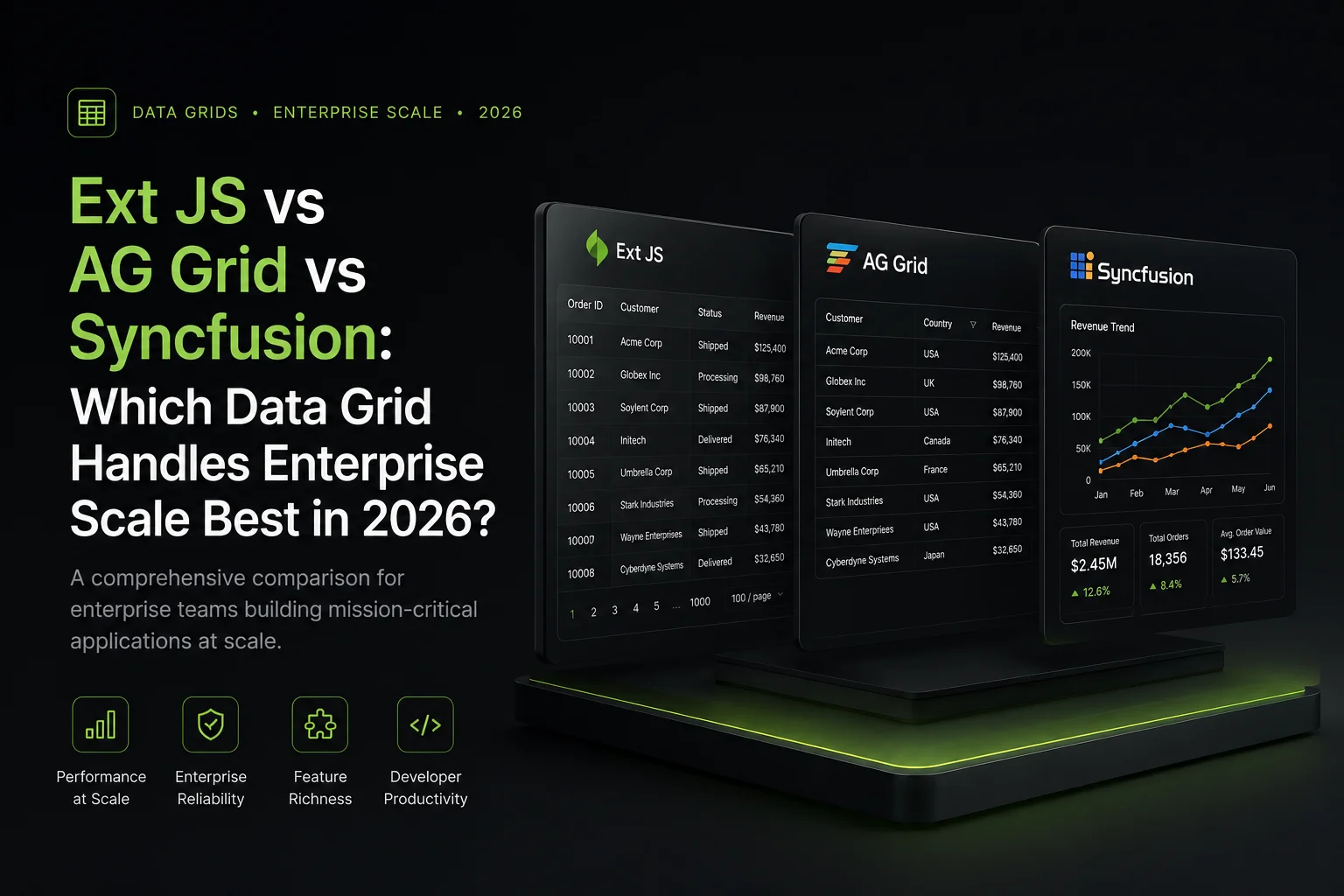
Ext JS vs AG Grid vs Syncfusion
Here’s a point-to-point comparison between Ext JS, AG Grid, and Syncfusion DataGrid that highlights the key differences between the three.
| Feature | Ext JS | AG Grid | Syncfusion DataGrid |
|---|---|---|---|
| Type of Product | Comprehensive JavaScript framework | Enterprise data grid library | UI component suite |
| Fundamental Strength | Full-scale business applications | Advanced data handling | Broad cross-platform components |
| UI Components | 140+ | Primarily grid-focused | Large component ecosystem |
| Best Suited For | ERP, CRM, enterprise systems and dashboards | Analytics-oriented applications | Multi-platform application development |
| Architectural Support | Built-in application architecture | Works with existing frameworks | Can integrate with widely used frameworks |
| Licensing | Commercial | Community + Enterprise options | Commercial |
What is Ext JS?
Developed by Sencha, Ext JS is a JavaScript framework for large-scale web applications. It provides forms, charts, layouts, grids, data management tools, dashboards, and application architecture patterns.
The latest Ext JS version launched in April 2026 focuses on enterprise applications where maintainability, consistency, and long-term support matter.
Essentially, Ext JS allows you to build complete applications without combining different third-party UI libraries.
Per its recent releases, Sencha Ext JS has removed legacy, runtime-heavy layout calculations from its Modern Toolkit.
The framework replaces absolute structural table computations with native CSS Flexbox and CSS Grid layouts. By doing so, it achieves low initial boot times.
What is AG Grid?
AG Grid is an enterprise data grid solution for applications that need advanced data visualization and interaction.
The solution supports popular frameworks, including Angular, Vue, and React. However, it requires a professional-grade interface to manipulate complex internal records.
The grid solution can help with various activities, such as grouping, pivoting, aggregation, filtering, column management, and server-side data handling.
It is particularly suited to financial dashboards, analytics platforms, reporting applications, and data-intensive interfaces.
Also Read: Add Elements to Array Start in JavaScript – 2026 Guide
What is Syncfusion DataGrid?
Syncfusion DataGrid is an expansive suite of lightweight, modular user interface components for cross-platform web and mobile environments.
It serves as a comprehensive application development software that covers various elements. So, whether simple document editors and schedulers or rich interactive maps and charts, Syncfusion’s capabilities encompass everything.
Syncfusion’s data grid uses a dedicated DataManager system to fetch, structure, and filter records from local or remote endpoints. Hence, it is a highly useful alternative for general-purpose utility dashboards.
Which Data Grid Handles Large Enterprise Datasets More Efficiently?
All of them can handle enterprise-level datasets. Yet, their approaches vary. Their performance depends on different factors such as rendering strategy, data architecture, server communication, and application complexity.
Let’s see how each handles large datasets.
Ext JS
Ext JS handles large datasets through buffered rendering and virtual data loading. The approach is useful for enterprise systems where multiple users work with large operational datasets, including inventory databases, customer records, logistics data, or financial transactions.
The efficiency of Ext JS across millions of records originates from an Ext.data.proxy.Server abstract layer.
The Ext JS server proxy performs binary-like operations on incoming JSON streams. Data structures pass via a dedicated schema reader into the virtual data store (Ext.data.Store). Thus, they isolate your application’s UI thread from expensive data serialization overhead during swift scrolling actions.
AG Grid
AG Grid focuses on virtualization. Therefore, it renders only visible rows and columns rather than creating hundreds of unnecessary DOM elements.
It boasts a server-side row model that allows applications to work with massive datasets by retrieving data in smaller blocks instead of transferring the complete dataset to the browser.
AG Grid’s performance model is advantageous for businesses that build analytics-based applications.
For example, for high-frequency financial platforms, AG Grid optimizes its memory footprint with its Enterprise Server-Side Row Model (SSRM) block cache machinery.
While executing intense pivoting or hierarchical grouping commands on millions of lines of live backend records, the grid establishes a structural cache block size.
Thus, advanced developers can refresh or purge specific parent row folders without removing adjacent, collapsed node structures from the active memory stack of the client browser.
Syncfusion DataGrid
Syncfusion DataGrid uses multiple features such as paging, virtualization, and optimized rendering. It particularly performs well when businesses require a comprehensive collection of UI components instead of a grid-only solution.
Nevertheless, specialized analytical grids require a higher degree of customization compared to dedicated grid-focused products.
What Suits Enterprise Application Development?
In a nutshell, between Ext JS, AG Grid, and Syncfusion, let’s understand which suits enterprise application development better.
Ext JS
Ext JS is meant for comprehensive enterprise application development instead of individual UI components. Therefore, businesses benefit from:
- Integrated UI components
- Consistent architecture
- Data binding
- Application-level patterns
- Built-in layouts and themes
- Complex form handling
- Dashboard capabilities
As a result, organizations don’t have to rely on multiple libraries.
AG Grid
AG Grid is ideal when a company has an existing application architecture. It suits well in scenarios, including:
- Financial analysis platforms
- Trading dashboards
- Business intelligence tools
- Data exploration applications
The primary strength of AG Grid is in-depth grid functionality.
Syncfusion DataGrid
Companies must choose Syncfusion if their enterprise application development goals require a wide, lightweight variety of UI widgets in a cost-effective model.
On the other hand, Syncfusion must be chosen if an organization’s team builds simpler internal applications where raw dataset scrolling performance under extreme loads doesn’t act as a fundamental bottleneck.
Final Words
Choosing Ext JS, AG Grid, or Syncfusion DataGrid refers to selecting between full-stack cohesion and standalone specialization.
The key isn’t merely Enterprise software development. It is also anchoring your long-lifecycle projects within a mature, comprehensive JavaScript framework.
The objective is to ensure complete system harmony, seamless component communication, and reliable rendering performance.
Additionally, factors such as long-term maintainability matter from the viewpoint of return on investment.
Get started with a free Sencha Ext JS 8.0 trial.
Frequently Asked Questions
Which JavaScript framework manages large enterprise data grids efficiently?
Sencha Ext JS stands out among many others due to its unified data package and native virtual rendering architecture built directly into the core platform. Developers can bind massive datasets to UI layouts without roping in third-party state managers.
Is AG Grid a comprehensive application development software?
No. It is a specialized data grid view component. Therefore, while building a complete development ecosystem, developers are required to combine it with external libraries, state mechanisms, and separate chart suites.
How does Syncfusion fit into enterprise application development workflows?
It does so by accelerating enterprise application development workflows through a diverse library of lightweight UI widgets under a unified API surface.
Is it possible to integrate enterprise grids into an existing React codebase?
Yes, with tools such as Sencha ReExt, you can drop robust Ext JS components into modern React application setups.
Product Comparisons
Technology Comparison
Data Grids
Application Development Software
Enterprise Software Development
Enterprise Applications
Software Engineering
UI Component Libraries
Developer Guides
Web Development
Front-End Development
JavaScript Frameworks
JavaScript


Latest Content
React Component Library for Data-Heavy Apps: Why 1 Vendor Beats 5
Data-heavy React apps rarely start with five UI vendors. They get there one reasonable decision…
October 21, 2026
How to Standardize on One UI Component Library Across Your React Apps
In most large organizations, every React app has its own UI stack. One team uses…
October 21, 2026
UI Component Library vs Component Framework: What Enterprise React Teams Need
Ask a React team what they use for UI, and you’ll usually hear the name…
October 21, 2026