



 Ask Sencha AI
Future Of Web Technologies And Programming
October 20, 2022
2964 Views
Get a summary of this article:
Are you looking to start a career in web development? If so, you must know about certain web technologies and programming languages, JavaScript web frameworks, databases, and CSS. Whether you want to become a back-end or front-end web developer, web technologies can help you work efficiently and be more productive.
In this article, we’ll discuss everything you should know about web technologies and programming languages.
What Is Web Technology?
Web Technology is the set of tools and techniques used for communication between several different devices over the internet. For example, we use a web browser to access web pages. Web browsers are essentially software tools that display text, images, videos, data, and animations on the internet. Web technologies are constantly evolving, and it’s essential for web developers to know about the latest web technologies to meet customer expectations. Staying updated with modern web technologies is key to shaping the future of RAD software development and building efficient, scalable applications.
The future of rapid web app development lies in using modern frameworks like Ext JS to build scalable, high-performance, and cross-platform applications efficiently.
What Are Different Web Technologies?
There are several different types of web technologies that can be divided into the following sections:
World Wide Web (WWW)
The World Wide Web is the system that enables us to access different web resources and documents over the internet. The WWW is based on the following technologies:
- Web browsers
- Hypertext Markup Language (HTML)
- Hypertext Transfer Protocol (HTTP)
Web Browser
A web browser is a software tool or application software that allows us to explore the World Wide Web. In other words, a web browser enables us to access the web resources that are part of the internet. When we access a web page from a website, the web browser first retrieves the files from the server and then displays the requested page on our screen.
Web Servers
A web server processes the client requests and provides users with files and content that make up a web page. A web server responds to the client requests using HTTP (Hypertext Transfer Protocol).
Web Pages
A webpage is essentially a hypertext document or digital document that part of the World Wide Web. You can access a web page with a web browser and an internet connection.
Web Development
Web development means developing and maintaining websites and web applications that work over the internet. It includes web programming, web design, web publishing, and database management.
What Are Front-End And Back-End Development?
Font and back-end development are the two types of web development:
Front-End Development
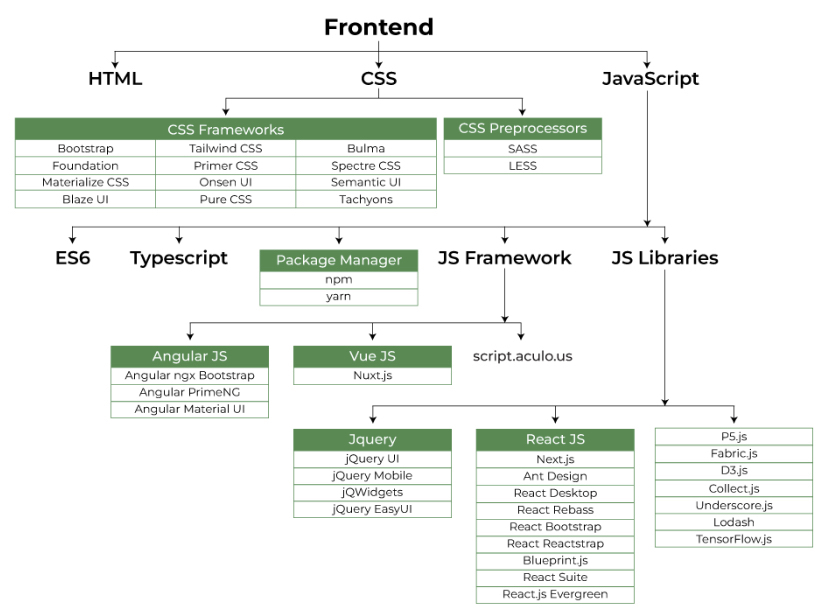
Front-end is the part of the website that users directly interact with. Hence, front-end development means developing the GUI (Graphical User Interface) of the website. It involves HTML (Hypertext Markup Language), CSS (Cascading Style Sheets,) and JavaScript. Front-end is also called the client side of a web app.
Back-End Development
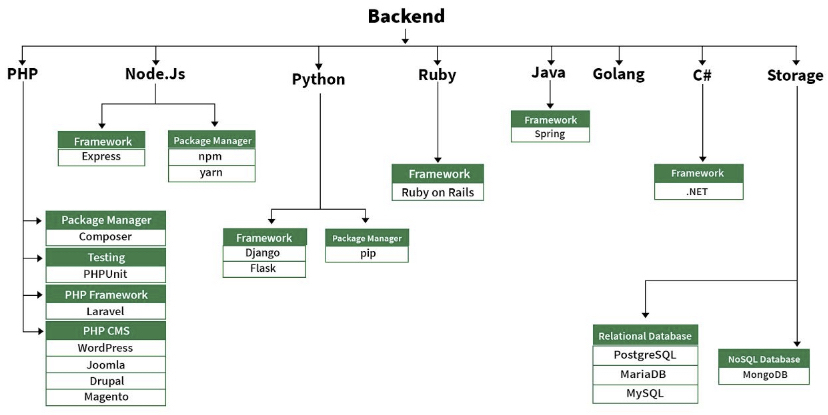
Back-end refers to the server side of a web app or website. Hence, back-end development refers to developing the server side of a website. Website users cannot see or interact with the back end of a web app – its purpose is to store and arrange files and data.
What Are Different Front-End Languages?
Here are some of the most common front-end languages:
HTML
HTML (Hypertext Markup Language) is among the basic web development technologies for designing the client side of the app. Additionally, it is the standard front-end language used to describe the structure of a webpage. Front-end developers can use HTML to create static pages consisting of text, images, headings, links, and tables.
CSS
CSS (Cascading Style Sheets) is a language that allows us to stylize HTML elements. It basically makes it easy to create beautiful web pages.
JavaScript
JavaScript or JS is one of the essential web technologies. It is a popular scripting language used to make a web app or site interactive. For example, JavaScript allows us to add interactive elements like buttons, visualizations, and animations.
AJAX
Ajax stands for Asynchronous Javascript and XML. It allows us to communicate with the server without the need to refresh the web page. As a result, it improves performance and user experience.
What Are Different Back-End Languages?
Here are the most popular back-end languages:
PHP
PHP is a popular server-side scripting language used for web development. It is an open-source language that supports several databases. For instance, you can use PHP to connect to and manage a database management system like MySQL.
Node.js
Node.js is an open-source runtime environment that allows developers to execute JS code outside a web browser.
Python
Python is another very popular open-source, object-oriented programming language used for several purposes. It can work on multiple platforms like Windows, Linux, and Mac. Additionally, one of the most liked features of Python is its human-friendly syntax, which makes it easy to learn and write clean code.
Ruby
Developed in the 1990s, Ruby is a general-purpose, object-oriented programming language. It also has a simple syntax, making it super easy to learn and write.
Java
Java is another widely used object-oriented programming language. Released in 1995 by Sun Microsystems, Java is highly scalable and easy to use.
JavaScript
We can use JavaScript programming language for both front-end and back-end.
What Are Different JavaScript Frameworks And Libraries?
JavaScript frameworks and libraries allow web developers to use pre-written JavaScript code or functions to add new features to their web apps. Using a JS library also speeds up the web development process, as you don’t have to write repetitive code snippets again and again.
JavaScript Technology
- ES6
- TypeScript
JavaScript Frameworks
Some of the most popular JS front-end frameworks include:
AngularJS
- Angular Bootstrap (ngx)
- Material UI
- Angular PrimeNG
Sencha
- Sencha Ext JS
- JS Grid
- React Grid
VueJS
Ember.js
JavaScript Libraries
Here are some of the best JS libraries:
jQuery
- jQuery UI and JQuery EasyUI
- jQWidgets
ReactJS
- Next.js
- React Material UI
- React Suite
- Ant Design
- React Reactstrap
- React Bootstrap
D3.js
Three.js
JavaScript InfoVis toolkit
Fabric.js
Collect.js
TensorFlow.js
What Are Web Protocols?
In short, web protocols are the rules for communicating and exchanging data over the web.
Hypertext Transfer Protocol (HTTP)
HTTP is also a commonly used protocol that enables communication between the server and the client. Thus, it is used for transferring files like text, videos, and images over the web.
Other Protocols
- SOAP
- TCP/IP Model
- SMTP
- UDP
- FTP
Conclusion
In short, everyone looking to start a career as a web developer should know about different web technologies to work efficiently and smartly. There are several different technologies, such as HTML, CSS, JavaScript, JavaScript frameworks, PHP, Ruby, and more.
Build future-ready web apps—start your free Ext JS trial today!
Frequently Asked Questions (FAQs)
What are the key technologies shaping the future of web development?
Technologies like WebAssembly, AI-assisted coding, Progressive Web Apps (PWAs), serverless architecture, and low-code/no-code platforms are redefining how modern web applications are built and deployed.
How will artificial intelligence impact programming?
AI will automate repetitive coding tasks, generate optimized code, improve debugging, enhance testing, and assist developers through intelligent coding companions—making development faster and more efficient.
What programming languages will dominate the future?
Languages like JavaScript, Python, Rust, TypeScript, and Go are expected to remain strong due to performance, ecosystem, and versatility in web, cloud, and AI development.
Are traditional frameworks still relevant in the future?
Yes. Frameworks like Ext JS, React, Angular, and Vue will continue to evolve with new features, performance improvements, and enterprise-grade capabilities to support modern development needs.
How will WebAssembly change web application performance?
WebAssembly enables near-native performance in browsers, allowing complex applications—such as games, editors, and heavy data tools—to run efficiently with languages like C++, Rust, or Python compiled to the web.


Latest Content

Bridge the Gap: Integrating Modern NPM Packages with Ext JS
In the modern web development landscape, the ability to leverage existing solutions is a superpower.…
April 29, 2026

Upgrading Your Ext JS 7.x Application to Ext JS 8.0
This guide covers the technical steps for upgrading Ext JS 7.x applications to 8.0. Upgrading…
April 23, 2026

Ext JS 6.x to Ext JS 8.0: Technical Upgrade Guide
This guide covers the technical steps for upgrading Ext JS 6.x applications to 8.0. Upgrading…
April 23, 2026