



 Ask Sencha AI
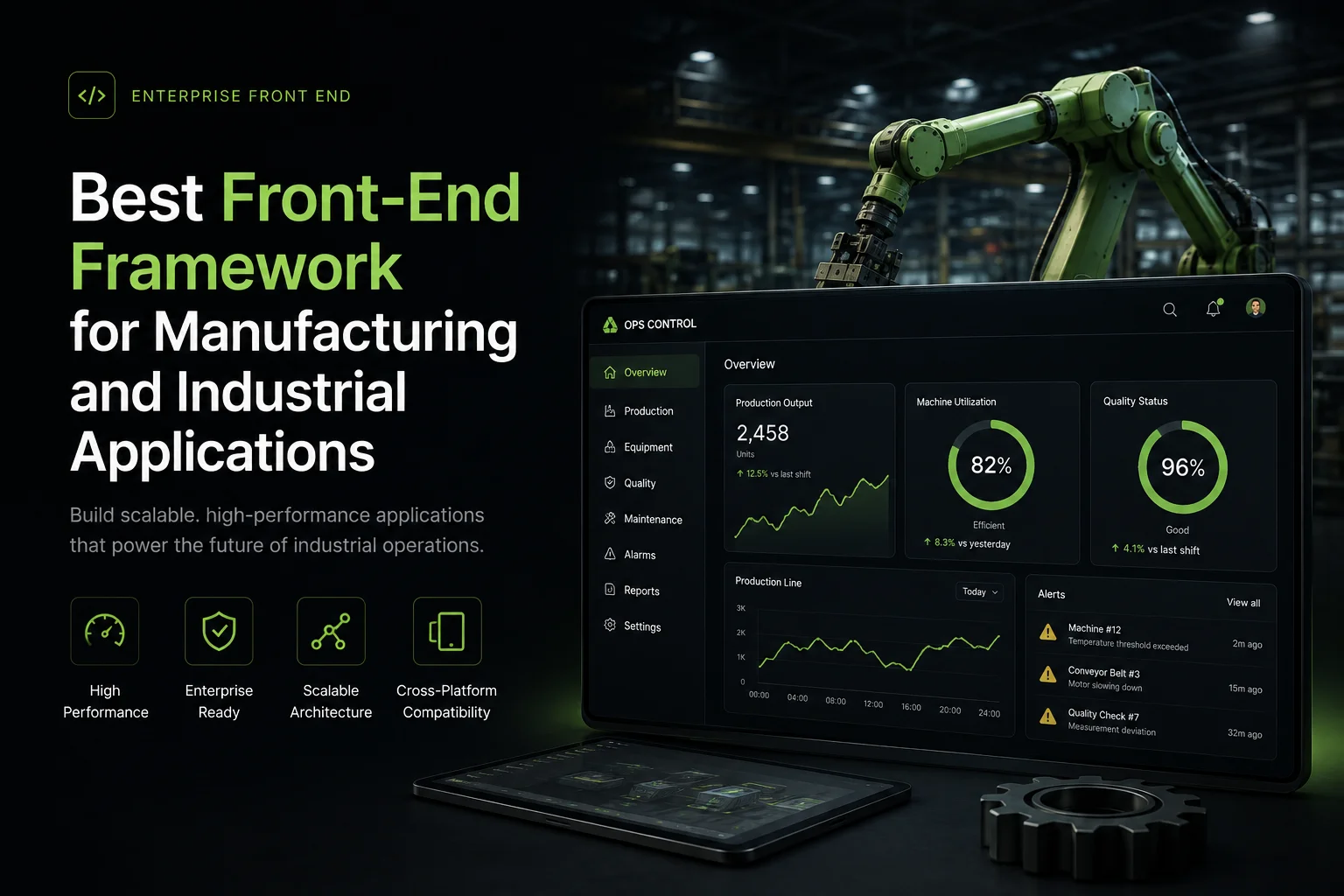
Best Front-End Framework for Manufacturing and Industrial Applications
August 5, 2026
827 Views
Get a summary of this article:
A line machine in an industrial unit begins overheating. A sensor catches it immediately. But the dashboard on the wall takes a few seconds to catch up. By the time the operator notices the warning, the batch is already ruined.
Shopping websites and apps can load a little slowly. But industrial apps cannot. They should be quick, accurate, readable, and continue running for years on hardware that undergoes rare upgrades.
Often, companies associate front-end frameworks with aesthetics or style. But they are more than just visuals. In critical industrial environments, they affect safety, uptime, and how engineers get paged in the middle of the night.
So, which front-end frameworks in 2026 can you consider evaluating for custom software application development for manufacturing environments?
The Uniqueness of Manufacturing Front-Ends
Before comparing Modern front-end frameworks for industrial applications, let’s understand what really makes manufacturing front-ends a different ball game. This will help you review and assess frameworks better.
- Real-Time, High-Frequency Data Streams: Sensor telemetry, PLC tags, and MES events can arrive several times per second per data point. A dashboard that binds every message to the DOM is likely to crash. But well-architected industrial front-ends batch, throttle, and update only the DOM nodes tied to the device reported in.
- Long Asset Lifecycles: Frameworks aren’t a fleeting choice you use for six months, and then you are done. HMI and SCADA screens run for a decade on the same hardware. That favors frameworks with solid backward-compatibility assurances, long-term support commitments, and enterprises that would be patching security holes after a few years.
- Data-Dense Grids and Complex Forms: Industrial UIs heavily rely on tables, trees, and forms, not marketing pages. Work orders, QC checklists, batch records, and maintenance logs signify it. Frameworks with mature, built-in component ecosystems save a team’s effort otherwise spent in re-inventing grid virtualization and validation logic.
- Operator-First UX: In an industrial unit, the application screen wouldn’t necessarily be in the operator’s hands. It is usually read from a few feet away. Sometimes the operators read it through safety glasses. In some cases, the light conditions may also vary. Therefore, high-contrast, large touch targets, and accessibility compliance aren’t just optional. They are compliance points and imperative safety requirements.
- Bandwidth and Hardware Constraints: Every industrial plant does not run on fiber. Therefore, edge gateways, older tablets, and semi-offline cells mean bundle size and runtime performance are crucial factors.
- Regulatory and Validation Overhead: In some industries such as aerospace manufacturing, pharmaceuticals, or food, UI changes can trigger revalidation. Frameworks and libraries with a stable API surface reduce how often a UI tweak forces a re-validation cycle.
Now that the checklist is clear, let’s look at 5 front-end frameworks for manufacturing and industrial applications.
1. React
React is the default choice for many industrial software development platform vendors that build custom dashboards. The reason? Not one. But many.
- Real-Time Graphics Ecosystem: Vendors who build web-deployable HMI and SCADA toolkits ship React bindings with Angular and Next.js versions. They do so to enable plant engineering teams to plug real-time graphics into their existing stack.
- Component Libraries that Arrive React-First: Charting, grid-virtualization, and drag-and-drop HMI-screen editors are almost always released as React components before any other framework.
- Composes with Telemetry-Heavy State: The framework’s component model pairs with WebSocket-driven state managers. This matters specifically when the system updates several tags concurrently.
Particularly, React has the world’s largest library of specialized UI controls that include everything from high-performance canvas chart wrappers to complex data grids. Besides, it has a declarative paradigm that allows developers to assemble custom dashboards for specific shop-floor machines.
Some common applications of React specifically in the industrial context include predictive maintenance dashboards, asset tracking interfaces, and cloud-connected IIoT analytics portals.
2. Angular
Angular is yet another framework choice for manufacturing and industrial applications. Here’s why it works for them.
- Proven Inside Real SCADA Products: Have you heard about the open-source FUXA project? It is a web-based SCADA/HMI and IoT dashboard editor built with an Angular frontend and Node.js backend. It is a modern web-based platform for industrial monitoring, SCADA/HMI applications, and IoT dashboards with a web-based engineering and design environment.
- Appropriate Aging: Angular also ages well across long maintenance windows. It has an opinionated structure that holds over the multi-year lifespans, which is common with HMI and SCADA deployments. Hence, it is often recommended as an enterprise-grade option.
- TypeScript Support: Angular’s exceptional TypeScript support and native integration with RxJS make handling asynchronous streaming data second nature. Furthermore, it has a stringent dependency injection and modular structure that enable teams across different geographies to build consistent, maintainable codebases.
Some use cases of Angular include multi-factory operational intelligence centers, large-scale MES portals, and enterprise plant management software.
3. Vue.js
Vue.js has emerged as yet another popular front-end framework for industrial applications in 2026. Here’s why it works for the manufacturing sector.
- Built for Dynamic Values: Vue has a reactive two-way data binding that simplifies handling dynamically changing data streams while maintaining an approachable learning curve. Therefore, it is a common choice for IoT device dashboards with fast-updating sensor metrics.
- Scoped, Efficient Re-Renders at Scale: Production IoT dashboard architectures have moved to Vue 3’s Composition API paired with Pinia. It is to keep updates scoped to the device tile that just reported in, updating only the UI components of a specific device when its telemetry arrives. Here, re-rendering the entire dashboard isn’t required.
- Middle Ground: For mid-sized manufacturing that uses multiple dashboards, Vue.js helps balance structure and flexibility better than React or Angular alone.
- Natural Pairing with Lightweight Charting Libraries: The framework also pairs organically with lightweight charting libraries. Hence, it is quick to stand up a live IoT monitoring view without a significant setup.
The progressive and legacy-friendly framework is suitable for embedded machine HMIs, rapid retrofits of legacy factory web tools, and lightweight local control terminals.
4. Svelte
Svelte signifies a shift from conventional frameworks. It doesn’t run a framework library in the browser. Instead, it is a build-time compiler that transforms components into raw, surgical vanilla JavaScript. Here are some reasons that make it a hit among industrial applications.
- No Virtual DOM Overhead: Compiling to lean, direct DOM updates translates into smaller bundles and snappier screen refreshes. These are valuable on the underpowered edge tablets and gateway devices common on plant floors.
- Built to Perform for Sensitive Dashboards: Svelte is also suited for apps that depend on load time and interactivity for responsiveness.
- Smaller Footprint: The framework is much easier to learn than Angular. Specifically, it helps reduce the ramp-up time for new engineers.
Svelte is widely used for resource-constrained edge devices, embedded touchscreen panels, and low-latency line-side operator stations.
Also Read: 10 Advanced JavaScript Tricks for Experienced Developers
5. Ext JS
Developed by Sencha, Ext JS also has considerable industrial application usage. Here’s why it is another favorite.
- Enterprise Components Ready Out of the Box: Advanced data grids, pivot tables, trees, and complex forms ship pre-built. This is precisely what surface area manufacturing execution systems, quality dashboards, and maintenance-management UIs need. The framework provides a complete application architecture with built-in components, routing, and the structure enterprise software development demands.
- Purpose-Built for Data-Dense Operational Screens: Ext JS provides the grid virtualization and validation logic that work orders, batch records, and maintenance logs depend on.
- Faster Path to Compliance-Heavy UIs: Ext JS enables teams to ship a compliant, data-heavy operational UI sooner.
Some key uses of Ext JS include production scheduling and Gantt displays, BOM tree inspectors, and batch execution logs. Additionally, warehouses use it for live inventory tracking and inline bulk editing.
Final Words – When to Choose What?
It is difficult, rather impossible, to pick a single podium winner. That’s because the right choice depends on your specific constraints. For instance, Angular is suited for enterprise-scale applications. React is popular for its flexibility and component-driven development. Vue is the right choice for progressive or mid-sized projects. Therefore, you must make an informed choice after a comprehensive review of your requirements, objectives, and specific operational needs. Here are some examples to summarize everything discussed above.
- Angular or Ext JS for a full SCADA/HMI platform
- React or Vue for a custom dashboard riding on an existing device-management platform
- Svelte for edge devices, embedded panels, and low-bandwidth cells
- Vue 3 for telemetry-dense, high-tag-count visualizations
Remember, developer preference alone shouldn’t be your assessment parameter. Factors such as legibility, responsiveness, and reliability at any time when the line suffers a setback are equally important.
FAQs
Which framework is better for a new industrial dashboard, Angular or React?
Both are proven choices. Angular suits large, longer-lived, and more structured applications. On the other hand, React is the right option for teams that demand flexibility and are more comfortable assembling their own state-management and routing stack.
When hundreds of sensors update per second, how do I ensure the UI stays responsive?
You can batch incoming messages, throttle re-renders, and update only the specific components tied to the changed device instead of the whole page.
What about frameworks for engineers who primarily work in Python?
Such teams sometimes choose Dash, which lets data scientists build interactive Plotly.js-powered dashboards with Python callbacks. This helps minimize the JavaScript knowledge needed while integrating with backend analytics workflows built on NumPy, Pandas, and ML models.
Technology Guides
Industrial Software Development
Manufacturing Software
Enterprise Software Development
Enterprise Applications
Software Engineering
Digital Transformation
Web Development
Front-End Development
JavaScript Frameworks
JavaScript


Latest Content
React Component Library for Data-Heavy Apps: Why 1 Vendor Beats 5
Data-heavy React apps rarely start with five UI vendors. They get there one reasonable decision…
October 21, 2026
How to Standardize on One UI Component Library Across Your React Apps
In most large organizations, every React app has its own UI stack. One team uses…
October 21, 2026
UI Component Library vs Component Framework: What Enterprise React Teams Need
Ask a React team what they use for UI, and you’ll usually hear the name…
October 21, 2026