



 Ask Sencha AI
What AI-Assisted Development Means for UI Framework Choice
August 5, 2026
715 Views
Get a summary of this article:
Those days when developers hand-crafted each line of JSX, template syntax, or CSS modules have almost faded away. Today, AI coding assistants have taken over these jobs. For example, they generate up to 60% of front-end boilerplate and create intricate data tables in seconds.
When it comes to dealing with the complexities of enterprise application development, these transformations feel good. But they also make product leads wonder if AI can write code; does their UI framework choice matter?
The answer is YES. But there has been a fundamental change in the selection criteria. So, instead of selecting a UI framework based on how simple it is for humans to comprehend, it is how effectively an AI agent can understand, generate, refactor, and maintain code within that ecosystem. So, let’s break down what AI-driven development means for your UI framework choice.
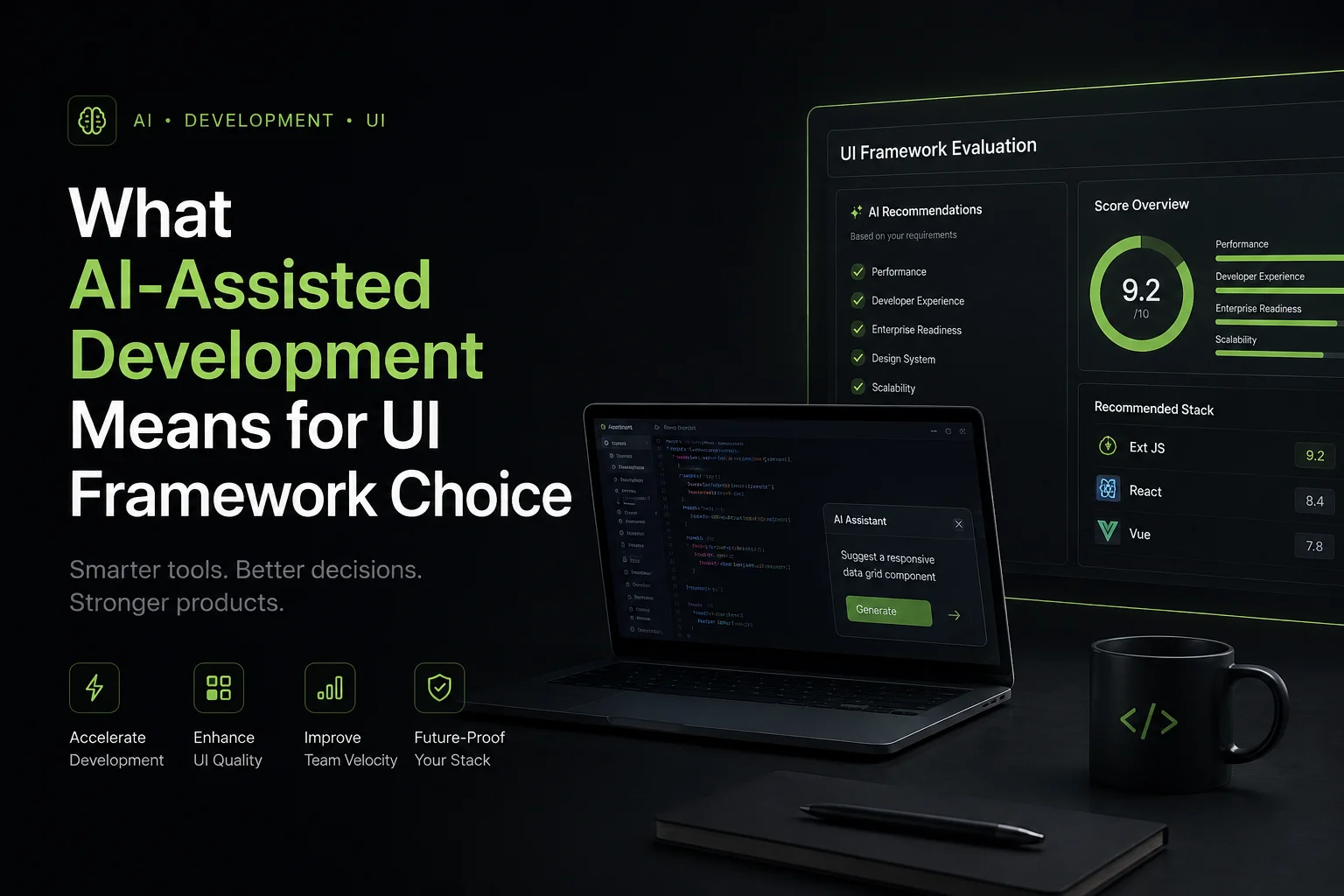
Choosing a UI Framework? What’s More Crucial Today.
These include convention density, type system integration, and documentation structure (not just volume). Let’s look at them in detail.
Convention Density
Frameworks with a narrow, yet right way of doing things produce more consistent AI output. Their streamlined approach provides little room for the model to invent its own approach. An example of this is Vue’s single-file component format. On the contrary, React’s flexibility was once its USP. But with AI, that flexibility can work against the technology’s consistency. Since a local state can be managed in different ways, the AI assistant might approach a different one every time, even within the same codebase.
Type System Integration
AI tools cannot be trusted blindly. You need something solid to validate their output accuracy and quality. This is where frameworks and stacks with strong TypeScript support step in. They give AI tools an immediate feedback loop. So, when an AI model generates a component with a prop type mismatch, the type checker highlights or flags it before you do. Such a quick validation becomes more crucial with AI-generated code than hand-written code.
Documentation Structure
More than the volume of documentation, it is the structure that matters. That’s because the documentation structure determines how cleanly it will map to real usage patterns. Many framework maintainers have begun noticing it. Accordingly, some are restructuring their documents to align with AI retrieval, front-loading canonical examples rather than burying them in prose.
AI-Assisted Development and UI Framework Choice – Factors that Matter
From UI framework maturity to security vulnerabilities arising from hallucination, here’s what matters when it comes to AI-assisted development and UI framework choice.
Mature UI Frameworks are More AI-Friendly
In other words, AI performs better with mature frameworks.
Large Language Models (LLMs) learn patterns from publicly available code and documentation. Therefore, AI is better positioned to generate high-quality code for React, Angular, Vue, Next.js, and Nuxt.
These frameworks are rich in GitHub repositories, have abundant Stack Overflow discussions, extensive documentation, a mature UI component library ecosystem, and community best practices. So, AI generating an instant React or Angular code isn’t magic. It is intelligence and capabilities that have stemmed from learning through years of proven implementation experience.
For example, AI models would have already processed billions of lines of React and Tailwind code. Such learning makes Claude Code, Cursor, and GitHub Copilot capable of achieving high hit rates while generating React components. On the other hand, hallucination rates are also low. Edge cases are often handled out of the box.
Of course, that doesn’t render newer or niche frameworks less useful. They offer several innovative features aligned with modern enterprise application development services. However, they wouldn’t have as many examples for AI to learn from. That can impact the reliability of AI’s suggestions.
It is also because custom or new frameworks have several limitations. For instance, they have lower context accuracy. So, even if a particular framework has a high runtime speed or cleaner syntax, AI will hallucinate deprecated methods, import incorrect packages, or invest non-existent props.
Component-Based Development that Aligns with AI
Earlier, a UI component library was mostly a design-consistency tool. Essentially, it was a way to ensure every button looked uniform. Now, it also doubles as a kind of local specification AI tools can draw from.
Therefore, when an assistant receives a request to add a setting panel by using a particular design system, it must have something to reference.
A UI component library with consistent naming, clear TypeScript interfaces, and Storybook-style usage examples provides AI a real vocabulary to refer to and compose from. If the library grows naturally with inconsistent APIs, AI might still produce something that technically renders correctly. However, it won’t necessarily consider your accessibility patterns. It may also break your spacing scale or duplicate an existing component.
Non-Negotiable Enterprise Scalability
AI can generate an engaging interface in just minutes.
However, the real challenge is different and comes in a little later. It is scaling the interface across hundreds of developers.
So, companies that offer enterprise application development services prioritize frameworks that support modular architecture, reusable components, strong typing, automated testing, maintainable project structures, predictable state management, and automated testing.
For instance, React usually partners with Toolkit, TypeScript, React Query, and various modern routing solutions. On the other hand, Angular is known for its enterprise capabilities out of the box. These include routing, forms, dependency injection, and its opinionated architecture.
Such standardized structures empower AI to work more efficiently.
Also Read: Framework vs Library – Key Differences Explained 2026
The Complicated Picture of Mobile Application Development
You may wonder what’s so complicated in mobile application development. The problem is the split between native and cross-platform approaches. AI assistance doesn’t touch them evenly.
Cross-platform frameworks benefit more from AI tools as a single generated component covers two platforms instead of one. Take Flutter’s widget tree for example. It is fully declarative and largely self-contained. Thus, a container wrapping a column, wrapping some text widgets, doesn’t have to model to reason about anything outside that tree. On the other hand, React Native derives a similar advantage from the wider JavaScript ecosystem. The sheer volume of React training data is yet another benefit.
Now, is native development losing out? No.
SwiftUI and Jetpack Compose are declarative and young. They have replaced older imperative UI paradigms, reasoning about which was genuinely challenging for AI tools. So, a model that generates SwiftUI code works with a view hierarchy that reads almost like a spec. This is against a model that generates classic UIKit code that must track delegate methods, manual layout constraints, and scattered view lifecycle state.
So now, apart from performance and familiarity, teams that pick a mobile stack have a new parameter or variable in the decision-making process. It is how cleanly a framework’s architecture maps to something an AI assistant can scaffold and maintain without constant correction.
The Value of Type Safety
AI is learning. Hence, it cannot always be perfect. The technology can make mistakes occasionally. TypeScript helps detect them automatically. So, frameworks that encourage TypeScript enable earlier error detection, better autocompletion, safer refactoring, and more reliable AI-generated code. Hence, enterprise teams are combining React and TypeScript, Angular and Vue + TypeScript. Solid typing simplifies validating AI-generated code.
The Significance of Documentation Quality
AI depends excessively on publicly available knowledge. So, when you have a framework with excellent documentation, AI can provide better explanations, more accurate code, correct implementation patterns, and reliable troubleshooting guidance. Poor documentation results in AI hallucinations or obsolete implementation recommendations. Hence, when you evaluate UI frameworks, you must also assess their documentation quality.
Hallucinated Security Vulnerabilities
AI assistants are useful. But they can inadvertently introduce security risks such as outdated NPM packages, bypassing sanitization routines, or exposing sensitive client-side variables. Accordingly, enterprise application development services must choose a UI framework with built-in security abstractions. It includes inherent Cross-Site Scripting (XSS) protection. Angular’s DOM sanitization and server-side rendering boundaries separate sensitive API keys from client-side bundles.
Final Thoughts
Let’s look at some takeaways before winding up this discussion. If you are currently evaluating frameworks, here’s what you must prioritize.
Frameworks and internal conventions with less room for variation. Fewer ways to do something means a more consistent output from humans and AI.
Your component library’s documentation and type definition must be treated as seriously as the components.
For mobile application development, assess how well a framework’s architecture maps to bounded, declarative structures. Comprehensive frameworks like Sencha Ext JS can further simplify enterprise development by providing production-ready UI components, built-in accessibility, and long-term enterprise support.
AI is faster. So, keep code review and testing standards tight.
Ecosystem maturity impacts the reliability of AI-generated output. Therefore, ensure it remains a genuine technical factor.
Now, what relevance does manual assessment intelligence have in today’s AI-driven development age? Remember, AI can simplify things for you. But it is you who will have to make choices and decisions, as you know what suits your organization better. Besides, it is the purview of human intelligence to recognize that today’s framework choices craft a three-way relationship between the team, the codebase, and AI tools working within. The relationship is worth the same scrupulousness that you’d apply while assessing performance benchmarks or reviewing architectures.
Get started with a free Sencha Ext JS 8.0 trial.
FAQs
Does AI-assisted development render UI framework choice useless or less important?
No. AI tools can generate code. But AI’s output is just as good as the data it relies upon. Therefore, the reliability of that outcome depends on the amount and quality of training data available with the framework and the consistency of its conventions. In this view, framework choice becomes a more significant factor in the long run.
How does AI-assisted development and UI framework choice affect mobile application development, in particular?
Declarative, component-based mobile frameworks such as SwiftUI, Jetpack Compose, or Flutter generate cleaner AI output than their older imperative approaches. Thanks to their bounded, tree-like structure that simplifies reasoning for a model without requiring a broader file or state context.
Which UI frameworks are more AI-friendly?
Frameworks with massive public codebases and strong conventions such as Angular, React, Flutter, and SwiftUI are considered more AI-friendly. These have abundant data and examples for AI models to produce cleaner AI-based output.
Sencha Ext JS
Artificial Intelligence
Enterprise Software Development
AI in Software Development
Software Engineering
Developer Guides
Developer Productivity
Application Architecture
Web Development
Front-End Development
JavaScript Frameworks
Technology Trends
JavaScript


Latest Content
React Component Library for Data-Heavy Apps: Why 1 Vendor Beats 5
Data-heavy React apps rarely start with five UI vendors. They get there one reasonable decision…
October 21, 2026
How to Standardize on One UI Component Library Across Your React Apps
In most large organizations, every React app has its own UI stack. One team uses…
October 21, 2026
UI Component Library vs Component Framework: What Enterprise React Teams Need
Ask a React team what they use for UI, and you’ll usually hear the name…
October 21, 2026