



 Ask Sencha AI
Best React Frameworks in 2026 for Data-Heavy Business Applications
Nov 4, 2026
117 Views
Get a summary of this article:
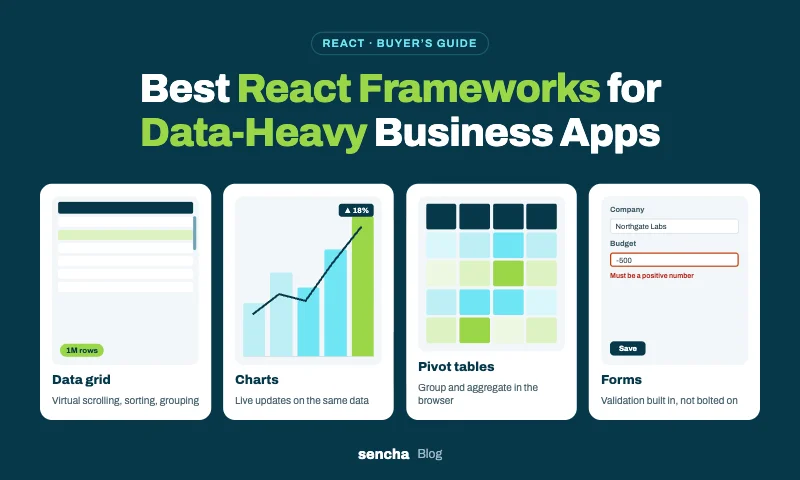
Most “best React frameworks” lists are written with marketing sites, blogs and consumer SaaS in mind: SEO, page speed, server rendering and edge deployment. Data-heavy business applications are different. They live behind a login, users keep them open all day, and the hard parts are grids, forms, filters and complex state, not search rankings.
This guide compares the main React frameworks of 2026 from that point of view: Next.js, React Router v7, TanStack Start, a plain Vite single-page app, and Astro for the content around your app. It also covers the layer no framework provides, the UI components your data screens are built from, and how ReExt fills it.
What data-heavy business apps need from a framework
Before comparing frameworks, be clear about what matters for this kind of app, and what doesn’t.
| Matters a lot | Matters less |
|---|---|
| Fast, reliable client-side navigation between many screens | SEO and search rankings |
| Data loading, caching and mutations | Static site generation |
| Authentication and route protection | Edge rendering for global visitors |
| Rich client-side interactivity and state | Minimal JavaScript on first load |
| Fast development builds for large codebases | Content and marketing features |
| Deployment that fits corporate infrastructure | Vendor-specific hosting features |
| Long-term stability and upgrade paths | The newest rendering model |
One more point shapes everything that follows: a React framework handles routing, rendering and data loading, but not the components on the screen. Grids, charts, forms and layouts still come from a separate component layer, and in data-heavy apps that layer is usually where most of the work and most of the risk live.
The best React frameworks for business apps in 2026
Next.js
What it is. The most widely used full-stack React framework, maintained by Vercel. Its App Router is built around React Server Components, server actions and streaming. Version 16 is current.
Strengths for data apps. The largest ecosystem, mature conventions, and one codebase for public pages and the authenticated app. It can deploy to any Node.js host or container, not only Vercel.
Watch-outs. Its server-first model adds concepts, such as server and client components and caching rules, that a client-heavy internal app may not need. Interactive components, including grids and charts, run as client components.
Best for. Products that combine public, SEO-sensitive pages with a large authenticated application, and teams that want the most widely supported option.
React Router v7
What it is. The successor to Remix, merged into React Router. It works as a plain routing library or in framework mode, with loaders, actions and optional server rendering. It can also run as a single-page app with server rendering switched off.
Strengths for data apps. A pragmatic, well-understood data model (loaders for reading, actions for writing), a smooth path for the many apps already using React Router, and the flexibility to start as a SPA and add server rendering later.
Watch-outs. Fewer built-in conventions than Next.js for very large codebases; you decide more of the structure yourself.
Best for. Teams already on React Router, and internal apps that want structured data loading without adopting server components.
TanStack Start
What it is. The newest of the major full-stack React frameworks, built on TanStack Router and Vite, with type-safe routes, loaders and server functions. Community sources report it reaching 1.0 in 2026; check its current release status before adopting.
Strengths for data apps. End-to-end type safety for routes, parameters and search parameters, which is valuable in apps with many filters and URL state. It integrates naturally with TanStack Query for caching, and keeps a clear line between client and server code.
Watch-outs. A younger ecosystem, fewer guides and fewer developers with experience than Next.js or React Router.
Best for. Type-safety-focused teams building client-heavy applications, especially those already using TanStack Query or Router.
Vite with a router (single-page app)
What it is. Not a framework on its own, but the most common setup for internal tools: Vite as the build tool, React, and a router such as React Router or TanStack Router, served as static files behind your existing backend and authentication.
Strengths for data apps. Very fast development builds, simple deployment to any web server or CDN, no server runtime to operate, and nothing in the way of rich client-side interactivity.
Watch-outs. No server rendering or server functions; data comes from your existing APIs. You assemble conventions yourself.
Best for. Internal business applications behind a login, where the backend already exists and SEO doesn’t matter.
Astro, for the content around the app
What it is. A content-first framework that can render React ui components as interactive islands.
Where it fits. Not for the application itself, but for documentation, help centers and marketing pages that sit alongside a data-heavy app.
Also Read: Create a React App with TypeScript in 2026
React frameworks compared for business applications
| Next.js | React Router v7 | TanStack Start | Vite SPA with a router | |
|---|---|---|---|---|
| Rendering model | Server-first, with server components | Client or server, your choice | Server rendering with clear client/server split | Client only |
| Data loading | Server components, server actions | Loaders and actions | Typed loaders and server functions | Your API plus a data library |
| Type safety of routes | Good | Good | Strongest | Depends on the router |
| Dev build speed | Good (Turbopack) | Fast (Vite) | Fast (Vite) | Fastest (Vite) |
| Deployment | Node.js server, containers, Vercel, static export | Node.js server or static SPA | Node.js server via Nitro, many hosts | Any web server or CDN |
| Ecosystem and hiring | Largest | Large | Growing | Large |
| Concepts to learn | Most | Moderate | Moderate | Fewest |
| Fit for internal apps behind a login | Good | Very good | Very good | Excellent |
| Fit for public pages plus app | Excellent | Good | Good | Weak |
What the table shows: for apps that live behind a login, the simplest options often win. A Vite SPA or React Router in SPA mode gives you fast builds, simple deployment and full client-side interactivity, which is what data screens need. Next.js earns its extra concepts when the same product also has public, search-indexed pages. TanStack Start is the choice for teams who want maximum type safety across a large number of routes and filters.
The layer no React framework provides: components
Every framework above answers “how do pages load and talk to the server?” None answers “where do my grids, charts, forms and layouts come from?” For data-heavy apps, that second question usually decides how fast teams ship and how consistent the app feels.
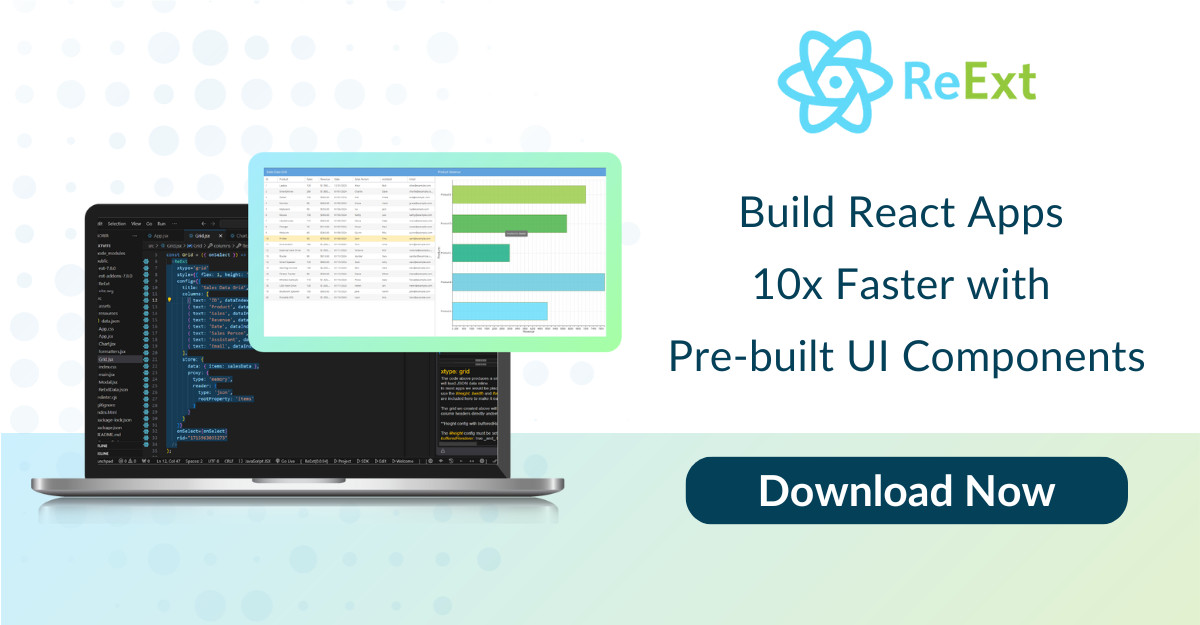
ReExt fills that layer by bringing Ext JS, with more than 140 components including data grids, pivot grids, charts, trees, forms and application layouts, into React. ReExt components are React components, so they sit inside whichever framework you choose. Official quick starts cover Vite and Next.js.
ReExt in a Vite single-page app
Wrap the app in ReExtProvider once, in src/main.jsx:
    import ReactDOM from 'react-dom/client';
    import { ReExtProvider } from '@sencha/reext';
    import App from './App';

    const ReExtData = {
      sdkversion: '7.9.0', toolkit: 'classic', theme: 'classic',
      urlbase: './', location: 'remote', debug: false,
    };

    ReactDOM.createRoot(document.getElementById('root')).render(
      <ReExtProvider splash={true} ReExtData={ReExtData} reextkey={import.meta.env.VITE_REEXT_KEY}>
        <App />
      </ReExtProvider>
    );
Then any route can render a grid, chart or form with <ReExt xtype=”grid” config={{ … }} />. The same setup applies when React Router or TanStack Router handles routing in the SPA.
ReExt in Next.js
In Next.js, ReExt components run as client components. A common pattern is to fetch data in a server component and pass it to a client component that renders the grid:
    // app/providers.tsx
    'use client';
    import type { ReactNode } from 'react';
    import { ReExtProvider } from '@sencha/reext';

    const ReExtData = {
      sdkversion: '7.9.0', toolkit: 'classic', theme: 'classic',
      urlbase: './', location: 'remote', debug: false,
    };

    export default function Providers({ children }: { children: ReactNode }) {
      return (
        <ReExtProvider splash={true} ReExtData={ReExtData} reextkey={process.env.NEXT_PUBLIC_REEXT_KEY}>
          {children}
        </ReExtProvider>
      );
    }
    // app/layout.tsx
    import type { ReactNode } from 'react';
    import Providers from './providers';

    export default function RootLayout({ children }: { children: ReactNode }) {
      return (
        <html lang="en">
          <body><Providers>{children}</Providers></body>
        </html>
      );
    }
    // app/orders/OrdersGrid.tsx
    'use client';
    import ReExt from '@sencha/reext';

    export default function OrdersGrid({ orders }: { orders: Record<string, unknown>[] }) {
      return (
        <ReExt
          xtype="grid"
          style={{ height: 480 }}
          config={{
            store: {
              fields: [{ name: 'orderDate', type: 'date', dateFormat: 'Y-m-d' }],
              data: orders,
              groupField: 'region',
            },
            features: [{ ftype: 'groupingsummary' }],
            columns: [
              { text: 'Customer', dataIndex: 'customer', flex: 1 },
              { text: 'Region', dataIndex: 'region', width: 110 },
              { text: 'Amount', dataIndex: 'amount', width: 130,
                xtype: 'numbercolumn', format: '$0,000', summaryType: 'sum' },
              { text: 'Order date', dataIndex: 'orderDate', width: 130,
                xtype: 'datecolumn', format: 'M j, Y' },
            ],
          }}
        />
      );
    }
    // app/orders/page.tsx: a server component that loads the data
    import OrdersGrid from './OrdersGrid';
    import { getOrders } from '@/lib/orders';

    export default async function OrdersPage() {
      const orders = await getOrders();   // runs on the server
      return <OrdersGrid orders={orders} />;
    }
Data passed from server to client components is serialized, so send dates as ISO strings and let the store’s fields turn them back into dates, as above.
Which React framework should you choose?
Match the framework to the app you’re building, then choose the component layer for its data screens.
| Your app | Framework | Component layer |
|---|---|---|
| Internal back-office app behind a login, existing backend APIs | Vite SPA with React Router or TanStack Router | ReExt for grids, forms, charts and layouts |
| Internal app that wants structured loaders and actions | React Router v7 (SPA or framework mode) | ReExt |
| Customer-facing product with public, SEO-sensitive pages and a large authenticated app | Next.js | ReExt as client components on the app’s data screens |
| Large app with many routes, filters and URL state, type-safety-first team | TanStack Start, or a Vite SPA with TanStack Router | ReExt |
| Existing Ext JS app moving to React | Vite SPA (simplest path, official ReExt quick start) or Next.js | ReExt, reusing existing Ext JS components and stores |
| Documentation or help center next to the app | Astro | Your design system for content pages |
Three rules of thumb
- Don’t pay for features you won’t use. If nothing is public, server rendering and edge deployment add complexity without much benefit. A SPA is a legitimate, often better, choice for internal apps.
- Choose the framework your team can maintain for years. Ecosystem size, hiring and upgrade history matter more for long-lived business apps than benchmark differences.
- Spend most of your evaluation time on the component layer. Routing and data loading are well solved by every option here. Grids, forms and layouts are where data-heavy apps succeed or stall.
Frequently asked questions
What is the best React framework in 2026?
There’s no single best one. Next.js is the most widely used and the strongest choice for products with public pages. React Router v7 and TanStack Start are strong for client-heavy apps, and a Vite single-page app is often the simplest and best fit for internal tools behind a login.
Is React a framework?
React itself is a library for building user interfaces. Frameworks such as Next.js, React Router v7 and TanStack Start add routing, data loading, rendering and build tooling around it.
Which React framework is best for enterprise apps?
For internal business apps, a Vite SPA or React Router v7 is often the most practical choice. For products that also need public, search-indexed pages, Next.js is the most complete. In both cases, the component layer, such as grids, forms and charts, matters as much as the framework.
Do I need server-side rendering for a business application?
Usually not, if the app is behind a login. Server rendering mainly helps SEO and first-page load for public pages. Internal apps often benefit more from simple deployment and fast client-side interactivity.
Does ReExt work with Next.js and Vite?
Yes. ReExt has official quick starts for Vite and for Next.js, in JavaScript and TypeScript. In Next.js, ReExt components run as client components, with ‘use client’ at the top of files that use them.
Pick the framework, then invest in the components
For data-heavy business applications, the best React framework is usually the simplest one that fits: a Vite SPA or React Router for internal apps, Next.js when public pages and the app live together, TanStack Start for type-safety-first teams. Whichever you choose, the framework won’t build your grids, forms or dashboards.
ReExt adds that layer to any of them: Ext JS’s 140+ data-focused components, inside your React app.
Next steps: start a 30-day ReExt trial, read React Data Grid: The Complete 2026 Guide for Enterprise Apps, or see 10 React UI Components Every Enterprise Dashboard Needs.


Latest Content

Performance Tuning Large Grids and Stores in Ext JS
Grids are where enterprise Ext JS applications live, and they are also where performance problems…
November 4, 2026
From JavaScript Library to React: Bringing Ext JS into Modern Front Ends
Many of today’s most important business applications started life in the era of the JavaScript…
November 4, 2026
Best JavaScript Framework for Data-Intensive Applications
“What’s the best JavaScript framework?” has no single answer, because frameworks are built for different…
November 4, 2026